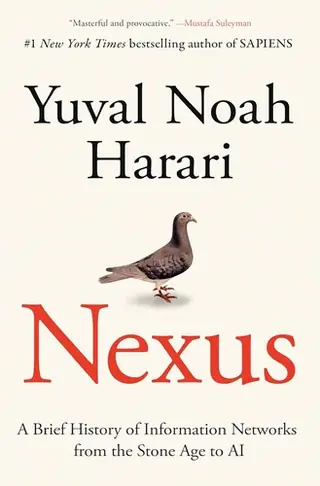
Nexus
A Brief History of Information Networks from the Stone Age to AI
by Yuval Noah Harari · first published 2024
50% recommend50% neutral
From the author of Sapiens comes the groundbreaking story of how information networks have made, and unmade, our world. For the last 100,000 years, we Sapiens have accumulated enormous power. But despite all our discoveries, inventions, and conquests, we now find ourselves in an existential crisis. The world is on the verge of ecological collapse. Misinformation abounds. And we are rushing headlong into the age of AI—a new information network that threatens to annihilate us. For all that we have accomplished, why are we so self-destructive? Nexus looks through the long lens of human hist
Affiliate links. As an Amazon Associate I earn from qualifying purchases.
If you haven’t, I recommend reading Harari, specifically Homo Deus and Nexus. He writes at length about what he calls dataism, a new kind of religion filling the void liberalism and enlightenment left in us. Good reads.
on “Apple Exclaves” ↗Nexus by Yuval Harari is one of the most influential books I’ve read.
on “Ask HN: What did you read in 2025?” ↗Nexus: A Brief History of Information Networks from the Stone Age to AI by Yuval Noah Harari Physics of the Impossible: A Scientific Exploration into the World of Phasers, Force Fields, Teleportation, and…
on “Ask HN: What are young technically minded people reading?” ↗I was listening to Yuval Harari's "Nexus" earlier this year. Great book, terrible narrator (for me). I kept wishing it was Scott Brick(one of my favorite narrators) instead. That frustration turned into ClonEpub - a desktop app that converts…
on “Show HN: I hated an audiobook narrator, so I built a voice cloning ePub reader” ↗> AI doesn't add anything to the ability to do mass surveillance I recommend reading Yuval Noah Harari's Nexus for a deep discussion around this. He makes the point that what makes this AI age much more dangerous for mass surveillance isn't just the collection of data, which has indeed been possible for a while,…
on “Anthropic CEO calls OpenAI's messaging around military deal 'straight up lies'” ↗…is used, I believe, is the opposite from what we think of. We believe that if there is sufficient information, we can use it to form an accurate model of reality. You should read Yuval Noah Harari's Nexus. He calls this "the naive view of information," which is ignorant of the existence of "intersubjective" realities (see also Angela Cooper-White's entry on "intersubjectivism" in The Encyclopedia of Psychology…
on “AI Uses Less Water Than the Public Thinks” ↗I won't answer your questions, but I think you'll find a lot of answers in Sapiens and Nexus, both books from Yuval Noah Harari. They explain a lot about the fantastic questions that you are posing.
on “Measles surge in Utah sparks fears US could undo decades of progress” ↗The book "Nexus" by Yuval Noah Harari essentially makes this same point. The way he phrases it is that information's primary role throughout history hasn't necessarily been to convey objective truth but to connect people…
on “Trying to teach in the age of the AI homework machine” ↗…is not relative. The humanities have long ago dispensed with facts since the advent of postmodernism; the ground has already been ceded. Yuval Noah Harari summarizes this eloquently in his latest work Nexus: In the late twentieth century, for example, intellectuals from the radical left like Michel Foucault and Edward Said claimed that scientific institutions like clinics and universities are…
on “Who isn't a big fan of "impartial" news? People who don't have power” ↗https://en.wikipedia.org/wiki/Agency_(philosophy) This is not my idea. Yuval Noah Harari discusses it in Nexus. Gemini (partially) summarizes it like this: Harari argues that AI is fundamentally different from previous technologies. It's not just a tool that follows instructions, but an "agent" capable of learning,…
on “AI can't even fix a simple bug – but sure, let's fire engineers” ↗…ignore facts, but because belief-change requires restructuring entire systems of interconnected ideas that is emotionally and psychologically demanding. This reminds me of a passage from yuval harari book Nexus : “…… even the most truthful accounts of reality can never represent it in full. There are always some aspects of reality that are neglected or distorted in every representation truth then isn’t a one-to-one…
on “Facts don't change minds, structure does” ↗The four books discussed in that passage are: AI Snake Oil – by Arvind Narayanan and Sayash Kapoor Nexus – by Yuval Noah Harari Genesis – by Henry Kissinger, Craig Mundie, and Eric Schmidt The Singularity Is Nearer – by Ray Kurzweil
on “An untidy history of AI across four books” ↗…printed on the bottom, perhaps how their developers use it, but far from the only mode it actually supports. It is helpful to frame this in the historical arc described by Yuval Harari in his recent book "Nexus" on the evolution of information systems. We're at the dawn of history for how to work with AI, and actively visualizing the future has an immediate ROI. "Chat" is cave man oral tradition. It is like…
on “Chat is a bad UI pattern for development tools” ↗Nexus by Yuval Harari covers bureaucracy in the same vein.
on “Microsoft became incompetent in IT” ↗