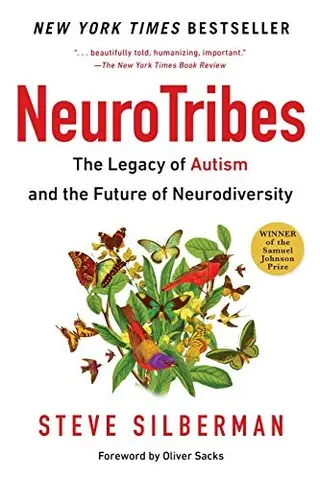
Neurotribes
The Legacy Of Autism And The Future Of Neurodiversity
by Steve Silberman · first published 2015
50% recommend50% neutral
Why HN recommends it
Traces the history of autism and how its diagnosis and core ideas developed over time. Offers background useful to anyone seeking an introduction to autism, and to parents of autistic children.
Summarised by Claude from recommending comments
What is autism? A lifelong disability, or a naturally occurring form of cognitive difference akin to certain forms of genius? In truth, it is all of these things and more—and the future of our society depends on our understanding it. WIRED reporter Steve Silberman unearths the secret history of autism, long suppressed by the same clinicians who became famous for discovering it, and finds surprising answers to the crucial question of why the number of diagnoses has soared in recent years. Going back to the earliest days of autism research and chronicling the brave and lonely journey of auti
Affiliate links. As an Amazon Associate I earn from qualifying purchases.
…anxiety disorder caused by climate change. - "The Inner Game of Tennis" by W. Timothy Gallwey. As a former competitive gamer, this really helped me step back from competition and just enjoy the game. - "Neurotribes" by Steve Silberman. Great book about the history of autism. Extremely sad but hopeful book. - "Different Loving" by Brame, Jacobs, and Brame. A fascinating look back in time to the kink world of the…
on “Ask HN: Any interesting books you have read lately?” ↗I'd strongly recommend you listen to Steve Silberman, Neurotribes author, on Fresh Air: http://www.npr.org/sections/health-shots/2015/09/02/43674237... (Audio controls in the left margin.) He addresses that a fair bit, mentioning that autism is one of the most heritable…
on “Autism and Evolution” ↗Not a direct reply to this, but I found “Neurotribes” by Steve Silberman a great book on parenting for austistic kids.
on “Struggles of Women Who Mask Their Autism” ↗I have autism and only discovered it two years ago at age 33. I have been intensely researching it. The book Neurotribes presents a very in-depth picture of the history of autism and the research and theories for the past century. This is not saying that autism is not real, that it is not a thing to understand, or something…
on “Psychological and psychiatric terms to avoid” ↗For anyone interested in the history of ASD, I highly recommend the book NeuroTribes [1] - I read this shortly after my son was diagnosed with ASD and it goes through a lot of history, up to the most recent DSM V definition. [1] https://en.wikipedia.org/wiki/NeuroTribes
on “Mother's blood test predicts a sub-type of autism” ↗…describing the various symptoms. (As the adage goes, if you've met one person with autism, you've met one person with autism...no two are alike.) I'm actually in the middle of reading Steve Silberman's Neurotribes, which I would highly recommend to anyone who wants to know more about autism. (Contrary to what the article says, Sasha Baron-Cohen (of Borat fame) is the cousin, not brother, of famed autism researcher…
on “Autism and gender imbalance in tech” ↗If you are curious about the history and current state of Autism Spectrum Disorder/Difference, Neurotribes by Steve Silberman was helpful to me. A fun thing I learned is that Oliver Sacks and Temple Grandin were friends.
on “Autism and the Microbiome: The Wrong Way Around?” ↗I want to strongly second this. Asperger was a complicated person with a complicated story in a brutal context, but ultimately a sympathetic and insightful man. His story is told in "Neurotribes" which is a thorough history of autism, and highly recommended.
on “Autistic people challenge preconceived ideas about rationality” ↗People have written plenty of papers, theses, and books on this topic. You could start with the book Neurotribes which explores the history of autism in psychiatry comprehensively.
on “Researchers find link between plastic additive and autism, ADHD” ↗Agreed. Steve Silberman, author of Neurotribes, says, "If you've met one autistic person, then you've met one autistic person." For me that was definitely a caution against one-size-fits-all approaches. I also think a fair bit here about how the…
on “1 in 68 children on autism spectrum, says US CDC” ↗I'm reading NeuroTribes by Steve Silberman, and while I'm not all the way through, the narrative of there being a "real" autism (and specifically as identified by Kranner) is very problematic at several levels. First, Kranner…
on “Brain overgrowth dictates autism severity, new research suggests” ↗I happen to be reading the book Neurotribes which is a decent (although sometimes pathologizing) treatment of autism, and it retrospectively diagnoses Dirac as on the spectrum. Silberman, the author, does reference and seems to rely heavily on…
on “Paul A. M. Dirac, Interview by Friedrich Hund (1982) [video]” ↗…That's pretty normal. It's not like eugenics is a new idea. Everybody knows Asperger cherry-picked the patients he reported and described them that way so the Nazis wouldn't kill them, right? (See Neurotribes) They sterilized 2 of my great aunts for epilepsy. Both later committed suicide. Normal people did that, and it's normal to think that way now. Something nobody ever thinks about: if this guy didn't…
on “How an autistic writer changed the way novelist David Mitchell sees his own son” ↗…within their social circle at a much higher frequency in say the 1800s than they do now. Also, it's always curious when I read studies about the increase in Autism rates. I am in the middle of reading Neurotribes and have read elsewhere that much of that increase can be explained in the broadening of the definition and increase in social awareness. Perhaps that doesn't account for the entirety of the increase,…
on “Childhood Autism and Assortative Mating (2012) [pdf]” ↗…over 100. Her ATEC score dropped from 120+ to around 70. However I fear this valuable research will die if we start normalizing autism or other mental illness as something we just 'deal with' I've read Neurotribes and I can understand the argument but there's rehabilitation and I think the metaphor around a prosthesis is very accurate.
on “Struggles of Women Who Mask Their Autism” ↗