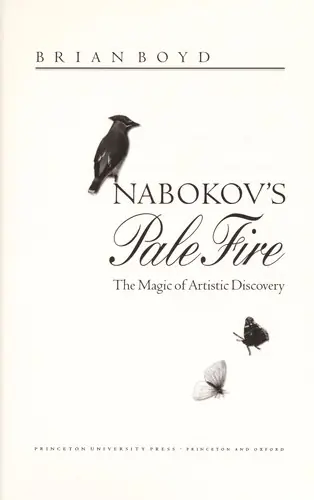
Nabokov's Pale fire
the magic of artistic discovery
by Brian Boyd · first published 2001
31% recommend69% neutral
Affiliate links. As an Amazon Associate I earn from qualifying purchases.
Mentions per year
What Hacker News says
Related books
 2024–2026
The maniac
Benjamín Labatut
Recommended by 7 · mentioned by 117 recommend · 11 mention7 recommend · 117 recommend
Brief History of Intelligence
Max Bennett
Recommended by 10 · mentioned by 1210 recommend · 12 mention10 recommend · 1210 recommend
 2007–2026
House of Leaves
Mark Z. Danielewski
Recommended by 59 · mentioned by 13959 recommend · 139 mention59 recommend · 13959 recommend
Eugene Onegin
Alexander Pushkin
Recommended by 4 · mentioned by 174 recommend · 17 mention4 recommend · 174 recommend
 2008–2026
Pale Fire
Vladimir Nabokov
Recommended by 41 · mentioned by 8041 recommend · 80 mention41 recommend · 8041 recommend
 2013–2025
Jack Reacher
Lee Child
Recommended by 13 · mentioned by 2713 recommend · 27 mention13 recommend · 2713 recommend
 2008–2026
Feersum endjinn
Iain Banks
Recommended by 15 · mentioned by 3315 recommend · 33 mention15 recommend · 3315 recommend
 2011–2026
The Clockwork Rocket
Greg Egan
Recommended by 17 · mentioned by 2217 recommend · 22 mention17 recommend · 2217 recommend
I finally read Nabokov's Pale Fire. It is far and away the best book I have ever read. I think about it multiple times a week unprompted and I'm sad because I am certain that I will never find another book like it.
on “Ask HN: What were the best books you read this year?” ↗Nabokov's Pale Fire. It pops into my mind every now and then, amazing read from start to end.
on “Ask HN: What is the best thing you read in 2024?” ↗The article omits Nabokov’s “Pale Fire” — a seminal work in this vein.
on “Ergodic Literature” ↗…Circular Ruins" is wonderful. If you want dryer, more satirical and postmodern, "Pierre Menard, Author of the Quixote" is hilarious. If you want a book that plays with the basic structure of a "novel", Nabokov's Pale Fire is a great read and a good introduction into what the technique of an unreliable narrator can truly achieve. No matter how out-there you think your interpretation of it is, if you look into published…
on “Short Little Difficult Books” ↗…reminding the reader of it. He lampoons academia while enabling many an academic career in the process. There are professors aplenty specializing in Nabokov and some in Pale Fire itself. For s&g I read "Nabokov's Pale Fire : The Magic of Artistic Discovery" by Brian Boyd, one of the aforementioned. It was interesting at first to see how literary criticsm and analysis work but eventually I had a Shatner moment.
on “Don't be terrified of Pale Fire” ↗'Unlike any other' might be a stretch. Writers have been playing these sorts of meta-narrative games for decades now. Nabokov's Pale Fire comes to mind. House of Leaves is another example.
on “How J.J. Abrams Created a Reading Experience Unlike Any Other” ↗…added marginalia and early book makers illuminations, of course contemporary book makers also include marginalia (like page numbers and the book/chapter title). Even pseudo-links appear in works like Nabokov's Pale Fire. My point is that extension and experimentation with form are part of any creative tradition. It's really hard to create a useful and consistent definition of literature that includes everything that's…
on “Is Literature Dead?” ↗The article talks about Ted Nelson's demo about hypertext. The first version of the demo was using Nabokov's Pale Fire book. This first version of the demo has been lost. The article is not saying that Nabokov's book has been lost, but that the usage of Nabokov's book as a demo for hypertext has been lost.
on “Nabokov's pale fire: the lost 'father of all hypertext demos'? (2011)” ↗The ultimate ode to the index would be Nabokov's "Pale Fire", in which the rereader is encouraged to have three books open, one for the index, one for the place where you are, and another for your lookups.
on “How the index helps us to understand, categorise and engage with the world” ↗Much of that baseline test actually comes from Nabokov's "Pale Fire" - which is also the book Joi picks up when she says "do you want to read to me".
on “Blade Runner 2099 Sequel Series Coming from Ridley Scott” ↗As much as I enjoy the original Blade Runner, it really does not feel like a masterpiece the way 2049 does. Note the usage of quotes from Nabokov's Pale Fire during the baseline test. A few I liked: Do you feel that there's a part of you that's missing? Interlinked. Did you buy a present for the person you love? Within cells interlinked. * spoiler alert…
on “Ted Chiang has won the PEN/Faulkner Foundation's short story prize” ↗Pale Fire book is shown in the movie Blade Runner 2049 https://www.youtube.com/watch?v=OtLvtMqWNz8 Solving Nabokov's Pale Fire - A Deep Dive https://www.youtube.com/watch?v=-8wEEaHUnkA Pale Fire is what we call as Ergodic literature Ergodic literature refers to texts requiring non-trivial effort from the reader to traverse,…
on “I Gave Claude Access to My Pen Plotter” ↗i like Infinite Jest, but among the "derivatives" of Nabokov's Pale Fire (the "original" postmodern novel + parody of academic hogwash with protos in Nabokov's earlier works; possible earlier proto in Poe's aesthetic defense of his poem The Raven), including Pynchon's Gravity's…
on “Consider the Sister” ↗