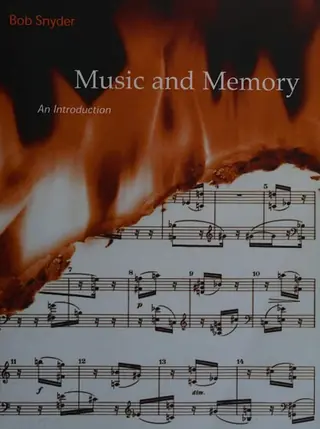
Music and memory
by Bob Snyder · first published 2000
8mentions
2recommended by
3HN commenters
2014–2026first – last mentioned
67% recommend33% neutral
Divided into two parts, this book shows how human memory influences the organization of music. The first part presents ideas about memory and perception from cognitive psychology and the second part of the book shows how these concepts are exemplified in music.
Affiliate links. As an Amazon Associate I earn from qualifying purchases.
…non-theory junk. It's extremely culturally-biased and, again, offers no real theoretical explanation. If you want real understanding of music in a useful way for real people, I recommend Bob Snyder's book "Music and Memory: An Introduction" which was actually written to teach creative artistic people about how music actually works rather than how aristocratic European music notation works. For some other perspectives,…
on “Music Theory for Musicians and Normal People” ↗…were already understood and studied by people in music cognition and related fields and yet most music education never brings up any of it and most music teachers are totally unaware. One good intro: Music and Memory by Bob Snyder. That was written not for technical people but for multimedia artists at the art school where he teaches. They needed to understand music to use it better in their art. So, he wrote a book…
on “Music Theory for Musicians and Normal People” ↗The author and anyone else who understands correctly that traditional music notation is shitty in lots of ways and is trying to understand how music really works should go get the book "Music and Memory: An Introduction" by Bob Snyder. It uses no music notation and explains music in terms of psychological principles of perception of time. It's not a complete theory of everything, but it shows the way…
on “Music theory for nerds” ↗…what is taught in what order. "Music theory" is almost always "European academic music jargon and notation patterns" with near-zero theory at all. If you actually want theory, you want something like "Music and Memory: An Introduction" by Bob Snyder which is written for creative multimedia artists and others with no formal music notation training, and it doesn't even ever show notation and never gets into harmony at…
on “Music Theory for the 21st-Century Classroom” ↗…maybe some of the YouTube stuff from "Hear Between the Lines" is a good start for new accessible stuff. Music cognition such as Sweet Anticipation by David Huron and everything like that… especially note Music and Memory by Bob Snyder which expresses everything except harmony in a style that avoids traditional notation, and Sounds of Music: Perception and Notation (out of print) by Gerald Eskalin who also wrote Lies My…
on “Awesome Music Theory: books, links, videos, research, visuals, composition” ↗As a non-musician non-Western programmer, the only music book that is making sense to me (still reading) is Robert Snyder's Music and Memory[1]. It's the first book that doesn't trick me by trying to pass cultural artefacts (notes, scales, raga, etc.) as some universal truth, or douse me in medieval pseudo-science (Pythagorean small ratios,…
on “Music Theory for Programmers” ↗…There are tons of parallels between music and speech, and I recommend the book Music, Language, and the Brain by Ani Patel for more in-depth about this. The stuff in the book I mentioned originally (Music and Memory) gets into a lot of the issues too. Our processing of all these interacting parts has to do with the various psychoacoustic factors that make things merge together or heard distinctly in our perception.…
on “Music Theory for Musicians and Normal People” ↗> If you want real understanding of music in a useful way for real people, I recommend Bob Snyder's book "Music and Memory: An Introduction" which was actually written to teach creative artistic people about how music actually works rather than how aristocratic European music notation works. Thank you! I've long been suspicious…
on “Music Theory for Musicians and Normal People” ↗