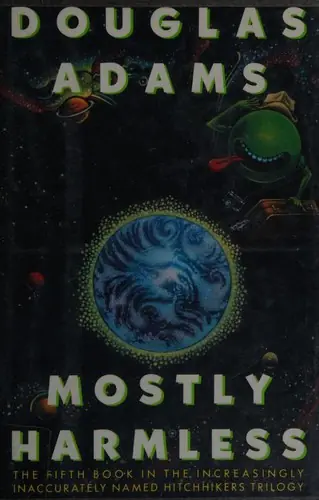
Mostly Harmless
by Douglas Adams · first published 1991
95% neutral5% critical
In the fifth volume of the Hitchhiker series, Random, the daughter of Arthur Dent, leaves her remote home planet on the edge of the universe to set out a cross-galactic odyssey in search of her ancestors' native planet.
Affiliate links. As an Amazon Associate I earn from qualifying purchases.
Mentions per year
What Hacker News says
Related books
 2014–2026
Footfall
Larry Niven, Jerry Pournelle
Recommended by 11 · mentioned by 2411 recommend · 24 mention11 recommend · 2411 recommend
 2008–2026
The Salmon of Doubt
Douglas Adams
Recommended by 10 · mentioned by 4710 recommend · 47 mention10 recommend · 4710 recommend
 2009–2026
Dragon's egg
Robert L. Forward
Recommended by 40 · mentioned by 6040 recommend · 60 mention40 recommend · 6040 recommend
 2007–2026
The Hitchhiker's Guide to the Galaxy
Douglas Adams
Recommended by 123 · mentioned by 481123 recommend · 481 mention123 recommend · 481123 recommend
 2008–2026
Anathem
Neal Stephenson
Recommended by 207 · mentioned by 393207 recommend · 393 mention207 recommend · 393207 recommend
 2007–2026
Foundation
Isaac Asimov
Recommended by 143 · mentioned by 487143 recommend · 487 mention143 recommend · 487143 recommend
Perhaps the end state is going to be from the last Hitchhiker's Guide to the Galaxy book, Mostly Harmless: > Anything that thinks logically can be fooled by something else that thinks at least as logically as it does. The easiest way to fool a completely logical robot is to feed it with the same stimulus…
on “Google's AI is being manipulated. The search giant is quietly fighting back” ↗…could only deduce the existence of the hole from the fact that the robots had clearly fallen out of it, taking its spare brain - which would have enabled it to see the hole - with them. - Douglas Adams, Mostly Harmless To wit: gaping holes in one's understanding can be chronically problematic when what should be in the gaping hole includes that which lets one know that there is, in fact, a gaping hole. One may be capable…
on “Beware the self-taught know it all” ↗This news article reminds me of the beginning of the book "Mostly Harmless" by Douglas Adams.
on “Welders set off Beirut blast while securing explosives” ↗I definitely felt like the series dropped off hard after Life, The Universe, And Everything. So Long And Thanks For All The Fish was kind of meandering, and Mostly Harmless was just plain depressing and a terrible ending for the series. So my personal advice would be to stop after the third book.
on “So Long and Thanks for All the Words: A Toast to Douglas Adams” ↗…regular event to cheer on safe in the knowledge earth will pop back into existence somehow sooner or later (even Douglas Adams attempt at getting his publisher to shut up about another sequel by ending Mostly Harmless with the destruction of Earth in every reality in the entire multiverse and then going ahead and dying on us didn't stop another sequel from being written ("And another thing..." by Eoin Colfer; surprisingly…
on “The Day the Moon Blew Up” ↗This immediately reminded me of a quote from Mostly Harmless by Douglas Adams (4th in the trilogy of 5): "The available worlds looked pretty grim. They had little to offer him because he had little to offer them. He had been extremely chastened to realize that…
on “A new book compiles knowledge necessary for society to recover after disaster” ↗…course quite different from a posthumously released book by the author himself, it is quite relevant given that part of the reason Adams wanted to turn Salmon of Doubt into a Hitchhikers book was that Mostly Harmless was quite bleak (I seem to remember claims he intentionally ended it the way he did to prevent being badgered about another sequel): I quite enjoyed "And Another Thing..." by Eoin Colfer, written as…
on “JRR Tolkien book Beren and Lúthien published after 100 years” ↗Subbed. One of my favourite fictive ship name would be an Adams one: GSV Mostly Harmless. Was great to see the replies, user names. :) Also the number of votes tells there's a large number of people who must really miss Banks (RIP). It's been a while so I will start re-reading the Culture…
on “Some Cautionary Notes on the New ‘Knife Missile’” ↗That reminds me of "Mostly Harmless" from Douglas Adams where Ford Prefect breaks into The Guide's offices and gets himself an infinite expense account from the computer system. That's a dangerous thing to have.
on “You don’t need to be “enterprise-ready” or “scalable”” ↗…movies that had explored the same theme, and Tricia wondered if he had ever considered moving, but heard that he had set his face against the idea. So: more movies, she guessed." - Douglas Adams in "Mostly Harmless"
Reminds me of "Nobody knows how to make a pencil": http://alexbarnett.net/blog/archive/2006/11/18/Nobody-knows-... It's the same thing at every human technology. And this in turn reminds me of Mostly Harmless, by Douglas Adams, where the protagonist finds himself in a simple rustic village. He is unable to reproduce any of the technology from his civilization and settles as a sandwich maker.
on “Dizzying but invisible depth” ↗Once again, the giants of sci-fi have beaten the scientists to the punch. From Douglas Adams' Mostly Harmless: A robot was programmed to believe that it liked herring sandwiches. This was actually the most difficult part of the whole experiment. Once the robot had been programmed to believe that it liked herring…
on “AI: Is pain the key?” ↗…children looked up to them with their sweet shining eyes and said ‘Daddy, what did you do all day today?’ they just said, ‘I performed my duties as an operative,’ and left it at that.” — Douglas Adams, Mostly Harmless
on “Life as a drone operator” ↗…that might go wrong and a thing that cannot possibly go wrong is that when a thing that cannot possibly go wrong goes wrong it usually turns out to be impossible to get at or repair.” — Douglas Adams, Mostly Harmless
on “New Exploit Breaks the iPhone's Messaging App with One Text” ↗Please let me quote from Mostly Harmless by Douglas Adams: The major difference between a thing that might go wrong and a thing that cannot possibly go wrong is that when a thing that cannot possibly go wrong goes wrong it usually turns out…
on “Reports from Nest Secure customers who are unable to arm/disarm or lock/unlock” ↗