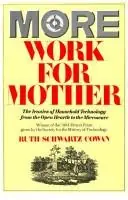
More work for mother
by Ruth Schwartz Cowan · first published 1983
14mentions
4recommended by
5HN commenters
2010–2024first – last mentioned
80% recommend20% neutral
This edition was finished in 1989 The new material was commissioned and edited by Robert M. Young and produced by Martin Klopstock and Selina O'Grady for Free Association Books
Affiliate links. As an Amazon Associate I earn from qualifying purchases.
…first place. Besides that, at least in the U.S. the actual demand of housework did not go down with technology. For a long time, the standards for homemaking just went up instead: http://www.amazon.com/More-Work-For-Mother-Technology/dp/046....
on “The most disruptive technology of the last century was home appliances” ↗See: More Work For Mother: The Ironies Of Household Technology From The Open Hearth To The Microwave By Ruth Schwartz Cowan
on “The rise of digital housekeeping: the hidden work of smart technology” ↗There's an excellent book about the history of domestic technology called "More work for mother." It details how the more domestic tech we created, the more work shifted from the man of the house to the lady of the house and standards were raised Three hundred years ago, full-time wives did about…
on “The big little lie of the TV kitchen island” ↗You might enjoy the book More Work for Mother. (I don't know why this is being downvoted, but the book is about the history of how domestic labor was shifted off men to women to free men up to get paid jobs.) http://micheleincalifornia.blogspot.com/2017/03/the-history-...
on “My Family’s Slave” ↗…they also did not handle it the same way I would. If it weren't for feeling attacked in an ugly and gratuitous way, there would be good common ground to be found there. If you are interested, the book "More work for mother" details 300 years of history of household tech. It partly agrees with you that maybe women should learn to lighten up a hair. But it also asserts the pressure for women to work so hard comes from real…
…of it. So we wind up discounting it entirely and not even recognizing that it existed. It's a huge blind spot. There's an interesting book about the history of technology for doing housework called "More Work for Mother." It details how in the past 300 years or so, we have very much reframed work in order to divide up domestic responsibilities and paid work. With the rise of money, we needed to free up male labor from…
on “Poor mental health at work 'widespread'” ↗…first time this type of model was used to help address shortages etc during a major conflict. For anyone interested in the history of women's work and household technology, I highly recommend the book More work for mother.
on “Mina Miller Edison” ↗…hours per week for about 300 years while we have increasingly created household technology to make the job easier. Meanwhile, the demands on her have crept up to keep her working that many hours. Source: More Work For Mother Historically, when jobs are male dominated, they pay well and have good benefits. If they become female dominated, the pay drops and it becomes a dead end job that is no longer held in high esteem. You…
If you look at the history of the Supermarket, the concept is only about 100 years old - https://en.wikipedia.org/wiki/King_Kullen From Ruth Cowan's More Work for Mother: "Butchers, greengrocers, coffee merchants, and bakers employed delivery boys to take order from and then carry purchases back to the homes of their more prosperous customers. Smoked, dried, and pickled…
on “Our self imposed scarcity of nice places” ↗If you read the book "More work for mother," which details 300 years of the history of housework, women have long been saddled with about 60 hours a week of housework. In modern times, if a woman works a full time job of 40 hours a week, that…
on “Marie Curie Got Her Start at a Secret University for Women” ↗The 60 hours of work a week for homemakers comes from a book called "More work for mother." It is a figure that has been stable for 300 years. I don't recall where specifically I got some of the other figures. I was trying to sort my life out, not prepare for debate on an internet forum I…
on “A.I. And Big Data Could Power a New War on Poverty?” ↗The book is called "More work for mother" because a lot of labor saving devices saved male labor by making the work physically less demanding and allowing it to thus be shifted to the wife. Three hundred or so years ago, most couples were literally…
on “The big little lie of the TV kitchen island” ↗Raising children can be tough, but 60 hours of housework per week? That statistic comes from the book "More Work for Mother" which is the history of "labor saving" devices and their impact on housework (short version: labor saving devices have generally led to increased expectations for quality, not actual reduction in hours…
on “I am a Female Sole Founder with no Dev Experience… Yeah, it’s a Tough Road” ↗…relationship, she told him bluntly that she can go out to dinner at a nice restaurant and get laid with any of her clients and if he didn't have more to offer her, why should she see him? According to the book "More work for mother", homemakers today work about 60 hours a week -- the same as homemakers did 300 years ago. The book is the history of technology in the home -- ie of "labor saving devices" like vacuum cleaners. Such…
on “Why do high-end prostitutes make so much money?” ↗