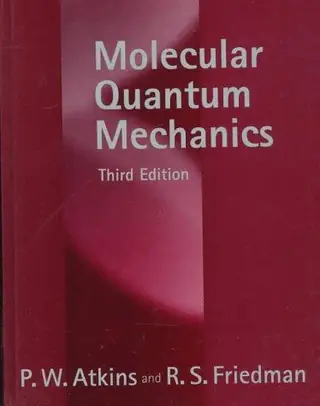
Molecular quantum mechanics
by Peter W. Atkins, R. S. Friedman · first published 1970
100% recommend
Affiliate links. As an Amazon Associate I earn from qualifying purchases.
Mentions per year
What Hacker News says
Related books
 2010–2025
Janeway's immunobiology
Kenneth P. Murphy, Kenneth Murphy
Recommended by 5 · mentioned by 65 recommend · 6 mention5 recommend · 65 recommend
 2011–2026
Concepts of programming languages
Robert W. Sebesta
Recommended by 4 · mentioned by 74 recommend · 7 mention4 recommend · 74 recommend
 2010–2023
Microelectronic circuits
Adel S. Sedra, Kenneth C. Smith
Recommended by 9 · mentioned by 119 recommend · 11 mention9 recommend · 119 recommend
 2008–2025
Ecology of the Planted Aquarium
Diana L. Walstad
Recommended by 10 · mentioned by 1110 recommend · 11 mention10 recommend · 1110 recommend
 2008–2026
The Feynman Lectures on Physics
Richard Phillips Feynman
Recommended by 69 · mentioned by 12669 recommend · 126 mention69 recommend · 12669 recommend
 2009–2026
Unix Network Programming
W. Richard Stevens, Bill Fenner, Andrew M. Rudoff, Richard W. Stevens
Recommended by 54 · mentioned by 6954 recommend · 69 mention54 recommend · 6954 recommend
 2016–2026
Statistical Rethinking
Richard McElreath
Recommended by 81 · mentioned by 9281 recommend · 92 mention81 recommend · 9281 recommend
…chemistry. Softley' Atomic Spectra and Keeler's Why Chemical Reactions Happen are phenomenal primers too but are a bit smaller in scope than the aforementioned two. The same Atkins from above also wrote Molecular Quantum Mechanics which is also a solid text
on “Ask HN: What, in your opinion, are the greatest and most useful textbooks?” ↗Molecular Quantum Mechanics by PW Atkins and RS Friedman Kind of a niche subject but this one really stands out. The prerequisites are a fairly solid understanding of linear algebra and differential and integral calculus. It's…
on “Ask HN: Which books do you consider real gems in your field of work/study?” ↗…addressed in the clear-cut cases often presented in introductory QM textbooks. I can't think of any must-read references right now, but if you're interested in this kind of thing I know of two books on molecular quantum mechanics; one by McWeeney (methods of molecular quantum mechanics) and one by Atkins (molecular quantum mechanics), which I haven't read myself, but I hear it's good. I don't know of any free online sources for…
on “Gravity versus electromagnetism ...” ↗…up with post hoc arguments and simplified narratives, and I think it it just makes life harder for undergraduate students. Maybe 'history of science' should be its own subject? Some textbooks (e.g. Molecular Quantum Mechanics, Atkins & Friedman) take a more nuanced view. They present failures of classical calculations of the heat capacity of solids near absolute zero side by side with blackbody radiation: > "Einstein recognized…
on “The Ultraviolet Myth” ↗…this brings us into the realm of numerical solutions, group theory symmetry arguments, and so on. If you find this subject interesting I suggest getting your hands on a copy of PW Atkins / RS Friedman "Molecular Quantum Mechanics" and perhaps also PCW Davies semi-pop-sci-but-with-way-too-many-equations (1979) "The forces of nature". (doesn't cover molecules though is great on background) https://www.amazon.com/Forces-Nature-P-C-Davies/dp/052131392...…
on “We are not empty: The concept of the atomic void is a mistake” ↗…of an observable, with an eigenfunction being a special kind of operator-function relationship. At the end, there's a nice non-QM application (Fourier transforms). source: PW Atkins & RS Friedman, "Molecular Quantum Mechanics 3rd Ed" > An observable is any dynamical variable that can be measured... in classical mechanics... observables are represented by functions* (such as position as a function of time), in quantum mechanics…
on “What is an eigenvalue?” ↗