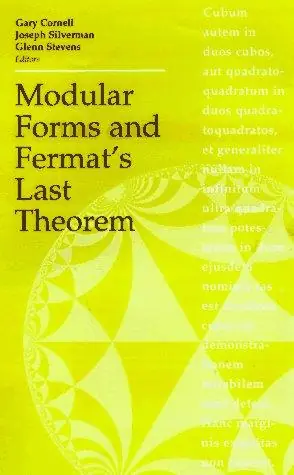
Modular Forms and Fermat's Last Theorem
by Gary Cornell, Joseph H. Silverman, Glenn Stevens · first published 1997
100% recommend
The book begins with an overview of the complete proof, followed by several introductory chapters surveying the basic theory of elliptic curves, modular functions, modular curves, Galois cohomology, and finite group schemes. Representation theory, which lies at the core of Wiles' proof, is dealt with in a chapter on automorphic representations and the Langlands-Tunnell theorem, and this is followed by in-depth discussions of Serre's conjectures, Galois deformations, universal deformation rings, Hecke algebras, complete intersections, and more, as the reader is led step-by-step through Wiles'
Affiliate links. As an Amazon Associate I earn from qualifying purchases.
…very complex) proof borrowed results from large swaths of mathematics not developed until the 20th century. If anyone is interested in trying to learn how the proof works at the formal level, the book Modular Forms and Fermat’s Last Theorem by Cornell, Silverman and Stevens provides a rigorous presentation that builds up the necessary mathematics to understand the entire thing. It’s easily a graduate-level textbook, but it’s probably accessible…
on “Twenty Years of Number Theory (1998) [video]” ↗…Wiles's proof of Fermat's Last Theorem begins with Yves Hellegouach's book, Invitation to the Mathematics of Fermat Wiles http://www.amazon.com/exec/obidos/ASIN/0123392519/donhosek and then Gary Cornell's Modular Forms and Fermat's Last Theorem http://www.amazon.com/exec/obidos/ASIN/0387946098/donhosek which assumes a graduate student's understanding of number theory and then the reader is ready to actually read Wiles. When I was in grad school,…
on “Mathematicians Report New Discovery About the Dodecahedron” ↗