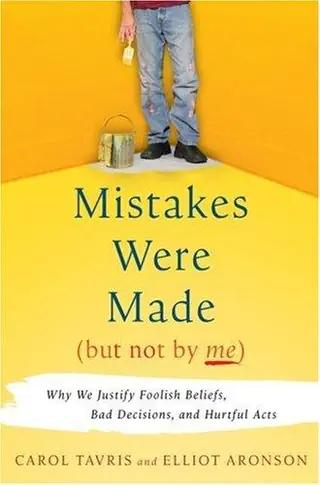
Mistakes Were Made
by Carol Tavris, Elliot Aronson · first published 2007
69% recommend31% neutral
Why HN recommends it
Explains cognitive dissonance and self-justification, with many anecdotes, showing why people and institutions rationalize bad decisions instead of admitting error. Suits readers curious about biases and human behavior.
Summarised by Claude from recommending comments
At some point we all make a bad decision, do something that harms another person, or cling to an outdated belief. When we do, we strive to reduce the cognitive dissonance that results from feeling that we, who are smart, moral, and right, just did something that was dumb, immoral, or wrong. Whether the consequences are trivial or tragic, it is difficult, and for some people impossible, to say, “I made a terrible mistake.” The higher the stakes—emotional, financial, moral—the greater that difficulty. Self-justification, the hardwired mechanism that blinds us to the possibility that we were
Affiliate links. As an Amazon Associate I earn from qualifying purchases.
…and a person's self-image (i.e. "I am difficult to fool") is often 'resolved' in favor of the more important factor, which is the person's self-image. So they deny reality. [1] http://www.amazon.com/Mistakes-Were-Made-But-Not/dp/B003HFFI...
on “Amateur ISIS Investigator Ends Up in Prison” ↗…burning down society for a quick buck would really explain a lot. If you work at Facebook and you feel compelled to tell me why your personal Faustian bargain was actually not such a bad thing, read Mistakes Were Made (But Not by Me). https://www.goodreads.com/book/show/522525.Mistakes_Were_Mad...
on “The Facts on News Reports About Facebook Data” ↗…virtuous and deserving. Humans are justification machines -- if we have something, we have to justify why we have it. If we don't, we have to justify why we don't. If you want insights into this topic, read Mistakes Were Made (But Not by Me), Predictably Irrational and On Being Certain. Even more than that, there are people who got rich by having the right insight at the right time, and acted on it. That often doesn't take hard work. Those…
on “ Working hard is overrated” ↗These are the ones I read this year that I really loved: Genghis Khan https://www.goodreads.com/book/show/93426.Genghis_Khan_and_t... Mistakes were made (but not by me) https://www.goodreads.com/book/show/522525.Mistakes_Were_Mad... Sapiens - a brief history of humankind https://www.goodreads.com/book/show/23692271-sapiens A little history of the world https://www.goodreads.com/book/show/61505.A_Little_History_o...…
on “Ask HN: Books you read in 2016?” ↗…you don't know if it really protects you. So assuming tenure will protect you is, likewise, a dangerous assumption. Addendum: I would also like to point out this excellent book: https://www.amazon.com/Mistakes-Were-Made-But-Not/dp/1491514... That's why Google cannot change its mind even if it wanted to, sadly.
on “What I believe II” ↗…show. Generally, in public downfalls like this, people over ascribe the causes to moral turpitude. There aren’t enough details here to say either way yet. There is a good book about this sort of thing Mistakes were made (but not by me). [1] I think the blog post is very good, providing a unique perspective, and wonderfully written. [1] https://www.amazon.com/Mistakes-Were-Made-But-Not/dp/1491514...
on “Sam Bankman-Fried and the geometry of conscience” ↗If you were interested in this, there's a pretty good book that goes into more detail and provides a lot of anecdotes: http://www.amazon.com/Mistakes-Were-Made-But-Not/dp/01560339...
on “Your Brain Lies to You” ↗I have found psychology books to be rather interesting in understanding social engineering. http://www.amazon.com/Mistakes-Were-Made-But-Not/dp/01510109... http://www.amazon.com/Lucifer-Effect-Understanding-Good-Peop... ..You get the idea.
on “Ask HN: Resources on social engineering” ↗The book Mistakes Were Made (But Not by Me) by Tavris and Aronson delves into this in great detail. Well worth a read.
on “People Can Be Convinced They Committed a Crime That Never Happened” ↗I'm very interested in cognitive biases, some of the writing in that area has some interesting takeaways on the pitfalls of memory: - _Mistakes Were Made (but Not by Me)_ - Tavris & Aronson - _Thinking, Fast and Slow_ - Kahneman Both of these are more "popular science" writing than "solid scientific" writing, however.
on “Ask HN: What are some of the best books you’ve read about memory and the brain?” ↗Mistakes Were Made by Carol Tarvis and Elliot Aronson. It's a long discussion on the mechanics of cognitive dissonance and self-justification. -- "A man travels many miles to consult the wisest guru in the land. When…
on “Ask HN: What's the "best" book you've ever read?” ↗Some randoms I remember : ) - Thinking in Systems - by Donella Meadows - Dead Aid - Dambisa Moyo - Day of Empire - Amy Chua - Mistakes Were Made (not by me) - Caroll Tavris - Brotopia - Emily Chang
on “You can just read 25 books” ↗…just use this money to pay him and when the investment pays off it’ll all work out... and then it grows from there. Cognitive dissonance is an amazing quality of the human brain. I recommend reading Mistakes Were Made But Not By Me - fascinating stories of how and why it happens.
on “The Eponymous Mr. Ponzi” ↗…burned." But beyond that, you're sadly mistaken if you believe that humans actually maximize utility and follow any kind of logical equation in their lives. I suggest you read Stumbling onto Happiness, Mistakes Were Made (But Not By Me), The Presentation of the Self in Everyday Life, and of course Predictably Irrational. All chock-full of good, meaty studies that show what irrational creatures we are.
on “Ask HN: Do you criticize?” ↗Rationality is largely a myth. Have you read anything like Predictably Irrational, or the less famous Stumbling On Happiness, or maybe The New Brain? Or Mistakes Were Made (But Not By Me)? They all make psychology and behavioral economics research very digestible, and all underscore the point: we're not rational. Even if we think we are. Our brains are essentially wired to be tangled…
on “Things I Learned the Hard Way: Ignore the Content” ↗