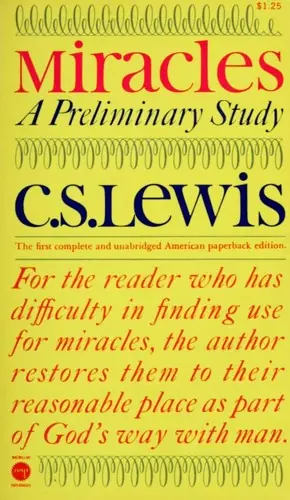
Miracles
a preliminary study
by C. S. Lewis · first published 1947
83% recommend17% neutral
An impeccable inquiry into the proposition that supernatural events can happen in this world. C. S. Lewis uses his remarkable logic to build a solid argument for the existence of divine intervention. "This book is intended as a preliminary to historical inquiry. I am not a trained historian, and I shall not examine the historical evidence for the Christian miracles. My effort is to put my readers in a position to do so." - p. 4.
Affiliate links. As an Amazon Associate I earn from qualifying purchases.
Mentions per year
What Hacker News says
Related books
 2010–2026
Orthodoxy
Gilbert Keith Chesterton
Recommended by 22 · mentioned by 3522 recommend · 35 mention22 recommend · 3522 recommend
Man's Search for Meaning
Viktor Emil Frankl
Recommended by 250 · mentioned by 325250 recommend · 325 mention250 recommend · 325250 recommend
…proportion. There are a lot of problems to grapple with in epistemology and ontology, some of which you've identified. This isn't the place to debate them, though. A great book to start with though, is Miracles, by C.S. Lewis. It blows through a lot of shallow thinking about God and the nature of reality, as well as a number of things you've referenced: which god is the true one? Why is God so mean? Also, I'd…
on “A Nihilist's Guide to Meaning” ↗…cop-out on my part (and it probably is, because I am at work), but the best response I can give to you is that if you really want to try to understand the issues you raise from a Christian perspective, "Miracles" by C.S. Lewis is probably the most succinct way I could answer your questions. He takes on the problems with nihilism and naturalism in a straightforward, but thorough manner. I didn't read it until…
on “Ask HN: Activity and reading to move through mid-life crisis?” ↗I’d start with C.S. Lewis’s Miracles for a take by an educated theist. Tim Keller’s talks at Google about the reason for belief cover similar ground.
on “Ask HN: How can one be educated, smart, and believe in God?” ↗…because I absolutely believe that we have free will. And in any case, to suggest otherwise to me would seem like a cop-out for the consequences of my own decisions. The first 3-4 chapters of the book Miracles by C.S. Lewis cover this topic pretty well in my opinion, even if you're not spiritual-minded.
on “The Libet experiment doesn't disprove free will (2019)” ↗…didn't actually come for me until I stumbled upon a small pastor's YouTube channel [1], and gradually started working my way through several books, including: - Man's Search for Meaning - Viktor Frankl - Miracles - C. S. Lewis - The Abolition of Man - C. S. Lewis [2] - Heretics - G. K. Chesterton - Orthodoxy - G. K. Chesterton - Nihilism - Seraphim Rose - The Experience of God - David Bentley Hart - The…
on “Wondering about the link between intelligence and meaning” ↗I recommend "Can a Scientist Believe in Miracles?" by Ian Hutchinson, physicist and professor at MIT. It covers the rational arguments for Christianity and how to integrate a scientific and Christian view of the world. And C.S. Lewis, of course, but…
on “Ask HN: What's on your learning list?” ↗