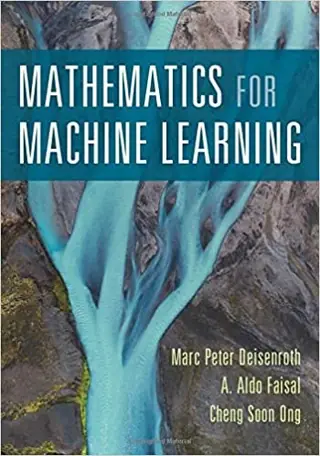
Mathematics for Machine Learning
by Marc Peter Deisenroth, A. Aldo Faisal, Cheng Soon Ong · first published 2019
100% recommend
Why HN recommends it
Concise, applications-focused coverage of the core math behind ML, especially linear algebra, with lots of exercises; free PDF available. Suits learners and engineers who want a solid foundation.
Summarised by Claude from recommending comments
The fundamental mathematical tools needed to understand machine learning include linear algebra, analytic geometry, matrix decompositions, vector calculus, optimization, probability, and statistics. These topics are traditionally taught in disparate courses, making it hard for data science or computer science students, or professionals, to efficiently learn the mathematics. This self-contained textbook bridges the gap between mathematical and machine learning texts, introducing the mathematical concepts with a minimum of prerequisites. It uses these concepts to derive four central machine l
Affiliate links. As an Amazon Associate I earn from qualifying purchases.
Mentions per year
What Hacker News says
Related books
Deep Learning
Christopher M. Bishop, Hugh Bishop
Recommended by 3 · mentioned by 43 recommend · 4 mention3 recommend · 43 recommend
 2007–2026
Pattern Recognition and Machine Learning
Christopher M. Bishop
Recommended by 80 · mentioned by 10480 recommend · 104 mention80 recommend · 10480 recommend
 2016–2026
Deep Learning with Python
Francois Chollet, Matthew Watson
Recommended by 36 · mentioned by 5336 recommend · 53 mention36 recommend · 5336 recommend
 2016–2023
Hands-On Machine Learning with Scikit-Learn and TensorFlow
Aurélien Géron
Recommended by 16 · mentioned by 1816 recommend · 18 mention16 recommend · 1816 recommend
 2014–2026
Introduction to Statistical Learning
Gareth James, Daniela Witten, Trevor Hastie, Robert Tibshirani
Recommended by 85 · mentioned by 10885 recommend · 108 mention85 recommend · 10885 recommend
 2007–2026
Introduction to linear algebra
Gilbert Strang
Recommended by 37 · mentioned by 5837 recommend · 58 mention37 recommend · 5837 recommend
 2014–2026
Foundations of Data Science
Avrim Blum, John Hopcroft, Ravindran Kannan
Recommended by 7 · mentioned by 247 recommend · 24 mention7 recommend · 247 recommend
 2009–2024
Functions of Several Variables
Wendell Fleming, W. H. Fleming
Recommended by 4 · mentioned by 54 recommend · 5 mention4 recommend · 54 recommend
Mathematics for Machine Learning by Marc Peter Deisenroth, A Aldo Faisal, and Cheng Soon Ong. https://mml-book.com/
on “Ask HN: What is good book about math in machine learning?” ↗…classes on the subject. Three books that I would recommend going over to make sure your foundation in ML and mathematics are solid are -Pattern recognition and machine learning by Christopher Bishop -Mathematics for Machine Learning by Peter Deisenroth -Deep Learning by Courville, Bengio and Goodfellow All three are legally available online in some form. I can't say I have any experience in finding a job related to ML though.
on “Ask HN: Has anyone successfully pivoted from web dev to AI/ML development?” ↗…formally. The instant feedback loop helps develop both computational thinking and mathematical rigor. Tools like Jupyter notebooks make this workflow seamless. For anyone interested in similar resources, "Mathematics for Machine Learning" by Deisenroth et al. and 3Blue1Brown's linear algebra series complement this beautifully by bridging theory and computation.
on “Online Book: Exploring Mathematics with Python” ↗Great book. I think it's a good time to mention a couple of nice books (related) 1. Elementary intro to math of machine learning [0]. Its style is a bit less austere than that of OP's. It also has a chapter on probability. It could possible serve as a great prequel to the book linked in the OP. 2. The book on probability related topics of general data science: high-dimensional geometry, random
on “Math Basics for Computer Science and Machine Learning [pdf]” ↗This for the background: https://mml-book.github.io/ This for actual methods: http://www.deeplearningbook.org/ This is also useful, but harder to read than the previous ones: https://web.stanford.edu/~hastie/Papers/ESLII.pdf
on “Ask HN: What Neural Networks/Deep Learning Books Should I Read?” ↗More free books: * Vectors, Matrices, and Least Squares — IMO the best beginner-friendly and applications-focused intro to (or review of) linear algebra. Covers a ton of fundamental ground while keeping things consistent and concise. Lots of exercises and a Julia supplement book. (http://vmls-book.stanford.edu/) * Mathematics for Machine Learning — good coverage of the most important math concep
on “Best Data Science Books According to the Experts” ↗Lack of math knowledge won't limit much as a practitioner, but will definitely make it harder for you to understand what is going on. Luckily, the math involved is not so difficult. For deep learning specifically you should be comfortable with linear algebra and multivariate calculus, and for machine learning in general you should be familiar with probabilistic thinking. "Mathematics for machine
on “NYU DS-GA 1008 – Deep Learning” ↗I’m on Chapter 4 of the Mathematics for Machine Learning. Enjoying it so far: https://mml-book.github.io/ After learning the math, which machine learning books come next?
on “The Mathematics of Artificial Intelligence (2022)” ↗You have most of the mathematics needed to understand ML in one free book, Mathematics for Machine Learning [1]. It covers just about anything you need. It would be better to study algebra, calculus, some trig and then statistics, it will give you a better knowledge, but this is a more condensed and a faster way to put you on track. If you have time, you can go through it in one month. [1] htt
on “Ask HN: How to learn math from zero for adults?” ↗"Mathematics for Machine Learning" by Marc Peter Deisenroth, A Aldo Faisal, and Cheng Soon Ong. https://mml-book.github.io/
on “Ask HN: What Neural Networks/Deep Learning Books Should I Read?” ↗This course from carnegie mellon university has recorded lectures you can watch and extensive notes which will give you a crash course in the applied math needed like a linear algebra crash course, probability http://www.datasciencecourse.org/lectures/ but of course these are just scratching the surface and you can get as advanced as you want like https://mml-book.github.io/
on “Where to learn the math for data science?” ↗there's also Intro to mathematical thinking: https://www.coursera.org/learn/mathematical-thinking/home/we... and mathematics for machine learning: https://mml-book.github.io/
on “Mathematics for Programmers [pdf]” ↗Start here with this https://mml-book.github.io/ Then this https://probml.github.io/pml-book/book1.html
on “Ask HN: How to get good as a self taught ML engineer?” ↗Catch up on some of the maths, eg https://mml-book.github.io/ I suspect that AI business is in such a place at the moment that any warm body with decent technical skills can get in as-is. And there's "AI" going on in lots of non-AI-branded business too.
on “Ask HN: How to Switch Career to ML?” ↗I think it gets to a sufficient depth if you also consider the Supplementary Material and Jupyter Notebooks hosted on GitHub. But for those with no ML background, the place to start is: https://mml-book.github.io/
on “Probabilistic Machine Learning: Advanced Topics” ↗