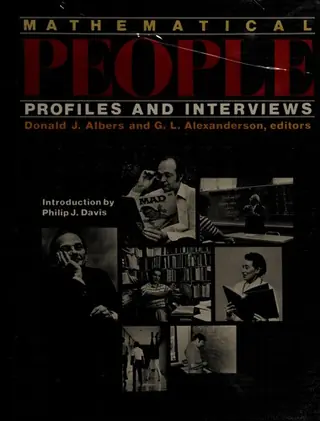
Mathematical people
by Donald J. Albers, Gerald L. Alexanderson · first published 1985
4mentions
1recommended by
4HN commenters
2009–2020first – last mentioned
25% recommend75% neutral
Interviews and profiles of mathematicians, teachers, and friends of mathematics provide an insight into the motives, philosophies, and talents that drive the creative process of mathematics.
Affiliate links. As an Amazon Associate I earn from qualifying purchases.
I recall reading about him as a teen in the great little bio book https://www.amazon.com/Mathematical-People-Interviews-Donald... There's a brief preview you can find in the Look Inside Amazon feature, navigating to the table of contents, which lists Ronald L. Graham on pg 105. Very entertaining read.
on “Ron Graham has died” ↗…and other forms of talent certainly run in families. If you read bios of scientists and mathematicians (as I am doing now, actually, in reading the Albers compendiums of interviews with mathematicians, _Mathematical People_ and _Fascinating Mathematical People_), time and again you find that a great mathematician has mathematician relatives or family which were talented in other ways. Consider the Bachs, the Polgars, the…
on “Super-Intelligent Humans Are Coming” ↗…teaching was a little puzzling. “My policy is to teach the student as much as possible and to require from him or her as little as possible,” he told Donald Albers and Gerald Alexanderson, the authors of “Mathematical People: Profiles and Interviews” in 2008. But, he added, the impact of his apparent lenience was that many of his students worked harder in his course than in any other. Would love to see more studies around…
on “Raymond Smullyan has died” ↗The solution I hit upon which moved me forward was this: research problems are homework problems. There is a famous story about this, which you can read in the book Mathematical People. George Dantzig came late to class one day and saw two problems on the blackboard. He worked them, not knowing that his professor had posted them as examples of unsolved research problems, NOT homework.…
on “What You'll Wish You'd Known (2005)” ↗