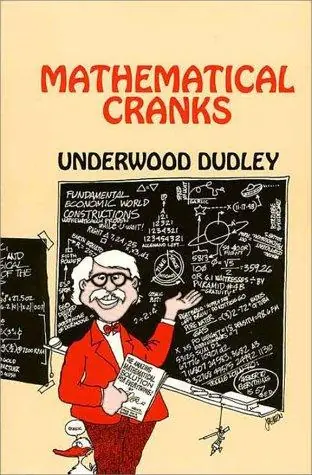
Mathematical cranks
by Underwood Dudley · first published 1992
6mentions
3recommended by
5HN commenters
2016–2026first – last mentioned
60% recommend40% neutral
Affiliate links. As an Amazon Associate I earn from qualifying purchases.
In addition to publishing a book-sized collection of failed angle trisections, Underwood Dudley is also the author of "Mathematical Cranks" (978-0883855072), which gives a broad and fascinating descriptions of all sorts of examples of the species. It remains one of my favorite books for the wide range of examples and a few insights into…
on “What to Do When the Trisector Comes (1983) [pdf]” ↗Underwood Dudley has written more comprehensive books about mathematical cranks (in general) and trisectors (in particular) which are a delight to read.
on “What to Do When the Trisector Comes (1983) [pdf]” ↗There’s a great book on Mathematical Cranks where one of the recurring themes is that the intuition must always be correct, and anything that seems counterintuitive is abhorrent and must be wrong.
on “The Making of a Prophet” ↗…yes! And you can get into trouble trying to engage with logic, because that is not the name of the game. >I've been perversely interested in this Me too, and with other crankery. I recommend the book Mathematical Cranks for similar entertainment. https://books.google.com/books/about/Mathematical_Cranks.htm... Maybe I am interested in it because you begin to see small reflections of similar behavior everywhere once…
on “Are Flat-Earthers Being Serious?” ↗> The source I linked to above cites Mathematical Cranks by Underwood Dudley, but I couldn’t find it in the book. I don't know why someone would make an AI slop fake of old mathematical crankery, but I think that has to be considered as a possibility. Especially…
on “A Crank Formula for π” ↗…wouldn't base e, as in Euler's constant, theoretically be more efficient than ternary numbers (base 3). But in trying to confirm it, found this suitable quote: > One of the eccentrics discussed in the book, Mathematical Cranks by Underwood Dudley, argues that e is the best base, based on a muddled understanding of Steiner's calculus problem, and with a greatly exaggerated sense of how important the choice of radix is.
on “How to pack ternary numbers in 8-bit bytes” ↗