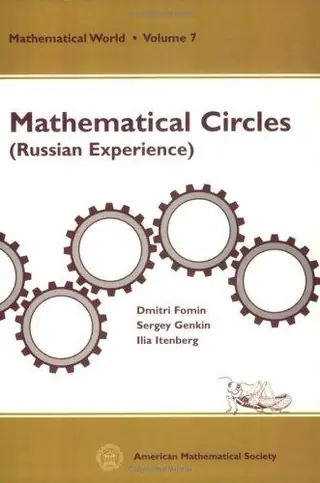
Mathematical circles
by S. A. Genkin · first published 1996
100% recommend
Why HN recommends it
Collection of problem-solving exercises for school-age students, drawn from the Russian math circle tradition. It teaches logic and problem solving to kids and includes fun discrete math puzzles.
Summarised by Claude from recommending comments
What kind of book is this? It is a book produced by a remarkable cultural circumstance in the former Soviet Union which fostered the creation of groups of students, teachers, and mathematicians called "mathematical circles". The work is predicated on the idea that studying mathematics can generate the same enthusiasm as playing a team sport - without necessarily being competitive. This book is intended for both students and teachers who love mathematics and want to study its various branches beyond the limits of school curriculum.
Affiliate links. As an Amazon Associate I earn from qualifying purchases.
Mentions per year
What Hacker News says
Related books
Graphs and their uses
óystein Ore
Recommended by 2 · mentioned by 22 recommend · 2 mention2 recommend · 22 recommend
 2012–2024
Mathematical Analysis
Tom M. Apostol
Recommended by 6 · mentioned by 96 recommend · 9 mention6 recommend · 96 recommend
 2008–2023
God Created the Integers
Stephen Hawking
Recommended by 6 · mentioned by 146 recommend · 14 mention6 recommend · 146 recommend
 2009–2024
Statistics
David Freedman, Robert Pisani, Roger Purves
Recommended by 11 · mentioned by 1511 recommend · 15 mention11 recommend · 1511 recommend
 2011–2026
Prime Obsession
John Derbyshire
Recommended by 22 · mentioned by 2622 recommend · 26 mention22 recommend · 2622 recommend
 2009–2024
Functions of Several Variables
Wendell Fleming, W. H. Fleming
Recommended by 4 · mentioned by 54 recommend · 5 mention4 recommend · 54 recommend
 2008–2026
A Mathematician's Lament
Paul Lockhart
Recommended by 47 · mentioned by 7147 recommend · 71 mention47 recommend · 7147 recommend
 2012–2025
Measurement
Paul Lockhart
Recommended by 23 · mentioned by 3023 recommend · 30 mention23 recommend · 3023 recommend
https://www.amazon.com/Mathematical-Circles-Dmitry-Fomin/dp/... It is a book produced by a remarkable cultural circumstance in the former Soviet Union which fostered the creation of groups of students, teachers, and mathematicians called "Mathematical…
on “Ask HN: Recommend a maths book for a teenager?” ↗This reminded me of a book that is, I think, an excellent way to teach math to kids: Mathematical Circles: Russian Experience, by Dmitri Fomin, Sergey Genkin, Ilia V. Itenberg (http://www.amazon.com/Mathematical-Circles-Russian-Experienc...)
on “Math for seven-year-olds” ↗…problems after that, there are a lot of great puzzles in Kordemsky's The Moscow Puzzles https://archive.org/details/moscowpuzzles3590000kord_m9a0, or you could take a look at Fomin, Genkin, & Itenberg's Mathematical Circles: Russian Experience which your kid could probably just about handle. There are also some great puzzles and games explained at the website of the Julia Robinson Math Festival, https://jrmf.org which can…
on “A seventh-grader student found a beautiful proof to Thales' Theorem (2002)” ↗Start with simple books to warm up those grey cells. For maths, I recommend Mathematical Circles: Full of fun discrete math problems.
on “Ask HN: How do I learn math/physics in my thirties?” ↗If I understand correctly, you're asking for books that will teach you logic, problem solving etc? If yes, check these out: - Mathematical Circles The Russian Experience (the book is in english) - How To Solve It by Polya - brilliant.org
on “Ask HN: Books that teach you logic building skills” ↗Absolutely. Key for me was to invite children's friends (and family) along, host it in our house and make it a recurring weekly thing. The books (presumably you also have these from the MSRI's 'Mathematical Circles Library') are great, but week-to-week I've found the free online NRICH resources much more directly useful: https://nrich.maths.org/about-nrich
on “At 17, Hannah Cairo solved a major math mystery” ↗