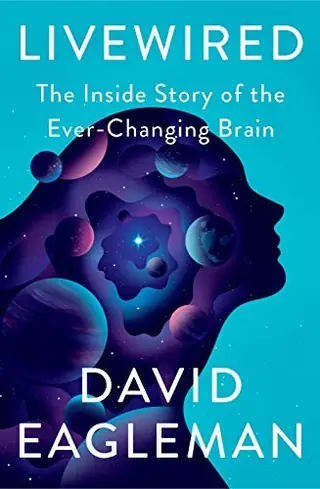
Livewired
by David Eagleman · first published 2020
6mentions
4recommended by
6HN commenters
2022–2025first – last mentioned
67% recommend33% neutral
“Vivid. . . . Livewired reads wonderfully, like what a book would be if it were written by Oliver Sacks and William Gibson, sitting on Carl Sagan’s front lawn.” —The Wall Street Journal What does drug withdrawal have in common with a broken heart? Why is the enemy of memory not time but other memories? How can a blind person learn to see with her tongue, or a deaf person learn to hear with his skin? Might we someday control a robot with our thoughts, just as we do our fingers and toes? Why do we dream at night, and what does that have to do with the rotation of the earth? The answers to the
Affiliate links. As an Amazon Associate I earn from qualifying purchases.
Check out the book Livewired [1] for more interesting stories like this, plus a futuristic take on how the brain could be plugged into various kinds of peripherals. 1: https://www.amazon.com/Livewired-Inside-Story-Ever-Changing-...
on “She was missing a chunk of her brain – it didn’t matter” ↗…by neighboring regions for whatever. To prevent that takeover pseudo signals are created to keep them busy. Can't remember the name of the book, but it was a pretty cool theory. EDIT: found the book - Livewired by David Eagleman
on “The brain makes a lot of waste. Now scientists think they know where it goes” ↗Check out “Livewired” by David Eagleman. It talks about the brain’s adaptability to various inputs and using technology to create new “senses”. I think I remember the directional thing being covered and it working to improve…
on “Cargo airships could be big” ↗…create courses manually. We've used AI to create all the courses (3-4 hours) dynamically. Courses are in AV Slideshow format with code, illustrations etc. P.S: The idea was inspired from a book named LiveWired.
on “Show HN: A tool that enables learning by comparison” ↗In case it’s interesting, the book Livewired talks about this. The author also has a company called Neosensory which converts sound into physical vibrations on a wristband
on “Tim Doucette, a blind astronomer who built the Deep Sky Eye Observatory” ↗…ways to enhance the _real-time_ experience (and joy) of action and reaction that comes when we play a musical instrument, or even when we tap on some random object that sounds particularly pleasant. In "Livewired", David Eagleman discusses the astounding ability of our neural networks to quickly integrate new senses and sources of information. Similarly, I think musicians are able to quickly and expertly map…
on “Show HN: RNN Musical Instrument” ↗