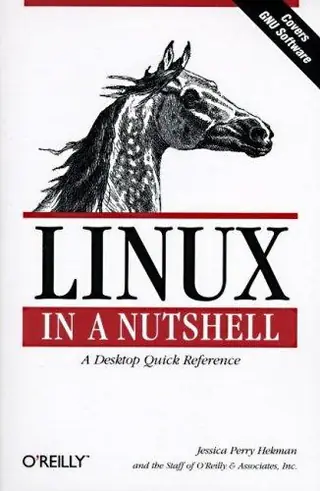
Linux in a Nutshell
by Jessica Perry Hekman, Ellen Siever, Aaron Weber, Stephen Figgins, Robert Love, Arnold Robbins, Stephen Spainhour · first published 1997
45% recommend55% neutral
Why HN recommends it
Comprehensive command-line reference covering Linux tools and the UNIX philosophy; suits beginners learning Linux and experienced users who want a go-to paper reference that has aged well.
Summarised by Claude from recommending comments
Everything you need to know about Linux is in this book. Written by Stephen Figgins, Ellen Siever, Robert Love, and Arnold Robbins -- people with years of active participation in the Linux community -- <i>Linux in a Nutshell</i>, Sixth Edition, thoroughly covers programming tools, system and network administration tools, the shell, editors, and LILO and GRUB boot loaders. <br><br>This updated edition offers a tighter focus on Linux system essentials, as well as more coverage of new capabilities such as virtualization, wireless network management, and revision control with git. It also highligh
Affiliate links. As an Amazon Associate I earn from qualifying purchases.
Mentions per year
What Hacker News says
Related books
 2008–2023
UNIX in a Nutshell
Arnold Robbins
Recommended by 7 · mentioned by 147 recommend · 14 mention7 recommend · 147 recommend
 2008–2026
The design and implementation of the FreeBSD operating system
Marshall Kirk McKusick, George V. Neville-Neil
Recommended by 36 · mentioned by 4736 recommend · 47 mention36 recommend · 4736 recommend
 2008–2026
Slack
Tom DeMarco
Recommended by 24 · mentioned by 4024 recommend · 40 mention24 recommend · 4024 recommend
 2007–2025
Made to stick
Chip Heath, Dan Heath, ʻAlizah Raʻanan
Recommended by 70 · mentioned by 8670 recommend · 86 mention70 recommend · 8670 recommend
Linux Programming Interface
Michael Kerrisk
Recommended by 98 · mentioned by 12698 recommend · 126 mention98 recommend · 12698 recommend
 2007–2026
The Art of War
孙武 (Sun Tzu)
Recommended by 57 · mentioned by 18057 recommend · 180 mention57 recommend · 18057 recommend
 2007–2026
The UNIX programming environment
Brian W. Kernighan
Recommended by 86 · mentioned by 13686 recommend · 136 mention86 recommend · 13686 recommend
 2007–2026
The C Programming Language
Brian W. Kernighan, Dennis MacAlistair Ritchie
Recommended by 246 · mentioned by 501246 recommend · 501 mention246 recommend · 501246 recommend
…command-line and terminal-focused tools. Parts of it are dated now (it's ... gasp, 22 years since its first edition), but since it's one of those books based on UNIX philosophy it's aged quite well. It, Linux in a Nutshell, the Sed & AWK book, are still a pretty good introduction. http://www.powells.com/biblio/61-9780596003302-0
on “An Awk Primer” ↗In the long run, I've learned the most important things from just using Linux, but I used books when starting and occasionally now. For me, it was Linux in a Nutshell (942 pages in the current edition) because I wanted a reference made of paper instead of pixels. Later for deep background, Design of the Linux Operating System https://archive.org/details/DesignUNIXOperatingSystem…
on “A Book on Linux” ↗Linux in a nutshell. Best book for Linux noobs and pros.
on “Ask HN: Best book you read in 2011” ↗I'm surprised no one mentioned SICP. I would also add: - The Little Schemer - Linux in a Nutshell - Unix power tools
on “Ask YC: What would you put on a hacker's bookshelf?” ↗For Linux, specifically, I can recommend the O'Reilly book "Linux in a nutshell". Now in its sixth edition, I have been recommending it for years and it's still my go-to book.
on “It used to be simpler to teach Unix” ↗…that number grows significantly. The founder of Gallery is the manager of a large team I work closely with, and on that team are the authors of Rhino, Parrot, Pychecker, "Linux Kernel Development" and "Linux in a Nutshell", and probably a few that I don't know of because I don't know everyone's pre-Google background.
on “Don't take your highest-paying internship offer” ↗…nostalgic books like my original Motorola 68000 processor guide, Rodney Zaks Z80 book, "Adventure game programming in BASIC", Commodore 64 Innerspace Compendium, etc. When a puppy chewed up my copy of "Linux in a Nutshell" I was tempted to buy the new edition but decided to try it online for a month with O'Reilly Safari through work and have not bothered to replace the paper copy for more than 2 years. I would categorize…
on “People mistake the internet’s knowledge for their own” ↗I love how immediately customizable this makes everything. Thank you. I'm imagining somebody tweaking this just a bit so that a robotic arm throws "Linux in a Nutshell" at them from across the room.
on “Um – Create your own man pages so you can remember how to do stuff” ↗This is more or less what I did, but under my own motivation. I charged myself to do all my CS homework in vi and had a copy of O'Reilly's Linux in a Nutshell at my side. It didn't take more than a couple of semesters and I didn't need the book at all.
on “How to Exit Vim” ↗Thank you! I was going to ask for the latest linux variant - are you speaking of Love's "Linux Kernel Development", or "Linux in a Nutshell"? I've been a primary linux user for a couple decades now but I'm not too keen on digging into kernel hacking but love details like the OPs post.
on “I summarized my understanding of Linux systems” ↗Hey, greetings from another former nedit user. It was my refuge from emacs on my 1997 redhat setup as I was stumbling around learning the ropes (I had to keep referring To my "Linux in a nutshell" book to remind myself how to open, save & quit in emacs) Nedit was a godsend, until I decided to look into that other weird editor (vim) that I kept hearing about (circa 1999 or so) ...
on “Fine, I'll build my own text editor” ↗