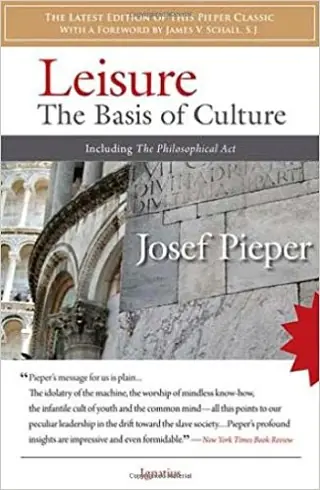
Leisure
by Josef Pieper · first published 1958
3mentions
1recommended by
2HN commenters
2021–2024first – last mentioned
50% recommend50% neutral
One of the most important philosophy titles published in the twentieth century, Josef Pieper's Leisure, the Basis of Culture is more significant, even more crucial, today than it was when it first appeared more than fifty years ago. This edition also includes his work The Philosophical Act. Leisure is an attitude of the mind and a condition of the soul that fosters a capacity to perceive the reality of the world. Pieper shows that the Greeks and medieval Europeans, understood the great value and importance of leisure. He also points out that religion can be born only in leisure -- a leisure th
Affiliate links. As an Amazon Associate I earn from qualifying purchases.
I would recommend Josef Pieper’s “Leisure: The Basis of Leisure” [0]. Leisure is not recreation. Indeed, the word “school” is derived from the Greek word for leisure, and the state of having to work was defined in terms of the lack of leisure,…
on “In Praise of Idleness (1932)” ↗Josef Pieper[0] has written about leisure at length. What we call "rest" today is largely either idleness or recreation and something meant only to "recharge us" so that we can continue to work. But this is ass-backwards and not leisure. Leisure…
on “How to rest well” ↗…duties and your own health. This would be the line between work ethic and workaholism. Work ethic is healthy, motivated by the right desires and motives. Workaholism is excessive, possibly escapist. Leisure, in the original sense (see Josef Pieper), is also necessary and increasing drowned out by work and recreation. All of these are good things, but they have their place.
on “90 Hours a Week and Loving It” ↗