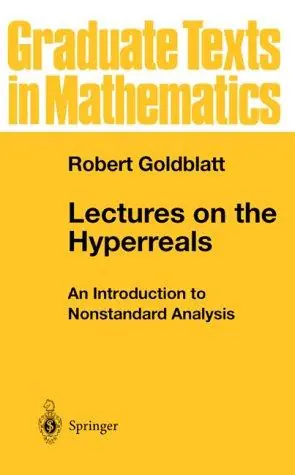
Lectures on the hyperreals
by Robert Goldblatt · first published 1998
100% recommend
This is an introduction to nonstandard analysis based on a course of lectures given several times by the author. It is suitable for use as a text at the beginning graduate or upper undergraduate level, or for self-study by anyone familiar with elementary real analysis. It presents nonstandard analysis not just as a theory about infinitely small and large numbers, but as a radically different way of viewing many standard mathematical concepts and constructions; a source of new ideas, objects and proofs; and a wellspring of powerful new principles of reasoning (transfer, overflow, saturation, en
Affiliate links. As an Amazon Associate I earn from qualifying purchases.
Mentions per year
What Hacker News says
Related books
Full Frontal Calculus
Seth Braver
Recommended by 2 · mentioned by 22 recommend · 2 mention2 recommend · 22 recommend
 2017–2026
A primer of infinitesimal analysis
John L. Bell
Recommended by 3 · mentioned by 53 recommend · 5 mention3 recommend · 53 recommend
 2011–2025
Radically elementary probability theory
Nelson, Edward
Recommended by 6 · mentioned by 76 recommend · 7 mention6 recommend · 76 recommend
 2013–2026
Infinitesimal Calculus
James M. Henle, Eugene M. Kleinberg
Recommended by 4 · mentioned by 74 recommend · 7 mention4 recommend · 74 recommend
 2009–2026
Elementary calculus
H. Jerome Keisler
Recommended by 9 · mentioned by 139 recommend · 13 mention9 recommend · 139 recommend
…think) some integration, in Hurd and Loeb, "An Introduction to Nonstandard Real Analysis". For the foundations of nonstandard analysis, and a wide-ranging overview, I strongly recommend Robert Goldblatt, "Lectures on the Hyperreals: an Introduction to Nonstandard Analysis", one of the Graduate Texts in Mathematics.
on “Elementary Calculus: An Infinitesimal Approach (2000)” ↗The best book I have read on nonstandard analysis is "Lectures on the Hyperreals", by Goldblatt, which is excellent. On the more practical end, Pétry's "Analyse Infinitésimale: une présentation non standard" is an extremely readable first-year-undergrad level textbook that shows…
on “Nonstandard Analysis (1972)” ↗By the way, the computation involving nonstandard reals is correct (to the best of my ten-year-old memory of studying this stuff). As usual, I will recommend Goldblatt's _Lectures on the Hyperreals_ for an intro to how it all works, and Pétry's "Analyse Infinitésimale: une présentation non standard" for an undergraduate first course in analysis expressed through nonstandard analysis.
on “Multiplicative Infinitesimals” ↗If we're going the hyperreal route, I quite like Goldblatt's GTM Lectures on the Hyperreals. You have to augment it with a paper or two if you want to work with other nonstandard objects, but when I was doing my graduate work it was the resource I kept going back to for clarity.
on “Simplifying and Refactoring Introductory Calculus” ↗…the History of Topos Theory"[2] (this does not require [1], it just undoes some historical assumptions made in [1] and, like everything else by McLarty, is extraordinarily well-written) 3. Goldblatt's "Lectures on the Hyperreals"[3] 4. Nelson's "Radically Elementary Probability Theory"[4] 5. Tao's "Ultraproducts as a Bridge Between Discrete and Continuous Analysis"[5] 6. Some canonical machine learning text, like Murphy[6]…
on “Physics, Topology, Logic and Computation: A Rosetta Stone (2009) [pdf]” ↗