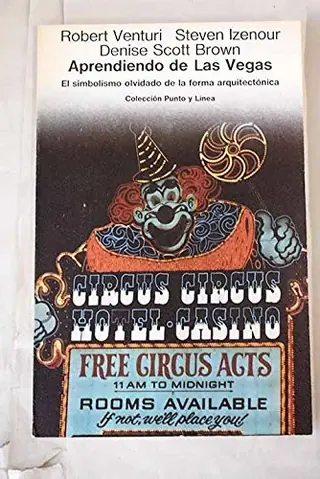
Learning from Las Vegas
The Forgotten Symbolism of Architectural Form
by Robert Venturi, Denise Scott Brown, Steven Izenour · first published 1972
50% recommend50% neutral
Upon its publication by the MIT Press in 1972, Learning from Las Vegas was immediately influential and controversial. The authors made an argument that was revolutionary for its time -- that the billboards and casinos of Las Vegas were worthy of architectural attention -- and offered a challenge for contemporary architects obsessed with the heroic and monumental. Learning from Las Vegas begins with the Las Vegas Strip and proceeds to "Ugly and Ordinary Architecture, or the Decorated Shed," on symbolism in architecture and the iconography of urban sprawl. As Scott Brown says in
Affiliate links. As an Amazon Associate I earn from qualifying purchases.
Learning from Las Vegas is Robert Venturi and Denise Scott Brown's seminal work and the ideas drove their work. In a nutshell, buildings are either ducks or decorated sheds. [0] Their clients hired them to design decorated sheds…
on “Sainsbury Wing contractors find 1990 letter from donor” ↗…suburbs are hell if you are young and don't have a car, don't have friends, etc. If you are a bit older you might like the square footage and relative quiet of the suburbs. https://en.wikipedia.org/wiki/Learning_from_Las_Vegas are https://en.wikipedia.org/wiki/The_Death_and_Life_of_Great_Am... are good reflections on American Vernacular architecture; that first book in particular has a collection of comments from clients…
on “Barren American Suburbs” ↗True about maintenance. Read this book https://en.wikipedia.org/wiki/Learning_from_Las_Vegas for the story about the Train shed; that book reveals the inner logic of contemporary vernacular architecture just as Jane Jacobs did for the prewar period. Also there is a "local knowledge" that rules…
on “We Don’t Like Our Underground House” ↗…got the commission over Richard Rogers perhaps in part because Charles Windsor called Rogers' design "a monstrous carbuncle." The columns have been there for thirty years and one of the learnings in Learning from Las Vegas is designing for that kind of lifespan is a reasonable architectural practice (thirty years is a typical mortgage term in the US). I think it is particularly relevant that the columns are in an ancillary…
on “Sainsbury Wing contractors find 1990 letter from donor” ↗The American indifference to architecture has a flip side: build an innovative building and you'll have innovative problems. The authors of "Learning from Las Vegas" once got a contract to design a fancy repair shed for trains in Pittsburg. They picked one out of a catalog and got the remark "If we wanted this, we should have hired an architect." The architects…
on “We Don’t Like Our Underground House” ↗…anti-architecture books that advocate for (alternatively) traditional downtowns and strip-mall construction https://en.wikipedia.org/wiki/The_Death_and_Life_of_Great_Am... https://en.wikipedia.org/wiki/Learning_from_Las_Vegas Robert Jay Lifton described two examples of postmodern personality types in this book: https://www.amazon.com/Protean-Self-Human-Resilience-Fragmen... one of those was environmental activists, the…
on “The Two Wings of Postmodernism” ↗I think it is funny how Jane Jacob's arguments are so similar to those of Venturi defending the "commercial strip" architecture which is also a vernacular architecture. (i.e. Learning from Las Vegas is the only architecture book where they have quotes about their designs such as "If this is what I wanted I wouldn't have hired an architect")
on “Jane Jacobs never adequately thought through the implications of gentrification” ↗There was an undergrad art history course where the professor contrasted his ideals here w/ Venturi and Scott-Brown's "messy vitality" as encoded in their "Learning from Las Vegas" project
on “Le Corbusier as I Knew Him (1977)” ↗Oh c'mon, like jedberg said, fast food chain restaurants and gas stations usually have good signage for driving (hat tip Learning from Las Vegas), so it makes sense to use them as visual milestones. I love Naomi Klein and all, but sometimes looking for small side street sign while everyone's going at least 45mph on a stroad is nearly impossible.
on “Facebook almost acquired Waze, but we ended up with Google” ↗Because they are sheds, most sheds are undecorated. They are unremaked upon for the same reason. But to be clear, Venturi and Scott Brown’s distinction is in the context of architectural practice. Learning from Las Vegas started as a studio in Harvard’s GSD. The radical idea was looking at actual buildings built for ordinary reasons in ordinary ways…the radical idea was valuing the study from contemporary vernacular architecture.
on “Sainsbury Wing contractors find 1990 letter from donor” ↗