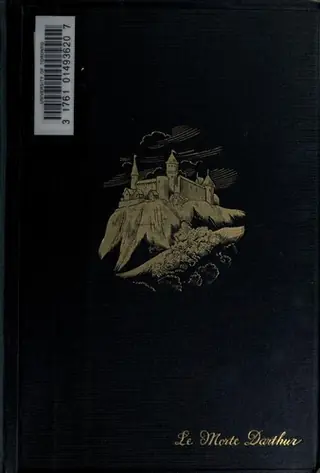
Le Morte d'Arthur
by Thomas Malory · first published 1557
16mentions
3recommended by
16HN commenters
2009–2026first – last mentioned
19% recommend75% neutral6% critical
Le Morte d'Arthur (originally spelled Le Morte Darthur, ungrammatical Middle French for "The Death of Arthur") is a 15th-century Middle English prose reworking by Sir Thomas Malory of tales about the legendary King Arthur, Guinevere, Lancelot, Merlin and the Knights of the Round Table—along with their respective folklore. In order to tell a "complete" story of Arthur from his conception to his death, Malory compiled, rearranged, interpreted and modified material from various French and English sources. Today, this is one of the best-known works of Arthurian literature. Many authors sin
Affiliate links. As an Amazon Associate I earn from qualifying purchases.
I stumbled on "Le Morte d'Arthur" in college. It was one of the few books that having a few beers really helped with.
on “Learn to read Middle English” ↗Big shout out to the Morte d'Arthur. I read it last year and at first found it hard to get into. There's tons of repetitive tournaments and jousting... the Marvel analogy is not wrong, it's a bit like a comic book. But gradually the characters…
on “Rediscovered Medieval Manuscript Offers New Twist on Arthurian Legend” ↗If I have a comfy chair, nice music, and an afternoon to relax, probably Le Morte d'Arthur. Or if I'm looking to forget the world, Mists of Avalon. For more historical diving, Oxford maintains a list of books and papers written on the matter.
on “King Arthur's ancient trail across Britain” ↗…how much I care about the contents of the passage. The Rime of the Ancient Mariner, being poetry, doesn't get any latitude: I must remember the word exactly. Some of the tedious battle descriptions in Le Morte d'Arthur get a pass no matter how badly they go wrong. If a card is causing me trouble, there are a few corrective actions I can take: In some instances I'll edit the card to blank out a more meaningful word…
on “How to write good prompts: using spaced repetition to create understanding” ↗…Monmouth - a Welsh monk who lived in the early 12th century. Good 200+ years before Malory. But Geoffrey of Monmouth's work was largely unknown until Thomas Malory revived it. Thomas Malory's book Le Morte D'Arthur became a bestseller because of the right timing - Guttenberg invented his printing press at just about that time. In either case - the Arthurian legend is entirely made up. Geoffrey of Monmouth weaved…
on “The Anatomy of Determination” ↗Regarding phonetic spelling, non-phonetic spelling such as is found in English is unusual - the idea of a French or German spelling bee is incoherent. Even though a book such as Le Morte d'Arthur is unfamiliar at first, the spelling differences disappear pretty quickly once an English speaker's attention is focused on it.
on “The Rise of "Logical Punctuation".” ↗…medieval and later iterations is the unpredictable duality of her nature, with potential for both good and evil." Edited to add, also see this bit from the Wikipedia article on Lady of the Lake: "In Le Morte d'Arthur, on the other hand, Nimue is still the one to trap Merlin, but Malory gives her a sympathetic reason: Merlin falls in love with her and will not leave her alone; Malory gives no indication that Nimue…
on “Clarke's Law, and who's to blame for bad science reporting” ↗…whatever, it counted). > Finally, yellow or gold knights were rare and blue knights nonexistent. The nearest thing to a canonical version of the Arthurian romances in English is probably Sir Thomas Malory's Le Morte d'Arthur, which may be too late (c. 1470) to count as strictly mediaeval, but which does include a single example of a blue knight: > So leave we Sir Gareth there with Sir Gringamore and his sisters, and turn…
on “Colour in the Middle Ages” ↗Le Morte D'Arthur, Sir Thomas Malory, Penguin Classics (1981 edition). Extremely tortuous phraseology. But I finished it, with gritted teeth at 15. I have long since abandoned the desire to finish every book I start.…
on “Short Little Difficult Books” ↗I suspect it is. Look at Chagnon's Yanomamo ethnographies, or at the Homeric epics. Or the Old Testament, or Beowulf, or Le Morte D’Arthur. Men cry at the drop of a hat in all of those.
on “Tears” ↗…country he lived in was probably called something like Britain, though may have simply been closer to Cymru. But I was largely paraphrasing T.H. White's Once And Future King, which in turn cribs the La Morte d'Arthur, which forms the basis for the "modern" Arthurian legend, and recasts it in an idealized England.
on “XMPP Myths” ↗I think that's probably based on the story line about Lancelot wounding Gawain with Balin's sword. Somewhere in Morte d'Arthur, but I don't recall the "wait to be at his best" part. It sounds like a Hollywood addition to the story, so maybe a movie?
on “Rediscovered Medieval Manuscript Offers New Twist on Arthurian Legend” ↗…along the way. I think it might have been Gawain now that you mention it. Pretty sure it started with a G so I kept thinking Gallahad. EDIT: Found it! Sir Gareth! https://en.wikipedia.org/wiki/Gareth#Le_Morte_d'Arthur
on “Rediscovered Medieval Manuscript Offers New Twist on Arthurian Legend” ↗…One thing that audiobooks have enabled me to do, that I probably never would have gotten around to do on my own (even as I do own the books), is to read classics like Rabelais' Gargantua or Mallory's Le Morte d'Arthur.
on “The Work of the Audiobook” ↗Mallory's Morte d'Arthur. Most of the Arthur "myth" is deliberately constructed fiction by specific authors, rather than folk myths.
on “Queen Caroline turned King Arthur into an 18C royal PR strategy” ↗