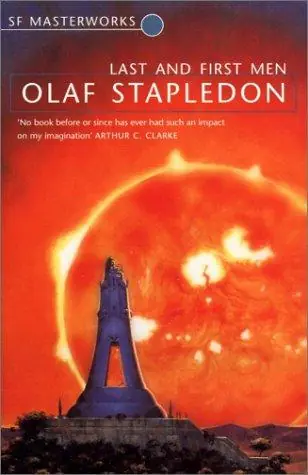
Last and First Men
by Olaf Stapledon · first published 1930
62% recommend33% neutral5% critical
Why HN recommends it
Epic future history of humanity across vast timescales, evolving through successive species; admired for its unique, imaginative sweep and for influencing later SF authors. Suits readers who want big ideas over plot.
Common criticism: Reads more like a history than a story, so some find it slow or boring
Summarised by Claude from recommending comments
One of the most succinct and accurate renderings of mankind's present state of mind and future progression. It documents the future of man from the start of WW2 and continues until the Sun engulfs the earth, and beyond. Considering this book was first published in 1931, it is remarkable, both in its honesty as regards human nature, and in its phenomenal span. By the time we reach chapter 3 of the 16 in this book, it is already 2300 AD and you feel like you have had the viewpoint of a God. So intense is the writing, that a few pages can take you hours to read and weeks to think about. What a wr
Affiliate links. As an Amazon Associate I earn from qualifying purchases.
Mentions per year
What Hacker News says
Related books
Odd John
Olaf Stapledon
Recommended by 2 · mentioned by 42 recommend · 4 mention2 recommend · 42 recommend
 2008–2025
To your scattered bodies go
Philip José Farmer
Recommended by 3 · mentioned by 33 recommend · 3 mention3 recommend · 33 recommend
 2013–2026
Star Maker
Olaf Stapledon
Recommended by 23 · mentioned by 3923 recommend · 39 mention23 recommend · 3923 recommend
 2018–2022
Here
Richard McGuire
Recommended by 3 · mentioned by 33 recommend · 3 mention3 recommend · 33 recommend
 2008–2025
More Than Human
Theodore Sturgeon
Recommended by 3 · mentioned by 73 recommend · 7 mention3 recommend · 73 recommend
 2014–2021
Nine Hundred Grandmothers
R. A. Lafferty
Recommended by 5 · mentioned by 65 recommend · 6 mention5 recommend · 65 recommend
 2008–2020
Slan
A. E. van Vogt, Oliver Wyman, Kevin J. Anderson
Recommended by 3 · mentioned by 43 recommend · 4 mention3 recommend · 43 recommend
…higher quality: 1. The Cyberiad 2. Babel-17 3. The Stars My Destination 4. The Sheep Look Up 5. More Than Human 6. Lord of Light 7. To Your Scattered Bodies Go 8. Earth Abides 9. Dying Inside 10. City 11. Last and First Men 12. Slan 13. The World of Null-A
on “32 Sci-Fi novels that you should add to your reading list” ↗…holographic projections with cyan grids and twirly animations. After a while these designs become lazy tropes - like villains who wear chunky black leather. Compare with something like Olaf Stapledon's Last and First Men, which is far more adventurous about possible futures. The background problem is that the 20th century was set up for an explosion of invention by the late 19th, with Maxwell/Heaviside leading the charge…
on “What the world will be like in a hundred years (1922)” ↗Nine Hundred Grandmothers, by R.A. Lafferty (out of print except for "The Books of Sand") Last and First Men, by Olaf Stapledon, free at http://www.feedbooks.com/book/2028/last-and-first-men Accelerando, by Charles Stross, free at http://www.antipope.org/charlie/blog-static/fiction/accelera... The Doubter's…
on “Ask HN: What are the most thought-provoking books that you have read?” ↗…freshman year in college I took a science fiction literature course (aside: it turned out that my dad took the same course with the same professor some 40 years earlier). The professor said that Stapledon's Last and First Men was the most ambitious and significant work in the genre's history, and I am inclined to agree.
on “On Stapledon's “Last and First Men” (1986)” ↗Could it be Last and First Men by Olaf Stapledon? It's a novel, not a short story, but it has the same structure you've described involving successive sentient races (including bird-like people) and the planets gradually becoming uninhabitable.…
on “Timeline of the far future” ↗Stanislaw lem.. i agree... Solaris was special.. and most purists seemed to suggest the translation from Polish was bad!... Olaf stapledon's last and first men, starMaker were both stunning... Ursula le guin also come to mind
on “Ask YC: What's the most inspiring sci-fi book you've read?” ↗The Essential Rene Guenon (meta-tradition). Last and First Men by Olaf Stapledon (Spinoza-inspired scifi). Embassytown by China Mieville. Past Master by R.A. Lafferty. Aesop's Fables by Roger L'Estrange, 1715 3rd ed. in 2 volumes, ~900 pages total, otherwise it's…
on “Ask HN: What is the most influential not-technology book(s) you have ever read?” ↗Same for 1930's Last and First Men, by Olaf Stapledon, which spans 2 billion years and eighteen species of variously augmented humans, https://en.m.wikipedia.org/wiki/Last_and_First_Men
on “Ask HN: Books that altered your view of reality” ↗If you enjoy thinking about epic timescales I recommend Olaf Stapledon's 'Last and First Men: A Story of the Near and Far Future' fairly outdated, heavy going, but unique.
on “The Silurian Hypothesis” ↗…on quite a number of bright thoughts. He and I have something in common: we both took out of the public library the same science fiction book when we were boys of about 15 or 16, which was Stapledon's Last and First Men. We took it out of the same country library in Porlock in Somerset. Whoever put that book on the shelves had a lot to answer for!" Libraries have their uses.
on “Last and First Men” ↗For a more detailed description of the future, see Stapledon's Last and First Men.
on “Timeline of the Far Future” ↗Last and First Men by Olaf Stapledon, 1930 (free online text), https://en.m.wikipedia.org/wiki/Last_and_First_Men > A work of unprecedented scale in the genre, it describes the history of humanity from the present onwards…
on “Ask HN: Which book helped you understand the world?” ↗I can't pick a favourite so I'll just list some books I love that might not be as well known as some others here. * Last and First Men, by Olaf Stapledon * Way Station, by Clifford D. Simak * The Gap (series), by Stephen Donaldson * The Golden Apples of the Sun, by Ray Bradbury * Tau Zero, by Poul Anderson
on “Ask HN: What is your favorite fiction book?” ↗If you can handle the science changing since publication in the 1930s(!!!) Olaf Stapledon is simply remarkable. "Last and first men" is one of my favorite books for just how unique it is, but "star maker" has some interesting parallels
on “Permutation City (1994)” ↗Olaf Stapledon’s Last and First Men, from 1930, seems to fit this genre too. It gets a bit outlandish with telepathy, but it’s ambitious novel telling of humanity’s ebbing and flowing, evolving a lot along the way, from ‘present day’ to…
on “Science fiction and the death of the sun” ↗