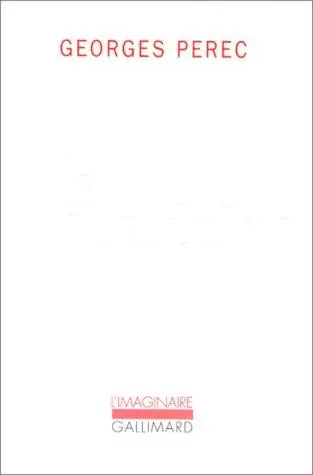
La Disparition
by Georges Perec · first published 1969
26% recommend68% neutral5% critical
Why HN recommends it
A novel written without the letter e, so the constraint drives the language. Its linguistic inventiveness stands out, and the English translation reproduces the trick.
Summarised by Claude from recommending comments
This is a book without any e letter (the most common one in French). One of most knew exemple of Oulipo work.
Affiliate links. As an Amazon Associate I earn from qualifying purchases.
Mentions per year
What Hacker News says
Related books
Void
Georges Perec, Gilbert Adair
Recommended by 1 · mentioned by 101 recommend · 10 mention1 recommend · 101 recommend
 2013–2025
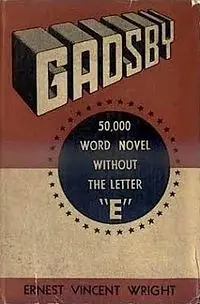
Gadsby
Ernest Vincent Wright, Ernest Wright
0 recommend · 9 mentioned0 recommend · 9 mention0 recommend · 90 recommend
 2011–2026
Naked Lunch
William S. Burroughs, William Burroughs
Recommended by 9 · mentioned by 479 recommend · 47 mention9 recommend · 479 recommend
 2009–2026
Le Ton beau de Marot
Douglas R. Hofstadter
Recommended by 27 · mentioned by 5227 recommend · 52 mention27 recommend · 5227 recommend
 2007–2026
Blood Meridian
Cormac McCarthy
Recommended by 105 · mentioned by 192105 recommend · 192 mention105 recommend · 192105 recommend
 2007–2026
War and Peace
Lev Tolstoi
Recommended by 78 · mentioned by 37078 recommend · 370 mention78 recommend · 37078 recommend
 2007–2026
Animal Farm
George Orwell
Recommended by 105 · mentioned by 407105 recommend · 407 mention105 recommend · 407105 recommend
I used to write short stories that didn't contain the letter 'e', inspired by George Perec's book La Disparition (cracking novel, highly recommended -- all the translations from French keep it up as well). It's challenging, obviously, but also forces you to employ very unusual and unique language.
on “On Smoking” ↗…then, I haven't found other works by Queneau to match it, and I've been more fascinated by Perec (especially _La Vie mode d'emploi_, though the constrained nature of the writing is not as visible; and _La Disparition_ which I find is suprisingly more than a linguistic tour de force).
on “Exercises in Style” ↗For folks following this discussion, I don't know about Anglic works, but I think "la disparition"[0] and "All'alba Shahrazad andrà ammazzata"[1] show outstanding illustrations of lipograms for Italians and Gauls. [0] http://www.amazon.com/Disparition-French-Language-Georges-Pe... [1] http://www.amazon.it/Allalba-Shahrazad-ammazzata-Giuseppe-Va...
on “Secrets of the Magus: Ricky Jay does closeup magic that flouts reality (1993)” ↗Also noteworthy, from Georges Perec: A Void (La Disparition), which was written entirely without using the letter "e" (and which the translation reproduces brilliantly well).
on “Ask HN: What are some great books that are relatively unknown in the US?” ↗there's a splash of math in some of Georges Perec's works of fiction. a fun literary example of a structure preserving transformation is the translation of Perec's "La Disparition" from the original french-without-the-letter-e to english-without-the-letter-e. see also: https://en.wikipedia.org/wiki/Oulipo
on “Ask HN: Books that blend math and fiction” ↗> Or those novels that do not ever use the letter "e". As a note on this, I think the novel you're talking about is Georges Perec's 'La Disparition'. Supposedly the lack of an 'e' is symbolic of the loss of his family in the Holocaust. Anyway, I always thought one of the greatest feats of the English language was the guy who translated the novel…
on “Goto (2007)” ↗I'd love to make a gag about how it couldn't possibly be - because Queneau has the letter e in it twice... But the one I was referring to is La Disparition by Georges Perec - with the letter e four times... :shrug:
on “Text-Only Social Network” ↗…मनो दीयताम्” by Kṣemendra) Not another poem on that theme, but something cool I remembered related to Ozymandias: Gilbert Adair, somewhere in his amazing translation (A Void) of Georges Perec's work La Disparition — written entirely without a single instance of the letter 'e' — has this rewrite of Ozymandias that maintains the lipogram constraint (and rhyme): Ozymandias I know a pilgrim from a distant land Who…
on “Ozymandias” ↗The most famous one is “La disparition” (translated to “A void“) by Georges Perec.
on “Ask HN: How do you stimulate your creativity on a day like today?” ↗Likewas, thirty years later George Perec wrote La disparition[1] which is also devoid of the letter "e", and was also translated to multiple languages with similar constraints (with some variants, the Spanish version for instance is written without "a"). [1]: https://en.m.wikipedia.org/wiki/A_Void
on “The most impressive linguistic feat I’ve ever seen” ↗…into great detail about the challenges it presents, with lots of different approaches and translations. He talks about many other significant challenges to the translator -- the one that comes to mind is La disparition by Georges Perec[1] -- a novel famously written without appearance of the letter e. It was translated into English by Gilbert Adair as A Void -- also lacking that most common of glyphs. Other unpublished…
on “Fernando Pessoa’s Disappearing Act (2017)” ↗…suite of five novellas each restricting themselves to a single vowel. In his case, he went through a dictionary by hand and created vocabulary lists for each novella. I've read the English translation of La disparition and I'd note that (a) the act of translating a Lipogram is kind of its own special challenge (which might be also why the Spanish version chose to omit a instead of e—without e, a wide class of plurals…
on “The most impressive linguistic feat I’ve ever seen” ↗Or: > [The novel] "A Void", translated from the original French La Disparition (lit. "The Disappearance"), is a 300-page French lipogrammatic novel, written in 1969 by Georges Perec, entirely without using the letter e, following Oulipo constraints. [0] [0] https://en.wikipedia.org/wiki/A_Void
on “Thousand Character Classic” ↗Georges Perec did the same with his novel "La Disparition". What is almost as impressive is that these novels (at least Perec's) have been translated to other languages.
on “Albert Einstein's theory of relativity in words of four letters or less (1999)” ↗…Kafka I've read had nothing difficult in their words, but the surrealist plots were very unsettling. In "Pedro Páramo" the reader feels lost in a harsh world and unsure of reality. Meanwhile, Perec's "La disparition" or Becket's "Molloy" are more about style tricks.
on “Short Little Difficult Books” ↗