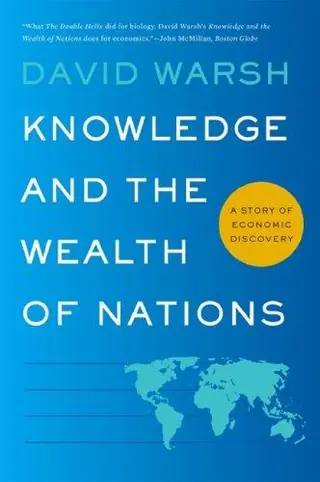
Knowledge and the Wealth of Nations
by David Warsh · first published 2006
6mentions
4recommended by
6HN commenters
2007–2019first – last mentioned
67% recommend33% neutral
Affiliate links. As an Amazon Associate I earn from qualifying purchases.
…Hawkins How To Create A Mind - Ray Kurzweil The Language Instinct - Steven Pinker The Origin of Wealth - Eric Beinhocker The Signal and the Noise - Nate Silver The Money Culture - Michael Lewis Knowledge and the Wealth of Nations - David Warsh Smart Machines: IBM's Watson and the Era of Cognitive Computing - John E. Kelly III and Steve Hamm The Idea Factory - Jon Gertner Winning The Knowledge Transfer Race - Michael J. English…
on “Ask HN: Best books you read in 2013” ↗…bubbles, users as if they're investors. See Davenport and Becks 'Attention Economy' as well as Mark Anielski's 'Economics of Happiness'. And to see the where I'm eventually trying to lead, see David Warsh's 'Knowledge and the Wealth of Nations' and the 2005 World Bank paper called "Where is the Wealth of Nations."
on “Preparing for Web 3.0” ↗"Knowledge and the Wealth of Nations" by David Warsh (2007). It's really two books: It shows how the academic field of Economics works today, and covers much of the field's history; and it also examines Paul Romer's theory of economic growth,…
on “Ask HN: What history of economics and technology book would you recommend?” ↗…misinformed. Macroeconomics relies very heavily on mathematical tools such as calculus and topology to model the collective behavior of humans. If you are really interested in learning more, I recommend "Knowledge and the Wealth of Nations: A Story of Economic Discovery".
on “How to earn your macroeconomics and finance white belt as a software developer” ↗…aware of it or not. And that lowering of transaction costs means that the world does become more efficient at allocating resources, if the Coase Theorem is true. Our professor read us a passage from Knowledge and the Wealth of Nations, part of which is cited here (edit: only a bit more detailed than the text in OP, but I still think it's a cool scene worth mentioning): http://www.salon.com/2006/11/16/milton_friedman/ That was the…
on “At 101 years old, Nobel Laureate Ronald Coase Writes New Book, Edits New Journal” ↗…both QWERTY-is-superior and QWERTY-demonstrates-market-failure stories are remarkably hardy perennials, presented as established fact without acknowledging the Liebowitz/Margolis counterargument. (E.g., _Knowledge and the Wealth of Nations_ by David Walsh (2006), carries approving blurbs from _The Financial Times_ and _The Economist_ on its cover, and should be easy to find in a library, maybe even a chain bookstore. "Paul David" and QWERTY…
on “The QWERTY myth” ↗