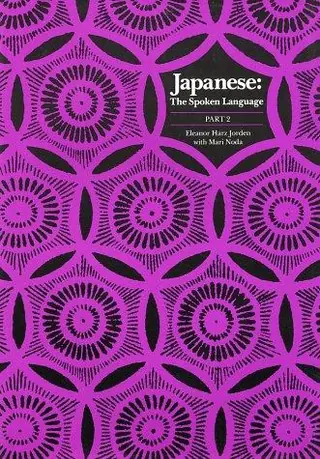
Japanese, The Spoken Language
by Eleanor Harz Jorden · first published 1987
7mentions
4recommended by
7HN commenters
2009–2024first – last mentioned
57% recommend29% neutral14% critical
Affiliate links. As an Amazon Associate I earn from qualifying purchases.
I recognize Kunrei-shiki as the style used in Eleanor Harz Jorden's seminal Japanese textbook, Japanese: The Spoken Language. I always thought Hepburn style was more appropriate for the goals of that book: to convey spoken Japanese in a way understandable to English speakers. But I think Jorden intended for accompanying audio…
on “Japan to revise official romanization rules for first time in 70 years” ↗Reminds me of Japanese: The Spoken Language, which is what I used to learn Japanese. It's quite challenging at first but I can't think of a better way for an adult to learn the language well.
on “A Japanese language guide for analytical thinkers” ↗Candidly, I wouldn't. If you put a gun to my head I'd say find yourself a copy of Japanese the Spoken Language with the CDs and drill them until your ears bleed. In particular, make sure you practice production (i.e. talk, talk, talk, if you don't sound like the CD keep talking until you do, then drill some more).…
on “How Learning a Second Language Changed My Life” ↗…can cherry pick parts of to supplement whatever topics you're covering in your regular course work, or leaf through when you want to refresh your understanding of the grammar. Books like Nakama, Genki, Japanese: the spoken language, etc. are great (although I don't like how many of these books don't use hiragana after the first few weeks), and then having a cheap grammar (this one's free, or $30 at most if you want a copy you can…
on “An introduction to Japanese” ↗…Japanese. I have a unique perspective on this issue, as I'm someone who has studied Japanese for a few years in college and is now using RtK. The courses I took focused heavily on spoken Japanese, using the Japanese: The Spoken Language series, which is also from Yale University Press and uses a very similar approach to the Chinese series by DeFrancis you mentioned (and also has the deficiency of being out-of-date). Although it gave…
on “Learn to read a sentence of Chinese in 3 minutes” ↗…the latin script with your starting accent (assuming of course your first language is written using the latin alphabet). However some textbooks persist with using it, despite being excellent otherwise (Japanese: The Spoken Language being one). I can't stress enough the need to move off reading Latin characters. It is also useful to learn the characters by sound rather than their roman equivalents. i.e instead of learning that ロ…
on “Show HN: Eskéndereyya – Learn How to Read and Write Arabic in Latin Script” ↗Even if research has shown advantages to waiting to teach the writing system, this approach has become extremely unpopular, to say the least. There are only one or two places still using the textbook "Japanese: The Spoken Language," and all other modern textbooks teach the writing system from the beginning. Even textbooks that used to use romanized Japanese for fairly logical pragmatic reasons, like "Japanese for Busy People,"…
on “An introduction to Japanese” ↗