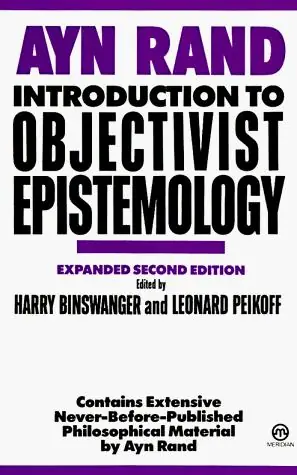
Introduction to Objectivist Epistemology
by Ayn Rand · first published 1967
71% recommend14% neutral14% critical
Why HN recommends it
Concise nonfiction account of Rand's theory of concepts and knowledge, framed in Aristotelian terms; suits readers comparing her epistemology with Aristotle or wanting a primer on the empiricist-rationalist divide.
Common criticism: Critics say it is weak philosophy and misreads Kant on key points
Summarised by Claude from recommending comments
Today man's mind is under attack by all the leading schools of philosophy. We are told that we cannot trust our senses, that logic is arbitrary, that concepts have no basis in reality. Ayn Rand opposes that torrent of nihilism, and she provides the alternative in this eloquent presentation of the essential nature--and power--of man's conceptual faculty. She offers a startlingly original solution to the problem that brought about the collapse of modern philosophy: the problem of universals. This brilliantly argued, superbly written work, together with an essay by philosophy professor Leonard Pe
Affiliate links. As an Amazon Associate I earn from qualifying purchases.
Mentions per year
What Hacker News says
Related books
 2009–2025
Objectivism
Leonard Peikoff
Recommended by 7 · mentioned by 97 recommend · 9 mention7 recommend · 97 recommend
 2008–2026
The Virtue of Selfishness
Ayn Rand, C. M. Hebert
Recommended by 16 · mentioned by 3116 recommend · 31 mention16 recommend · 3116 recommend
 2010–2020
Liberalism and the Limits of Justice
Michael J. Sandel
Recommended by 1 · mentioned by 21 recommend · 2 mention1 recommend · 21 recommend
 2008–2021
Utilitarianism
John Stuart Mill
Recommended by 5 · mentioned by 75 recommend · 7 mention5 recommend · 75 recommend
 2009–2026
Philosophy
Ayn Rand
Recommended by 4 · mentioned by 64 recommend · 6 mention4 recommend · 64 recommend
 2008–2016
The Romantic Manifesto
Ayn Rand
Recommended by 4 · mentioned by 64 recommend · 6 mention4 recommend · 64 recommend
 2007–2024
For the New Intellectual
Ayn Rand
Recommended by 1 · mentioned by 41 recommend · 4 mention1 recommend · 41 recommend
"The Virtue of Selfishness" "Capitalism: The Unknown Ideal" "Philosophy: Who Needs It" "Introduction to Objectivist Epistemology" All by Ayn Rand. Whether you end up agreeing with her or not, she will definitely will make you think.
on “Ask HN: Best Philosophical Books?” ↗…reject all philosophy, and are thus throwing the baby out with the bath water. For anyone with a serious interest in these issues I recommend that you read Ayn Rand's "Philosophy: Who Needs It" and her "Introduction to Objectivist Epistemology". In the former book, her answer is that everyone needs a philosophy because it is the science of fundamentals that apply to everyone and all sciences.
on “Why philosophy is largely ignored by science” ↗I would recommend Rand's Philosophy: Who Needs It then Peikoff's Objectivism: The Philosophy of Ayn Rand. The Introduction to Objectivist Epistemology (ITOE) is good but is a bit technical and not everyone has the interest and motivation to read it. At the very least, if you can find it at a bookstore, read the intro because it does a good job of setting…
on “Review: Ayn Rand’s ‘Ideal’ Presents a Protagonist Familiar in Her Superiority” ↗…At the risk of having this and my first comment downvoted into oblivion, I got them from Ayn Rand. She has a short (80-page) nonfiction book about just these things which I think is remarkable, called Introduction to Objectivist Epistemology. If you are not predisposed to despising the author, it's a quick, very interesting read that I recommend. Edit: And there are the downvotes...
on “Münchhausen Trilemma” ↗"Introduction to Objectivist Epistemology" by Ayn Rand
on “What is the book that has completely changed your way of thinking?” ↗_Introduction to Objectivist Epistemology_, Ayn Rand The "Organon" books by Aristotle _Introduction to Logic_, H. W. B. Joseph _An Invitation to Formal Reasoning_, Fred Sommers & George Englebretsen
on “Articles, Ideas, Books and/or Concepts that have changed your life” ↗Atlas Shrugged, The Fountainhead, and Introduction to Objectivist Epistemology, by Ayn Rand. To a lesser extent, The Double Helix, by James D. Watson.
on “What is the book that has completely changed your way of thinking?” ↗…Atlas Shrugged by Ayn Rand. Those are the two to start with. If you like those, check out some of her nonfiction books: The Virtue of Selfishness: A New Concept of Egoism, Philosophy: Who Needs It, and Introduction to Objectivist Epistemology (these are but a few - Rand wrote a long series of nonfiction books). Ayn Rand's Normative Ethics: The Virtuous Egoist by Tara Smith (a philosophy professor at UT-Austin) is excellent because it unpacks…
on “Ask HN: What are some books that changed how you think?” ↗…her. However, her ideas are becoming harder to ignore - they are important! Highly recommend reading at least Atlas Shrugged, The Fountainhead, and Objectivism: The Philosophy of Ayn Rand. Then pick up Introduction to Objectivist Epistemology, Virtue of Selfishness, Capitalism: The Unknown Ideal, and the recently released Understanding Objectivism . UO is very good (it's useful/personal, down to earth), but requires familiarity with Objectivism.
on “The Criminalization of Everyday Life” ↗…reality". 2. "Reality is consistent". 3. "The human mind is capable of knowledge about reality". These all need to be taken as axioms if any further knowledge is going to be possible. There's a book called Introduction to Objectivist Epistemology which covers this in much more detail. (Ayn Rand gets a bad rep, but few people know about her theories of concepts and knowledge. They indicate the path to solving many of the issues in philosophy of…
on “What’s so bad about Scientism?” ↗Introduction to Objectivist Epistemology has radically changed my view of almost everything, including software development. I’m able to cut through a lot of controversial issues by using its methods to ask incisive questions. https://www.amazon.com/Introduction-Objectivist-Epistemology...
on “Ask HN: What are the best unknown books you have read?” ↗…lightspace and gravitytime to avoid this error. You won't learn much in modern philosophy courses in regard to these issues but you need to understand the history and read Ayn Rand's Philosophy:Who_Needs_It, Introduction_To_Objectivist_Epistemology and the title essay of her anthology For_The_New_Intellectual.
on “Hypothetically I'm a genius, how do I contribute to physics?” ↗…to reading serious Objectivist non-fiction, I found it held together much better with my view of reality. It's basically a version of Aristotelianism, with some of the mystical implications removed. (Introduction to Objectivist Epistemology is the book to read if you want to dive in at the deep end).
on “Why I Majored in Philosophy Despite Everyone Telling Me Not To (2013)” ↗…form correct simplifications. Objectivism isn't taken seriously in mainstream intellectual circles but it should be, because it shows how to avoid the pitfalls of both empiricism and rationalism. (See Introduction to Objectivist Epistemology for details).
on “Italian court rules food theft 'not a crime' if hungry” ↗So you haven't read her, and you admit that you're acting unfairly? How do you know that comparing her to Aristotle is laughable if you don't actually know what she said? I recommend "Introduction to Objectivist Epistemology" if you'd like to compare her epistemology with Aristotle's. Edit: again, why the downvote? Yes, I know some people don't like Ayn Rand (and others adore her). But there's nothing in this message that…
on “Albert Einstein: Why Socialism? (1949)” ↗