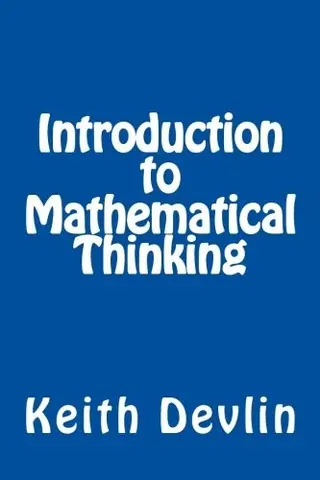
Introduction to Mathematical Thinking
by Keith J. Devlin · first published 2012
89% recommend11% neutral
Why HN recommends it
Gentle on-ramp to proofs and mathematical notation for non-math majors, built around the Coursera course. Starts slowly, then gets harder; suits self-learners heading toward analysis or higher math.
Summarised by Claude from recommending comments
Affiliate links. As an Amazon Associate I earn from qualifying purchases.
Mentions per year
What Hacker News says
Related books
 2014–2023
Aha! Insight
Martin Gardner
Recommended by 4 · mentioned by 64 recommend · 6 mention4 recommend · 64 recommend
 2016–2026
A Programmer's Introduction to Mathematics
Jeremy Kun
Recommended by 24 · mentioned by 3124 recommend · 31 mention24 recommend · 3124 recommend
 2018–2025
The way of analysis
Robert S. Strichartz
Recommended by 3 · mentioned by 63 recommend · 6 mention3 recommend · 63 recommend
 2013–2023
Measure and category
John C. Oxtoby, Oxtoby
Recommended by 3 · mentioned by 33 recommend · 3 mention3 recommend · 33 recommend
Differential and integral calculus
N. Piskunov
Recommended by 3 · mentioned by 33 recommend · 3 mention3 recommend · 33 recommend
Problems in Mathematical Analysis
Boris Demidovich
Recommended by 3 · mentioned by 43 recommend · 4 mention3 recommend · 43 recommend
 2010–2025
Linear algebra with applications
Otto Bretscher
Recommended by 4 · mentioned by 124 recommend · 12 mention4 recommend · 124 recommend
 2010–2024
Real Mathematical Analysis
Charles Chapman Pugh
Recommended by 8 · mentioned by 98 recommend · 9 mention8 recommend · 98 recommend
…analysis (it will certainly help you learn analysis, but might not help too much in your course, since it's quite non-traditional). If you're not used to proof techniques, I highly recommend Keith Devlin's "Introduction to Mathematical Thinking". About strategies to studying analysis: examples. I think it's really important to work out lots of examples by hand all the time. Every time you read a definition in your textbook, whatever it is,…
on “Ask HN: Resources to learn real analysis?” ↗A couple of years ago I did the Introduction to Mathematical Thinking course on Coursera [1]. Even though I found it hard, I enjoyed it and learned a lot, and I feel I got some insight into mathematical though processes. Recommended. [1] https://www.coursera.org/learn/mathematical-thinking
on “Math education: It’s not about numbers, it’s about learning how to think” ↗…Programs at https://htdp.org/ if you want to learn more about how recursion is used in programming and where. For mathematical induction you make read: 1. What is Mathematics by Courant and Robbins 2. Introduction to Mathematical Thinking by Keith Devlin
on “How do I think about recursion in math and programming?” ↗…working through ANY Linear Algebra textbook is going to improve your Linear Algebra skills. In the spirit of OP's question: How to Solve it by G. Polya Solving Mathematical Problems by Terrence Tao Introduction to Mathematical Thinking by Keith Devlin Are all amazing, How to Solve it in particular is an all time classic.
on “Ask HN: Math books that made you significantly better at math?” ↗A lot of people have mentioned Keith Devlin's book "Introduction to Mathematical Thinking" by Keith Devlin but for me his other book "Mathematics: The Science of Patterns" was something that really had a huge impact on me just to put mathematics in perspective. Probably has something to do…
on “Ask HN: Math books that made you significantly better at math?” ↗Introduction to Mathematical Thinking by Keith Devlin https://www.coursera.org/learn/mathematical-thinking? After this I got what math is about:)
on “Ask HN: What's the best lecture series you've ever seen?” ↗At some point I was interested in learning to read and write proofs. I did the "Introduction to Mathematical Thinking" MOOC from Keith Devlin. The curriculum is available as a book as well. The class is basically how to write and read proofs for non-math majors. It starts pretty slow, but gets harder at some point.…
on “Everything You Always Wanted to Know About Mathematics [pdf]” ↗For understanding higher math I have found this primer course extremely useful: Introduction to Mathematical Thinking by Keith Devlin (Stanford) https://www.coursera.org/learn/mathematical-thinking
on “Poor Man's Computer Science Bootcamp – Basics” ↗…book Geometry by Tatiana Alekseyevskaya, learn some Discrete Math (I recommend You the book on the topic by Thomas VanDrunnen), read the other four books in the gelfand series. Learn some logic. Read Introduction to Mathematical Thinking by Keith Devlin. I think at this point You Will able to read some resources o calculus or abstract Algebra. If this seems like a Lot, don't dismay. There was this guy George Green having to take care…
on “Ask HN: How should I structure my mathematics self-teaching?” ↗Some I can recommend that are still available on Coursera: - Introduction to mathematical thinking [1] - Introduction to Mathematical Philosophy [2] - Machine Learning (actually a CS course, but involves linear algebra and some calculus) [3] - Calculus: Single Variable [4] [1] https://www.coursera.org/course/maththink…
on “Curse Of The Gifted (2000)” ↗I did #27 "Introduction to Mathematical Thinking" during Feb-April this year. I enjoyed it a lot and found it challenging without being impossible to complete. Finished with a distinction and a feeling of great satisfaction. I'm now doing Coursera's…
on “List of the Most Popular MOOCs” ↗…undergraduate/college textbooks are actually fine in this regard (like Topics in Contemporary Math by Bello, Britton, and Kaul). As for the rest, some of my favorites: - Warner, Pure Mathematcis for Beginners - Devlin, Introduction to Mathematical Thinking - Stewart, Concepts of Modern Mathematics - Herrmann, Sally, Number, Shape, and Symmetry - Baylis, What is Mathematical Analysis? - Feil, Krone, Essential Discrete Math for Computer Science - Rotman,…
on “Higher Math for Beginners (1987)” ↗Coursera's 'Introduction to Mathematical Thinking' is a great starter course for real Analysis https://www.coursera.org/learn/mathematical-thinking
on “Ask HN: Resources to learn real analysis?” ↗…remember the symbol, but really the issue that everyone has to deal with is figuring out why that term is there which can take much more brainpower. Im not an expert but learned a lot through Coureras Introduction to Mathematical Thinking.
on “How to read a mathematics textbook (2016)” ↗You internalise mathematical notation by using it to solve mathematical problems and express mathematical ideas. Two excellent resources are: 1. Introduction to Mathematical Thinking (if you prefer moocs) - https://www.coursera.org/learn/mathematical-thinking? 2. How to think Like a Mathematican - https://www.amazon.co.uk/How-Think-Like-Mathematician-Underg...
on “Ask HN: Good articles/courses for understanding mathematical notation?” ↗