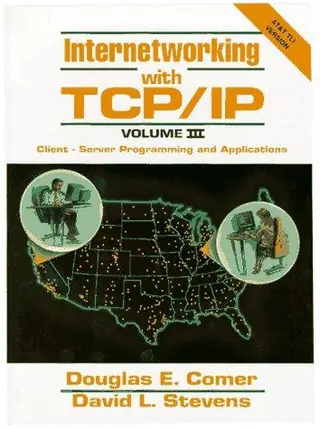
Internetworking with TCP/IP
by Douglas E. Comer, David L. Stevens, Michael Evangelista · first published 1988
71% recommend29% neutral
Why HN recommends it
A clear, theory-focused walk through the TCP/IP protocol suite. It is readable and suits anyone learning networking or needing a solid reference on how the stack works.
Summarised by Claude from recommending comments
This revision of a best-seller provides an in-depth look at the TCP/IP Internet Protocols. It presents a complete implementation showing the internals of the TCP/IP protocol software with actual ANSI C code. Examines the details of individual protocols, their implementation and the internals of protocol software. Contains working source code for most protocols including TCP, IP, ICMP, IGMP, UDP, ARP, RIP, SNMP, and a significant pat of OSPF. Reflects changes in the protocol standards and updates the example code to ANSI standard C. Uses the widely-accepted data-mark interpretation of TCP urgen
Affiliate links. As an Amazon Associate I earn from qualifying purchases.
Mentions per year
What Hacker News says
Related books
 2008–2026
TCP/IP Illustrated
W. Richard Stevens, Kevin R. Fall, Gary R. Wright
Recommended by 58 · mentioned by 8458 recommend · 84 mention58 recommend · 8458 recommend
 2018–2024
An engineering approach to computer networking
Srinivsan Keshav
Recommended by 2 · mentioned by 22 recommend · 2 mention2 recommend · 22 recommend
 2014–2026
High Performance Browser Networking
Ilya Grigorik
Recommended by 58 · mentioned by 6758 recommend · 67 mention58 recommend · 6758 recommend
 2013–2026
The TCP/IP Guide
Charles Kozierok
Recommended by 11 · mentioned by 1211 recommend · 12 mention11 recommend · 1211 recommend
 2012–2026
Computer networking
James F. Kurose, Keith W. Ross
Recommended by 30 · mentioned by 4530 recommend · 45 mention30 recommend · 4530 recommend
 2007–2026
Computer Networks
Andrew S. Tanenbaum, John David Wetherall, David J. Wetherall, Nickolas Feamster
Recommended by 50 · mentioned by 10450 recommend · 104 mention50 recommend · 10450 recommend
TCP/IP Illustrated, Volume 1
Kevin Fall, W. Richard Stevens
Recommended by 17 · mentioned by 2617 recommend · 26 mention17 recommend · 2617 recommend
 2009–2026
Unix Network Programming
W. Richard Stevens, Bill Fenner, Andrew M. Rudoff, Richard W. Stevens
Recommended by 54 · mentioned by 6954 recommend · 69 mention54 recommend · 6954 recommend
…exercise). Also, I can never recommend Computer Systems: A Programmer's Perspective[1] enough. (Also features a rare mistakes in an exercise or two, but that's detail.) And for network protocols, Comer's Internetworking with TCP/IP[3] was just great (you only need volume 1). I've read Stevens' books on socket and IPC programming in Unix, but didn't like them, so I also stayed away from TCP/IP Illustrated, but others have different…
on “Ask HN: I'm looking for a good book on the fundamentals of CS” ↗…Greenspun's stuff was what convinced me that software was actually worth doing, and the reading list was great: SICP, Learning Emacs, Fogel's CVS book (hey, that's all they had in the elder days... :), Internetworking with TCP/IP, SQL for Smarties, Tufte, etc.
on “Ask YC: How many people here have a degree and are programmers?” ↗Computer Networking, A systems approach. A great book. Highly recommended. http://www.amazon.com/Computer-Networks-Third-Approach-Netwo... Of course, one of the classics is this one: Internetworking with TCP/IP vol. 1. http://www.amazon.com/Internetworking-TCP-Vol-1-Principles-A... Edit: If you are considering Linux, then the implementation is discussed here. I would not suggest this, unless you are actually…
on “Ask HN: Good (computer) networking books?” ↗…once did some research on networking and related stuff - it was not my primary topic, but I remember a few things. During my reading, I found one of the best (as in readable) books was Doug Comer's "Internetworking With TCP/IP vol. 1" - an excellent theoretical reference. [1] However, skip the other volumes from Doug Comer (I think there are 3 volumes). For writing practical applications, Richard Stevens' "Unix Network Programming"…
on “Bottleneck Bandwidth and RTT” ↗Internetworking with TCP/IP by Dr. Douglas Comer.
on “Ask HN: What's the best computer science book you've read recently?” ↗…never clicked for me before I learned about the protocols themselves first. My brain just rejected using an API for something I didn't understand. So if you're like me, I highly recommend reading Comer's "Internetworking with TCP/IP" first, and sitting down to socket programming later.
on “Beej's Guide to Network Programming (1994-2020)” ↗The rest of the stack. Spend some time with layers 3&4 and you won't regret it. It was the most boring class I has in school and I use it every day. Read this book: http://goo.gl/ZGifKa (Internetworking with TCP/IP Vol.1: Principles, Protocols, and Architecture (4th Edition)). Knowing how TCP/IP works will give you an edge over other devs for understanding data movement and endear you to the IT/network/security…
on “Ask HN: I have 10 months to spend. What should I learn?” ↗I actually can't find the book you are referencing. I do see: "Operating System Design: The Xinu Approach" and also the books "Internetworking with TCP /IPvolumes1-3." Might you have a link to the title you are referencing here? I have read the Internetworking series which is excellent.
on “Let's code a TCP/IP stack, 1: Ethernet & ARP (2016)” ↗Doug Comer's "Internetworking with TCP IP" volumes 1&2. Walks you through the protocol suite along with the implementation of a simple stack in C. https://www.cs.purdue.edu/homes/comer/netbooks.html Richard Steven's "TCP/IP Illustrated" books…
on “TCP is harder than it looks” ↗Everyone who downvoted my comment needs to pick up and read a copy of Comer's "Internetworking with TCP/IP". That and Stevens' TCP/IP Illustrated are the best sources for networking out there. You won't find the info on any blog. It won't be in something on ServerFault or StackOverflow and definitely not HN.…
on “Filter all ICMP and watch the world burn” ↗Nice list. I was just leafing through Internetworking with TCP/IP Vol 2 by Comer. Excellent book and a good one to add to your list. A bit old now, with non-ANSI C code, but still very interesting!
on “Ask HN: What technical books are you reading?” ↗I was just going to say the same - I learned basic networking and the TCP/IP stack with Comer's first edition of Internetworking with TCP/IP. His way of explaining it just clicked with me.
on “A TCP/IP Tutorial (1991)” ↗This, and any book by W. Richard Stevens. I also cut my teeth on Internetworking with TCP/IP by Comer. https://www.amazon.com/Internetworking-TCP-IP-One-6th/dp/013...
on “Ask HN: Good books/courses to learn networking essentials for web developers?” ↗…itself), this is an essay by Douglas Comer from January 2009 -- according to the HTTP header, at least, which I'm inclined to trust given the system. If that name's familiar but you're not sure why, he wrote Internetworking with TCP/IP.
on “How to Insult a Computer Scientist” ↗…the advent of digital books[1] transformed my 積ん読 from a huge and ugly pile of heavy artifacts — that ultimately had to be sold at a yard sale in 2005 ($1 for all 3 gigantic hardback volumes of Comer's Internetworking with TCP/IP!!), with the remainder ending up in a landfill — into an invisible, weightless trove of knowledge and entertainment. I haven't bought a paper book since I bought a paperback copy of Zen and the Art of…
on ““Tsundoku,” the Japanese Word for the New Books That Pile Up on Our Shelves” ↗