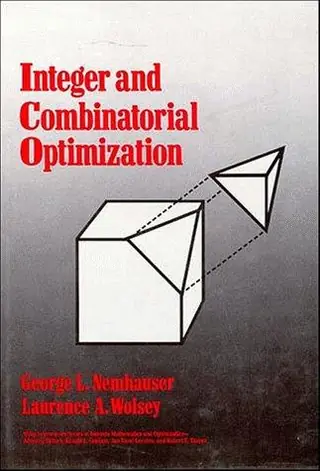
Integer and combinatorial optimization
by George L. Nemhauser · first published 1988
8mentions
2recommended by
4HN commenters
2013–2022first – last mentioned
50% recommend50% neutral
"A unifying approach to optimization problems is to formulate them like linear programming problems, while restricting some or all of the variables to the integers. This book is an encyclopedic resource for such formulations, as well as for understanding the structure of and solving the resulting integer programming problems."--Computing Reviews.
Affiliate links. As an Amazon Associate I earn from qualifying purchases.
…research optimization is enormous, going back to the 1950s. The best of that literature is quite well written. For combinatorial optimization, there is George L. Nemhauser and Laurence A. Wolsey, 'Integer and Combinatorial Optimization', ISBN 0-471-35943-2, John Wiley & Sons, Inc., New York, 1999. The details of optimization are not always trivial, and several fairly challenging graduate applied math courses, complete with non-trivial…
on “Google Optimization Tools” ↗…textbooks I liked much, for theory. If you're interested in discrete optimization too (the other half of math optimization), the classics are: "Optimization Over Integers" by Bertsimas & Weismantel "Integer and Combinatorial Optimization" by Nemhauser & Wolsey
on “Ask HN: Literature for mathematical optimization?” ↗…on how far are away from an optimal solution; such duality theory is what yielded the bound of 0.025% above. For combinatorial optimization there is, say, George L. Nemhauser and Laurence A. Wolsey, 'Integer and Combinatorial Optimization', ISBN 0-471-35943-2, John Wiley & Sons, Inc., New York. William J. Cook, William H. Cunningham, William R. Pulleyblank, and Alexander Schrijver, 'Combinatorial Optimization', ISBN 0-471-55894-X, John…
on “Discrete Optimization course begins today” ↗…techniques are indeed very successful in practice and I hope that you will also enjoy these lectures. They make up a third of the class. The references Integer Programming by Laurence A. Wolsey Integer and Combinatorial Optimization by Laurence A. Wolsey, George L. Nemhauser Large Scale Linear and Integer Optimization: A Unified Approach by Richard Kipp Martin Introduction to Linear Optimization by Dimitris Bertsimas, John…
on “Discrete Optimization course begins today” ↗…Disclosure: Minty was one of my professors. Since I have mentioned integer linear programming, I should include a reference, e.g. (with my TeX markup) George L.\ Nemhauser and Laurence A.\ Wolsey, {\it Integer and Combinatorial Optimization,\/} ISBN 0-471-35943-2, John Wiley \& Sons, Inc., New York, 1999.\ \ Disclosure: At one time Nemhauser gave me three words of advice, and that was the main direction for my Ph.D. dissertation. Yes,…
on “My 2019 Mathematics a to Z: Linear Programming” ↗…Tsitsiklis. Introduction to linear optimization. Vol. 6. Belmont, MA: Athena Scientific, 1997. [6] L.A. Wolsey (1998). Integer programming (Vol. 42). New York: Wiley. [7] L.A. Wolsey, G.L. Nemhauser. Integer and combinatorial optimization. John Wiley & Sons; 2014 Aug 28. [8] M. Conforti, G. Cornuéjols, G. Zambelli (2014). Integer programming (Vol. 271). Berlin: Springer.
on “Linear Programming: How Does It Work?” ↗…at Johns Hopkins on designing a large IP network, e.g., a big chunk of the Internet. Yes, it's a big problem in 'combinatorial' optimization as in, say, George L. Nemhauser and Laurence A. Wolsey, 'Integer and Combinatorial Optimization', ISBN 0-471-35943-2, John Wiley & Sons, Inc., New York, 1999. Yes, these problems are apparently the original motivations for the question of P versus NP. At times companies have tried to attack this…
on “Industrial Mathematics” ↗…the now old work of G. Nemhauser. His work was for combinatorial optimization and not just for exactly the traveling salesman problem (TSP). E.g., there is George L. Nemhauser and Laurence A. Wolsey, Integer and Combinatorial Optimization, ISBN 0-471-35943-2, John Wiley & Sons, Inc., New York, 1999. Some approaches involve set covering and set partitioning. Soooo, for the FedEx fleet, first just generate all single airplane feasible…
on “Transformers, originally designed to handle language, are taking on vision” ↗