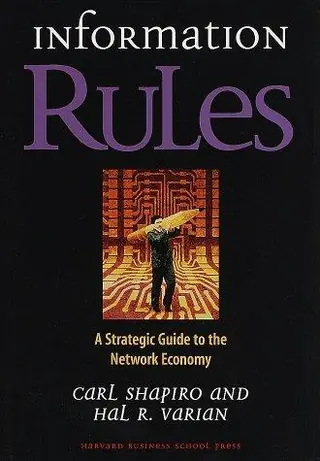
Information rules
by Carl Shapiro, Hal R. Varian · first published 1998
67% recommend33% neutral
Why HN recommends it
Explains how markets behave when marginal cost is near zero: pricing and segmentation, lock-in, network effects, and complements. Suits software and tech people wanting an economic framework for strategy.
Summarised by Claude from recommending comments
How businesses can handle the economic transition from atoms to bits.
Affiliate links. As an Amazon Associate I earn from qualifying purchases.
Mentions per year
What Hacker News says
Related books
 2007–2019
The wealth of networks
Yochai Benkler
Recommended by 4 · mentioned by 94 recommend · 9 mention4 recommend · 94 recommend
 2007–2026
Plowing the dark
Richard Powers
Recommended by 3 · mentioned by 53 recommend · 5 mention3 recommend · 53 recommend
 2007–2022
Bargaining for advantage
G. Richard Shell
Recommended by 18 · mentioned by 2318 recommend · 23 mention18 recommend · 2318 recommend
 2007–2026
A Book of Five Rings
Miyamoto Musashi
Recommended by 21 · mentioned by 5021 recommend · 50 mention21 recommend · 5021 recommend
 2007–2025
The mysterious island
Jules Verne
Recommended by 32 · mentioned by 5132 recommend · 51 mention32 recommend · 5132 recommend
 2007–2025
The Innovator's Solution
Clayton M. Christensen
Recommended by 22 · mentioned by 3922 recommend · 39 mention22 recommend · 3922 recommend
 2007–2025
Made to stick
Chip Heath, Dan Heath, ʻAlizah Raʻanan
Recommended by 70 · mentioned by 8670 recommend · 86 mention70 recommend · 8670 recommend
 2008–2026
The goal
Eliyahu M. Goldratt, Jeff Cox, Ensemble cast, Dwight Jon Zimmerman
Recommended by 85 · mentioned by 12085 recommend · 120 mention85 recommend · 12085 recommend
…article. Demand-side scaling is one approach to lock-in. Others include APIs, open/closed data policies, utility, interaction with other services, ease-of-use, and more. Hal Varian and Carl Shapiro's Information Rules is a far more complete look at various elements of lock in from both a provider and consumer perspective. http://www.powells.com/biblio?isbn=978-0875848631
on “The only barrier to entry you should care about” ↗…goods I meant that they still require paper and shipping and retailing and such, but it's probably just a bad use of the term.) There's a fantastic book about the economics of information goods called "Information Rules" ( https://www.amazon.com/dp/087584863X ). Software is an information good so this covers some topics relevant to the digital economy. My favorite part is the chapter on lock-in. In particular the…
on “Google is transforming public education with low-cost laptops and free apps” ↗I like the book Information Rules by Shapiro and Varian as a review of these kinds of concepts in general. I don't think it is necessary to even view these topics as strategy, to a certain extent it is just the nature of the incentives…
on “Laws of Tech Economics: Commoditize Your Complement” ↗> network-effect kool-aid It's not just hand waving. I'd recommend the book by Varian (now Google's chief economist) and Shapiro, "Information Rules". Of course, the strength of "network effects" may be exaggerated in some cases. In others (eBay), they most certainly aren't.
on “Pmarca: If Microsoft goes fully hostile on Yahoo” ↗This textbook is free on line, and as far as I can tell is fairly "standard" economics: http://www.introecon.com/ One that is very relevant to our field is "Information Rules" by Varian and Shapiro. I can't recommend it enough. Definitely look for standard stuff and get that figured out before you go looking at mises.org or marxist.org or whatever. Those guys definitely…
on “What went wrong with economics” ↗…nearly zero means that the chance of hitting a few out of the park justifies a whole bunch of expensive flops. Yep. If you're interested in the economics of our field, I can't help but recommending 'Information Rules' ( http://www.amazon.com/dp/087584863X?tag=dedasys-20 ). One of the co-authors is now the chief economist at Google.
on “Ask HN: Are you a single founder ?” ↗…couldn't be more dry and boring, but after that the economic discussion in the book about how economics changes when the marginal cost of product reaches zero or near-zero is fascinating. Hal Varian's "Information Rules" -- This book covers the same ground at Yochai's book, but is less academic in tone. FYI, Varian is Google's chief economist.
on “Ask HN: What is the best Economics read?” ↗…lot and get big fast (acquire users), otherwise you'll get run over by competitors. The only way to win is with VC. Read up on first mover advantage and network effects. In fact, just buy Varian's Information Rules.
on “Ask HN: If a startup is looking for investments is because can't generate money?” ↗Studied economics in college. The two books we read on information economics were Rethinking the Network Economy by S J Liebowitz and Information Rules by Varian and Shapiro. I found Information Rules to be the superior text. They are both around 10 years old however, something more current may be more desirable.
on “Ask HN: Good books on Information Economics?” ↗If you're interested in the economics of tech, this is one of my favorite books: Information Rules: A Strategic Guide to the Network Economy - http://amzn.to/2hKFpwW One of the authors, Varian, is now Google's Chief Economist, so they must think highly of him too. The book is a bit older, but like…
on “W. Brian Arthur popularized an economic theory that changed Silicon Valley” ↗…The book I cited, Slauter's Who Owns the News?, gives a great history of English law from before the Statute of Anne. For a view from the Internet era back, on an economics angle, Shapiro and Varian's Information Rules is a great read. For a more nuanced view from those who lean open, James Boyle's books are all worthwhile. The author is, as it happens, an open-leaning intellectual property lawyer.
on “License Zero: Comments on “The Truth Is Paywalled but the Lies Are Free”” ↗…at the beginning and end - it makes it sound like a simpson's parody of a news show. The point about looking at things that don't change is good though, it's one of the things that Hal Varian says in "Information Rules", which is, by the way, an excellent book about economics.
on “Tim O'Reilly's Recent Interview with Jeff Bezos on S3, EC2, and 37Signals (video)” ↗"Information Rules" by Carl Shapiro and Hal R. Varian "Getting to Yes" by Roger Fisher, William Ury, and Bruce Patton
on “What business or strategy books do you read to keep you on course” ↗…understanding what happens why is crucial to being able to do a 'DHH style' company that doesn't get crushed by a big player, or undercut by a bit of open source software. I highly recommend the book 'Information Rules': http://www.amazon.com/dp/087584863X?tag=dedasys-20
on “YC Analysis: "37signals/DHH style" companies?” ↗Information Rules is an excellent book going into details of how markets work in information economies where the marginal cost of a product is near-zero. It covers segmentation, lock-in, network effects, etc. ( http://www.amazon.com/dp/087584863X/…
on “Microsoft to Limit Capabilities of Cheap Laptops” ↗