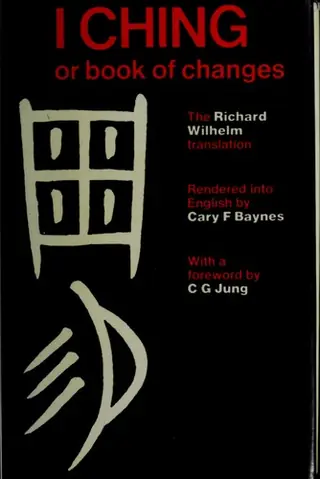
I Ching
or, Book of Changes
by Richard Wilhelm, Cary F. Baynes, Carl Gustav Jung · first published 1950
21% recommend72% neutral6% critical
Why HN recommends it
This translation includes annotations and a foreword by Jung. It serves as an introduction to Chinese thought and the oracle's approach to change, and suits newcomers to Taoist philosophy.
Common criticism: Some critics dismiss the book's mystical reputation as overhyped by its fans.
Summarised by Claude from recommending comments
A translation of the early document of Chinese philosophy with explanatory notes.
Affiliate links. As an Amazon Associate I earn from qualifying purchases.
Mentions per year
What Hacker News says
Related books
Mind magic
Bill Harvey
Recommended by 1 · mentioned by 21 recommend · 2 mention1 recommend · 21 recommend
 2009–2026
The Man in the High Castle
Philip K. Dick
Recommended by 25 · mentioned by 7625 recommend · 76 mention25 recommend · 7625 recommend
Records of the Grand Historian
(Xi Han)Si Ma Qian
Recommended by 2 · mentioned by 82 recommend · 8 mention2 recommend · 82 recommend
 2009–2026
The Tao of Pooh
Benjamin Hoff, Ernest H. Shepard, A. A. Milne
Recommended by 28 · mentioned by 4128 recommend · 41 mention28 recommend · 4128 recommend
 2013–2026
The Dice Man
Luke Rhinehart
Recommended by 9 · mentioned by 199 recommend · 19 mention9 recommend · 199 recommend
…hubristic titles I've ever seen in "The Gospel According to Jesus"). I agree with your main point. Not only has much come West, much of value has come West. For example, I consider the Wilhelm-Baynes I Ching to be a masterpiece. Our civilization -- heck, my life -- has improved immeasurably by exposure to the Sanskrit and Chinese classics. On the narrower point of California Buddhism and similar spiritual…
on “The Best Goal is No Goal” ↗…way of embedding images and live representations of data) that goes way beyond this and any other Lisp REPL I've seen, so let's not get too smug. On another note, it's a pleasure to see a bit of the I Ching in there - in the classic Wilhelm/Baynes edition, no less. It is one of the greatest works of civilization. (As for Wilhelm/Baynes: how a translation of a translation could have turned out so well is…
on “Can your REPL do this?” ↗…get depressed that it is pretty damn hard to catch up with everything that I want to read. My list would be too long to post, but these are the ones next in line: - Meditations - Digital Minimalism - I Ching - Art of War - Tao Te King - Steppenwolf - Think and grow rich In general want to focus on books of: business, leadership, self development, productivity and spiritualism (mostly buddhism).
on “Ask HN: Books you plan to read in 2020?” ↗…as I re-read it with additional experience in some of the engineering and organizational disciplines it touches. Sad as it is, it's got a little bit of everything. It's definitely got my vote for the I Ching of critical systems engineering. Spend the time. Chances are you'll remember it.
on “Hands-on Assignment – Therac-25 (2007)” ↗…the classical text is always shown first, fully intact. Built it because I wanted something that treated the tradition seriously. Carl Jung wrote the foreword to this exact translation and credited the I Ching with shaping his theory of synchronicity.
on “I built a free I Ching oracle web app” ↗…understanding why. - A Tractate on Japanese Aesthetics by Donald Richie. This is a fairly recent book but it serves as an excellent introduction to East Asian and Japanese thought via art and aesthetics. - I Ching. The Chinese classic is super easy to read and is diametrically opposite to the static, eternal universal Platonic model much of Western thought it built upon. - You should also probably read something…
on “So You Want to Study Philosophy” ↗I strongly recommend this translation of the I Ching https://apps.apple.com/gb/app/i-ching-book-of-changes/id4381...
on “How Taiwan’s Digital Minister solved a mask supply problem” ↗…as I dwelled deeper into the material. I have actually read a good copy of Sun Tzu already. And after having looked briefly at the sight, I decided to dwell no further into the subject. I recommend I'Ching translated by Richard Herman, if it has been retranslated into english.
on “Comparing English Translations of Sun Tzu's The Art of War” ↗…part, but it's certainly wrapped up in the move towards narrowly scientific thinking. Or as Nietzsche would put it, we're too Apollonian and not enough Dionysian. FWIW I'm also fond of the Tarot, and the I Ching, and find both surprisingly insightful and useful (me of 10 years ago would not believe that I just wrote that).
on “Audiophile forum debating which versions of memcpy had the highest sound quality (2013)” ↗…understanding why. - A Tractate on Japanese Aesthetics by Donald Richie. This is a fairly recent book but it serves as an excellent introduction to East Asian and Japanese thought via art and aesthetics. - I Ching. The Chinese classic is super easy to read and is diametrically opposite to the static, eternal universal Platonic model much of Western thought it built upon. - You should also probably read something…
on “Ask HN: How do I get started in philosophy” ↗…alone English) and really helps you get how different the thought really is while still keeping the originals poetic quality. [0] I recommend his translations of the inner Chuang Tzu chapters and the I-Ching, as well as his book China Root.
on “How scientists are bringing advanced meditation out of the monastery” ↗…Thomas Cleary is another neat collection of translations that cover a broad range of Taoist thought with decent of annotations to help you understand. And finally, I'd recommend grabbing a copy of the I-Ching (I like David Hinton's translation) and some Taoist T'ang dynasty poets (Li Bo or Li Bai is a good one to start with) to round it all out. I've found that reading relevant poetry helps me put the philosophical…
on “Daoist History” ↗The biggest one for me was Richard Wilhelm's translation (with annotations -- the annotations are really important) of the Tao Te Ching. Following that, the same translator's work on the I Ching. (Sorry for the potentially weird transliteration -- I never know what to do for Chinese!) My own interpretation is that while we can say "I think therefore I am" you can't really prove anything else.…
on “Ask HN: What books changed the way you think about almost everything?” ↗…are or would be interested in him, but if posts about the likes of C.G. Jung ever became prominent here (which they won't), they'd get ripped to shreds. If you doubt that, go read his foreword to the I Ching. Personally, I think Jung is fascinating and his ideas in some ways are attractive, though I could never figure out how to actually make use of his writings.
on “The Holy Grail of the Unconscious” ↗Carl Jung addressed the root issue -- pyschological taboos -- in his introduction to the Wilhelm translation of I Ching. " The I Ching insists upon self-knowledge throughout. The method by which this is to be achieved is open to every kind of misuse, and is therefore not for the frivolous-minded and immature; nor is it…
on “Audiophile forum debating which versions of memcpy had the highest sound quality (2013)” ↗