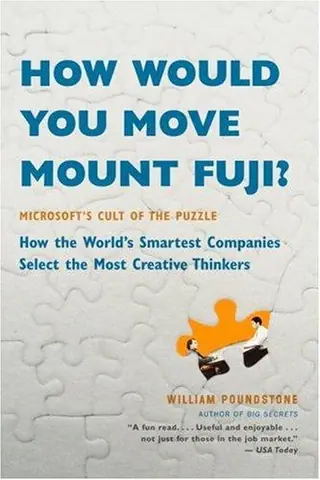
How would you move Mount Fuji?
Microsoft's Cult of the Puzzle -- How the World's Smartest Companies Select the Most Creative Thinkers
by William Poundstone · first published 2003
44% recommend50% neutral6% critical
Why HN recommends it
Covers the history and logic of brainteaser-style interview puzzles, including IQ testing and Microsoft's hiring practices; recommended for job seekers and anyone curious about how companies use puzzles.
Summarised by Claude from recommending comments
For years, Microsoft and other high-tech companies have been posing riddles and logic puzzles like these in their notoriously grueling job interviews. Now "puzzle interviews" have become a hot new trend in hiring. From Wall Street to Silicon Valley, employers are using tough and tricky questions to gauge job candidates' intelligence, imagination, and problem-solving ability -- qualities needed to survive in today's hypercompetitive global marketplace. For the first time, William Poundstone reveals the toughest questions used at Microsoft and other Fortune 500 companies -- and supplies the answ
Affiliate links. As an Amazon Associate I earn from qualifying purchases.
Google is like Microsoft 20 years ago. Everybody should read "How Would You Move Mount Fuji" -- a detailed book on the topic of IQ, puzzles, and job interviews. http://www.amazon.com/How-Would-Move-Mount-Fuji/dp/031677849... Microsoft has, of late, moved away from these sorts of questions…
on “Crazy Questions at Google Job Interview” ↗There is a book that has some of the same questions, and a lot more. It's "How would you move Mount Fuji" by William Poundstone (http://www.amazon.com/Would-Move-Mount-Microsofts-Puzzle/dp/...). As stated in some of the comments already posted, asking this kind of questions in interviews is by now "deprecated"…
on “Google Interview Questions” ↗Terman and IQ are also mentioned in "How Would You Move Mount Fuji" (http://www.amazon.com/How-Would-Move-Mount-Fuji/dp/031677849...). I recommend it to anyone interested in brainteasers and how Microsoft and a lot of other companies use them during the interviewing…
on “Does having a high IQ make you less creative?” ↗…culture (if you can, it's almost impossible for small companies) and then prep for the interview at hand. I guess that falls under "motivated enough" :) If you want to be prepared in a general sense, get "How would you move Mount Fuji", a book on those interview puzzlers. The upside of most of those puzzles is that the answer is blindingly obvious once you read it the first time. So read that book, and you're done ;)
on “Being recruited in the USA” ↗I'm familiar with other books by the author of How would you move Mount Fuji? Thanks for that book suggestion. I have just requested the book from my county library system for use in updating my FAQ document for posting on my personal website.
on “Dear Startups: stop asking me math puzzles to figure out if I can code” ↗I have seen a few google questions, and feel they are good quality, and nothing like the quoted question. I suspect google learned from the points rasied in thr book "how would you move mount fuji" (a now famous microsoft question). The book is well researched and has some well thoughtout advice at the back. The quoted question looks like an old microsoft question, but, I might be wrong.
on “Developers: What do you consider a 'good' interview question?” ↗If you like this type of puzzle, I can recommend the book: “How Would You Move Mount Fuji?: Microsoft's Cult of the Puzzle”.
on “The pirate game” ↗It started a long time ago. See the 2004 book "How Would You Move Mount Fuji?: Microsoft's Cult of the Puzzle -- How the World's Smartest Companies Select the Most Creative Thinkers" https://www.amazon.com/How-Would-Move-Mount-Fuji/dp/03167784... which discusses the use of these…
on “I Hate Puzzles: Am I Still a Programmer? (2011)” ↗There’s a whole book on Microsoft’s hiring brainteasers, appropriately from 2004 right around when the practice was waning and brainteasers started to get a bad reputation: How Would You Move Mount Fuji?: Microsoft's Cult of the Puzzle (https://www.amazon.com/dp/0316778494)
on “That time when I failed the Microsoft interview” ↗Years ago, I read a book titled How Would You Move Mount Fuji? [0] about the cult of Fermi Questions [1]. These are questions where you're looking for an order of magnitude. The cult of Fermi Questions in Silicon Valley started with William Shockley [2] using them…
on “That time when I failed the Microsoft interview” ↗I remember when I was prepping for my Microsoft interview. There was so much lore online as to the types of questions they'd ask and how to prepare. I even found 'How Would You Move Mount Fuji?' in the library and started reading through it. It was an absolute waste of time as I, fortunately, learned weeks before the interview. As an example, one of the questions I was asked was 'how would…
on “Why we don't hire programmers based on puzzles and tricks” ↗No, they sound an awful lot like old Microsoft interview questions -- in particular, ones collected in a book called How Would You Move Mount Fuji? I wrote an article about the book for Wired News back in 2003...: http://www.wired.com/culture/lifestyle/news/2003/06/59366
on “Google interview questions - fun brain teasers” ↗I'm not sure if I'm replying to what you're asking, but if you read "How would you move Mount Fuji", the beginning of that book discredits IQ tests.
on “Dear Startups: stop asking me math puzzles to figure out if I can code” ↗A few of those are from the 2003 book "How Would You Move Mount Fuji?" which is about Microsoft interviews. They are part of Silicon Valley/Seattle lore, but likely no longer used.
on “What Does It Take To Get A Job At Google? (Infographic)” ↗I hate to tell everyone this, but this isn't new. It's been this way for 25+ years. This is just a new form. There were the "brain teaser" questions in the late 90's (How Would You Move Mount Fuji), and then there was the whiteboard coding (reverse a linked list). It's always been this way, and IMO it's stupid, but there will always be companies that do this. I've been discounted, because even…
on ““I've had to relearn coding to get through the new interviews”” ↗