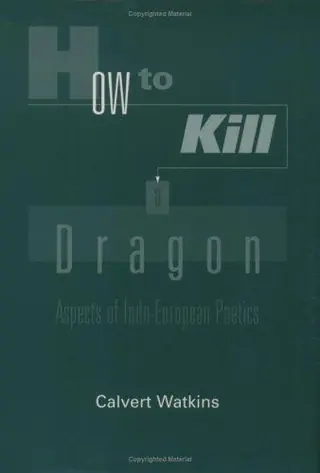
How to kill a dragon
by Calvert Watkins · first published 1995
4mentions
2recommended by
4HN commenters
2019–2026first – last mentioned
50% recommend50% neutral
In How to Kill a Dragon Calvert Watkins follows the continuum of poetic formulae in Indo-European languages, from Old Hittite to medieval Irish. He uses the comparative method to reconstruct traditional poetic formulae of considerable complexity that stretch as far back as the original common language. Thus, Watkins reveals the antiquity and tenacity of the Indo-European poetic tradition.
Affiliate links. As an Amazon Associate I earn from qualifying purchases.
…language family), but you're dead on, it was only in the 1930s or so Milman and Parry documented oral composition of stories in Eastern Europe, with tape recorders of the time iirc The Cal Watkins book "How To Kill A Dragon" is superb for a discussion of formulae in Indo-European languages
on “Wine-dark sea” ↗Check out "How to Kill a Dragon" by Calvert Watkins (1995) https://en.m.wikipedia.org/wiki/How_to_Kill_a_Dragon
on “Phylogenetic analyses uncover ancient roots of Indo-European folktales (2016)” ↗…riddle to solve, no real riddle that the machine has hidden in the words. When reading the above hymn, whether in sanskrit or English, whether it's me or an indologist like Jamison or Watkins (who wrote "How to Kill a Dragon" on Indo-European poetics), we are trying to imagine the same thing the original writer had imagined. In case of LLM, it's just a sequence of words that sounds cool. It may have no meaning.
on “LLM poetry and the "greatness" question: Experiments by Gwern and Mercor” ↗…it, know that it's OK to skip the minutiae of pottery shards.) A slightly older but enduringly popular work is In Search of the Indo-Europeans: Language, Archaeology, and Myth (Mallory 1989). I'm told How to Kill a Dragon: Aspects of Indo-European Poetics (Watkins 1995) is very good too, but I have not read it myself. Chapter 2 of Indo-European Language and Culture: An Introduction (Fortson 2004) is a very good summary…
on “OpenAI to become for-profit company” ↗