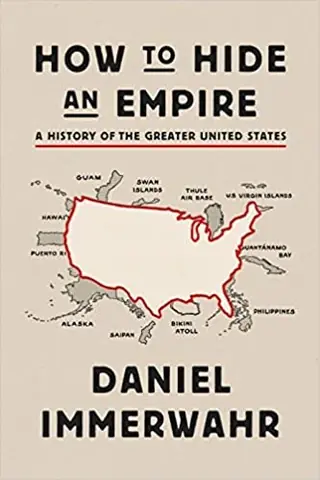
How to Hide an Empire
A History of the Greater United States
by Daniel Immerwahr, María Luisa Rodriguez Tapia · first published 2019
71% recommend29% neutral
Why HN recommends it
Readable, well-researched history of the wider US territorial empire, covering overseas holdings like the Philippines and how 20th-century technology reshaped imperial power; recommended for readers new to the topic.
Summarised by Claude from recommending comments
We are familiar with maps that outline all fifty states. And we are also familiar with the idea that the United States is an “empire,” exercising power around the world. But what about the actual territories―the islands, atolls, and archipelagos―this country has governed and inhabited? In How to Hide an Empire, Daniel Immerwahr tells the fascinating story of the United States outside the United States. In crackling, fast-paced prose, he reveals forgotten episodes that cast American history in a new light. We travel to the Guano Islands, where prospectors collected one of the nineteenth cent
Affiliate links. As an Amazon Associate I earn from qualifying purchases.
Mentions per year
What Hacker News says
Related books
 2009–2026
Understanding Power
Noam Chomsky, Peter R. Mitchell, John Schoeffel
Recommended by 27 · mentioned by 4327 recommend · 43 mention27 recommend · 4327 recommend
 2015–2026
Dark Forest
Cixin Liu, Joel Martinsen
Recommended by 36 · mentioned by 9536 recommend · 95 mention36 recommend · 9536 recommend
 2017–2026
Why We Sleep
Matthew P. Walker, Matthew Walker
Recommended by 202 · mentioned by 378202 recommend · 378 mention202 recommend · 378202 recommend
 2007–2026
Animal Farm
George Orwell
Recommended by 105 · mentioned by 407105 recommend · 407 mention105 recommend · 407105 recommend
 2007–2026
The Diamond Age
Neal Stephenson
Recommended by 284 · mentioned by 596284 recommend · 596 mention284 recommend · 596284 recommend
There's a great book by Daniel Immerwahr on the subject: How to Hide an Empire (https://www.amazon.com/How-Hide-Empire-History-Greater/dp/03...).
on “Napoleon’s Vision for a New Imperial Rome” ↗…felt that Greg Grandin's Myth of the Frontier was actually the second-best counter-narrative to the standard accounts of American relations with its neighbors published in 2019. The most interesting was How to Hide an Empire by Daniel Immerwahr: https://www.nytimes.com/2019/02/13/books/review-how-to-hide-... One of the more interesting sections for the Hacker News crowd is how technological advancements in World War II like…
on “2020 Pulitzer Prize Winners” ↗…is called America, seemingly excluding Canada, Central America, South America. And a fact that I didn't know until recently was that the Philippines prior to WW II was part of the United States. See "How to hide an empire" by Daniel Immerwahr: https://www.amazon.com/How-Hide-Empire-History-Greater/dp/03...
on “The Kivaloo Data Store” ↗It is indeed an empire. Two good books: [1] How to Hide an Empire: A History of the Greater United States by Daniel Immerwahr https://www.amazon.com/How-Hide-Empire-History-Greater/dp/03... [2] Understanding Power by Noam Chomsky https://www.amazon.com/Understanding-Power-Indispensible-Cho...
Many of these are addressed in the book 'Understanding Power' by Noam Chomsky. It's very readable. It's got hefty footnotes that are available as pdf [1]. Another book is 'How to Hide an Empire' by Daniel Immerwahr. [1] http://understandingpower.org/
on “The Girl in the Kent State Photo” ↗For anyone interested: the article mentions “How to Hide an Empire” by Daniel Immerwahr. It's a very well-written and well-researched book -- Immerwahr does a great job creating a narrative from all the historical events in the book. The reason I mention it here is because…
on “Guam: The America That Americans Forget” ↗…Capitalism: How Big Tech and Big Content Captured Creative Labor Markets and How We'll Win Them Back” by Cory Doctorow, Rebecca Giblin “Range: Why Generalists Triumph in a Specialized World” by David Epstein “How to Hide an Empire: A History of the Greater United States” by Daniel Immerwahr (this one prompted by honeymooning in Panama and learning the US used to control the canal)
on “Ask HN: Books you read in 2023 and recommend for 2024” ↗> as long as the money can keep flowing I think you answered your own question there. But then, this was true before history ended too. I strongly recommend "How to Hide an Empire" by Daniel Immerwahr - it's an easy and fascinating read.
on “The impact of Orwell's "Homage to Catalonia" on Noam Chomsky's path to anarchism” ↗How to Hide an Empire: a short history of the greater United States. It includes an excellent discussion of how technological advancements in the 20th century (such as synthetic rubber, airplanes, and radio) changed the physical…
on “Ask HN: What Are You Reading?” ↗The borders were continuously shifting, but they did stay somewhat near a focal point for centuries. The US meanwhile has an overseas empire for honestly no good reason. Highly recommend the book “How to hide an empire” which talks about the American version of colonialism.
Yes even going back to Pearl Harbor, President Roosevelt rewrote his drafts of his speech to obscure the fact that the Philippines, a major site of the attack, was also a US colony. "How to Hide an Empire", Daniel Immerwahr https://www.youtube.com/watch?v=ZaKOOqXDnqA
on “The Assange case is collapsing but it remains a travesty of justice” ↗OP here. Please note that this piece is a review of Daniel Immerwahr's book, "How to Hide an Empire: A History of the Greater United States".
on “How to Hide an Empire: A History of the Greater United States” ↗…own country’s imperial past. “One of the truly distinctive features of the United States’ empire is how persistently ignored it has been,” the historian Daniel Immerwahr writes in his introduction to How to Hide an Empire: A History of the Greater United States, his new book on the United States’ overseas empire. Triumphalist accounts of the U.S.’s rise to superpower status usually begin with World War II: Pearl Harbor…
on “How to Hide an Empire: A History of the Greater United States” ↗I learned from the book "How to Hide an Empire" that an initial motivation for US imperialism in the Caribbean was to harvest bird droppings for fertilizer, even to the point of conflicts with Britain and Venezuela: https://www.vox.com/2014/7/31/5951731/bird-shit-imperialism…
on “Pigeon Towers: A Low-Tech Alternative to Synthetic Fertilizers (2016)” ↗