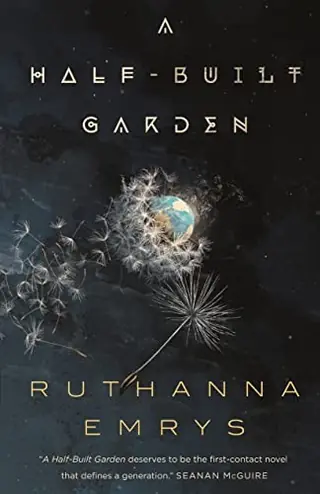
Half-Built Garden
by Ruthanna Emrys · first published 2022
50% recommend25% neutral25% critical
On a warm March night in 2083, Judy Wallach-Stevens wakes to a warning of unknown pollutants in the Chesapeake Bay. She heads out to check what she expects to be a false alarm—and stumbles upon the first alien visitors to Earth. These aliens have crossed the galaxy to save humanity, convinced that the people of Earth must leave their ecologically-ravaged planet behind and join them among the stars. And if humanity doesn't agree, they may need to be saved by force. The watershed networks aren't ready to give up on Earth. Decades ago, they rose up to exile the last corporations to a few artif
Affiliate links. As an Amazon Associate I earn from qualifying purchases.
Mentions per year
What Hacker News says
Related books
 2019–2025
To Be Taught, If Fortunate
Becky Chambers
Recommended by 3 · mentioned by 43 recommend · 4 mention3 recommend · 43 recommend
 2015–2026
The Long Way to a Small, Angry Planet
Becky Chambers
Recommended by 24 · mentioned by 4024 recommend · 40 mention24 recommend · 4024 recommend
 2017–2026
Walkaway
Cory Doctorow
Recommended by 22 · mentioned by 3622 recommend · 36 mention22 recommend · 3622 recommend
 2014–2026
Three-Body Problem
Cixin Liu, Ken Liu
Recommended by 233 · mentioned by 513233 recommend · 513 mention233 recommend · 513233 recommend
You may enjoy Becky Chambers's To Be Taught, if Fortunate and Ruthanna Emrys's A Half-Built Garden. Neither is very Butlerian in its writing but they's taking aim at the same question of how we may do space colonization without space colonialism.
on “The Life of Octavia Butler” ↗…From Steampunk to Solarpunk (2008) post is when the term was coined. https://en.wikipedia.org/wiki/Solarpunk#Background I also really dig hopepunk (2017), the opposite of grimdark. And shout out to A Half Built Garden, (2022) a sci-fi first-encounter book described as solarpunk, hopepunk, and (coining the term) diaperpunk. Wikipedia: > The various "-punk" subgenres are connected by the idea of social disruption. Hopepunk…
on “From Steampunk to Solarpunk (2008)” ↗A Half Built Garden was lovely, I thought. Ada Palmer had a good write-up on Hopepunk. Many of the example books come towards the latter half of the write-up. https://beforewegoblog.com/purity-and-futures-of-hard-work-b...
on “We need more optimistic science fiction” ↗…by absurd DMCA anti-circumvention - allows these worldwide fiefdoms to deny outside agency via legally enforced technocratic dominion. I ran across Robin Berjon's 2023 book recommendation thread (via Half Built Garden, a great book on daiperpunk eco-conwcious economic mutualism that touches upon some of these threads but isn't my point here), and the first book How Data Happened quickly went on my to-read list with…
on “Intellectual Property and the Fissured Economy” ↗…books keep making me think about the world we live in now, that keep feeling pertinent. To that, some of the #hopepunk / #solarpunk style books have been really fun. Malka Older's Infomocracy, Emry's A Half Built Garden. I also loved being transported to the space-Byzantines in Arkady Martines's A Memory Called Empire; a reverberation of the past set far in the future. The interwoven Hives & world of Ada Palmer's Too…
on “Best Sci-Fi and Fantasy Books of the 21st Century (So Far)” ↗…Doctorow, The Conquest of Bread by Peter Kropotkin, The Anarchist Cookbook by Keith McHenry (and look into Food not Bombs, Food not Lawns etc while you're at it), and various solarpunk copium like "A Half-Built Garden" by Ruthanna Emrys.
on “Yes, AI Will Take Your Job” ↗…Peter Thiel The Power Broker , by Robert A. Caro The Rise of Theodore Roosevelt, by Edmund Morris Elon Musk, by Ashlee Vance The Sovereign Individual, by James Davidson and William Rees-Mogg’s A Half-Built Garden, by Ruthanna Emrys Uncanny Valley, by Anna Wiener'
on “Silicon Valley's Reading List Reveals Its Political Ambitions” ↗…environmental ones. Some books tackled this by demonstrating the presumptive and flawed approach sci fi writers take to biospheres / space stations / generation ships for example (Voyage from Yesteryear, A Half Built Garden) where despite all the engineering, the biosphere suffers. I suppose a part of why Dune made such waves was that it took a very human and ecological perspective front and center. The Road could be seen…
on “Cormac McCarthy's personal library” ↗