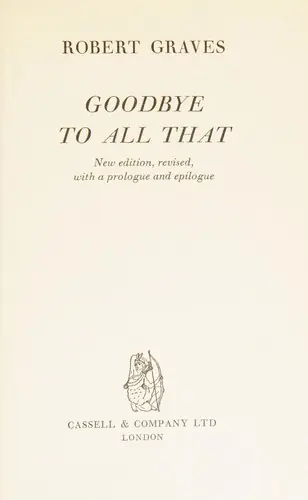
Goodbye to All That
by Robert Graves · first published 1957
12mentions
5recommended by
9HN commenters
2015–2026first – last mentioned
56% recommend44% neutral
Why HN recommends it
Firsthand memoir of fighting in the First World War, valued as one of the best accounts from someone who actually served; easy, engaging read that suits anyone curious about the war.
Summarised by Claude from recommending comments
Affiliate links. As an Amazon Associate I earn from qualifying purchases.
Quite. I have read a handful of memoirs written by persons around 30, and the ones that impressed me were memoirs of military service: Goodbye to All That by Robert Graves (yes, evidently he got various details wrong), The Killing Zone by Frederick Downs, etc. But in general I'd rather the memoirist have fifty years under his or her belt.
on “The Age 30 Crisis and Seasons of a Man's Life” ↗Written by protagonists: "The Complete Memoirs of George Sherston" by Siegfried Sassoon. (Ignore the title, it's actually his autobiography, and you could probably skip the first book in the trilogy). "Goodbye to all that" by Robert Graves. Two of the best writers in the English language recounting their times in the trenches.
on “Why the US Navy Won't Blast the Iranians and 'Open' Strait of Hormuz” ↗Highly recommend Goodbye to All That, his memoirs. One of the best books written on the first world war from the perspectives of someone actually fighting it. https://en.wikipedia.org/wiki/Good-Bye_to_All_That
on “Robert Graves: The Reluctant First World War Poet” ↗His "Goodbye to All That" is a good memoir of the First World War. Though his Mythologies are the most readable or engaging one. I prefer Thomas Bullfinch for Mythology.
on “Robert Graves' Mythologies” ↗Perhaps a better description of the same can be found in 'Goodbye to All That'. I don't have a copy at hand, but I remember it having detailed description of the trenches.
on “Acoup: The Trench Stalemate” ↗I didn’t especially enjoy this essay, but Goodbye To All That is a great (and pretty easy) read, which I’d highly recommend
on “Robert Graves in the Great War (2018)” ↗Somewhere in Goodbye to All That, Robert Graves writes that the regulars regarded the Christmas truce in no particularly sentimental light, but as a commonplace exchange of courtesies between enemies. I don't think that Graves was then…
on “The Christmas Truce of World War I” ↗Possible counter-example for your teacher: Arthur C. Clarke's 'The Sentinel'? I also recall Robert Graves' writing, in 'Goodbye to All That', of one of his fellow soldiers saying that after the war, he would read the whole of Trollope's Barchester chronicles, as nothing happens in them, though that is not strictly true.
on “The significance of plot without conflict (2012)” ↗…blog or something. There are also writers who can do all of these: my personal favourite is Robert Graves (possibly because once many years ago I got him to autograph his Selected Poems and his memoir Goodbye to all That).
on “The art of over-engineering your side projects” ↗Graves makes a (not unflattering) cameo appearance in Sassoon's novel Memoirs of an Infantry Officer as "Owen Cromlech". I believe Sassoon would have had a chance to read Goodbye to All That before he published the novel.
on “Robert Graves: The Reluctant First World War Poet” ↗…like the middle ages (which it doesn’t try to be, it models itself more according to the great sagas) Aragorn would just die a horrible death of shatting blood in insane pain. I recentrly read Graves’ Goodbye to All That and his description of the trenches is exactly like Mordor. But there’s no elves and hobbits, it’s just orks fighting orks. Reading it as an adult at the whole book is extremely coloured by Tolien’s experiences…
on “Peter Thiel doesn't understand his favorite book” ↗…approachable and give interesting perspectives they just get buried behind a wall of syllabi and listicles. This is how I ended up reading Thompson's 'The Making of the English Working Class' and Graves' 'Goodbye to all That' among others.
on “Quality non-fiction books are the antithesis of AI slop” ↗