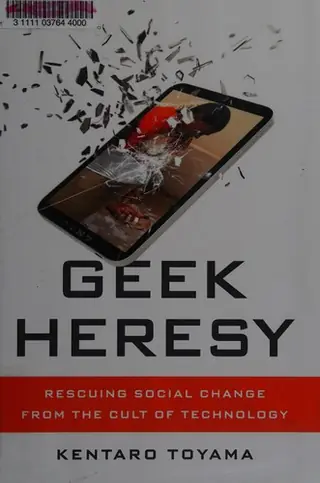
Geek heresy
by Kentaro Toyama · first published 2015
88% recommend13% neutral
Why HN recommends it
Argues that technology alone rarely fixes social problems, drawing on case studies from the author's years running tech-for-development projects. Recommended for skeptics of tech-solutionism and social change workers.
Summarised by Claude from recommending comments
"In 2004, Kentaro Toyama, an award-winning computer scientist, moved to India to start a new research group for Microsoft. Its mission: to explore novel technological solutions to the world's persistent social problems. Together with his team, he invented electronic devices for under-resourced urban schools and developed digital platforms for remote agrarian communities. But after a decade of designing technologies for humanitarian causes, Toyama concluded that no technology, however dazzling, could cause social change on its own. Technologists and policy-makers love to boast about modern inno
Affiliate links. As an Amazon Associate I earn from qualifying purchases.
Mentions per year
What Hacker News says
Related books
 2010–2022
The Flickering Mind
Todd Oppenheimer
Recommended by 2 · mentioned by 22 recommend · 2 mention2 recommend · 22 recommend
 2008–2026
Silicon snake oil
Clifford Stoll
Recommended by 13 · mentioned by 4013 recommend · 40 mention13 recommend · 4013 recommend
 2008–2026
Mindstorms
Seymour Papert
Recommended by 89 · mentioned by 12489 recommend · 124 mention89 recommend · 12489 recommend
For those who fervently believe that "Video Games Are The Future of Education", I would like to recommend two books: "Geek Heresy" by Kentaro Toyama, and "The Flickering Mind" by Todd Oppenheimer. The former offers a voice of caution, and is written by the former head of MSR Asia. The latter is filled with historical examples…
on “Video Games Are the Future of Education” ↗You may enjoy "Geek Heresy" http://www.amazon.com/Geek-Heresy-Rescuing-Social-Technology...
on “Silicon Valley is perhaps the most productive and innovative place in the world” ↗…key role (as a tool) to play in reducing poverty. Obviously poverty is a complex problem and technology is jut one tool to be used as part of solutions. As Kentaro Toyama wrote in his excellent book, "Geek Heresy: Rescuing Social Change from the Cult of Technology" [1], technology is an amplifier of intent. This is why we started engageSPARK (a not-for-profit social enterprise), aka "Twilio for Non-Techies",…
on “The Most Important Thing: Decline in poverty, illiteracy and disease” ↗I thoroughly enjoyed Geek Heresy by Kentaro Toyama, which is precisely about taking that trope apart. The book goes over a number of case studies about technocrats thinking their purely technological solutions would "make the world a…
on “Mark Zuckerberg's manifesto for Facebook offers a social dystopia” ↗…learning and that's part of the reason I ban them: https://jakeseliger.com/2008/12/28/laptops-students-distract... . I have seen good evidence that computers do the opposite, in the form of Toyama's book Geek Heresy: https://jakeseliger.com/2015/11/17/geek-heresy-rescuing-soci... .
on “Ask HN: Do computers and tablets really improve education at elementary level?” ↗Thank you for articulating these points so well. Possibly preaching to the choir here, but you should check out "Geek Heresy" by Kentaro Toyama.
on “A new book critiques medicine” ↗Regarding Ed Tech, for a merciless look at this recurring insanity, see Todd Oppenheimer's "The Flickering Mind", and in general, Kentaro Toyama's "Geek Heresy".
on “Magic Leap reportedly slashes jobs and steps away from consumer plans” ↗…"Technology for Emerging Markets" research team and oversaw 50+ research projects spanning health, education, governance, and more. He then spent 5 years at UC Berkeley writing a book about what he learnt ("Geek Heresy", http://geekheresy.org). I did a PhD in this general area (voice interfaces for non-literate users), and Kentaro's main thesis (technology only amplifies human capacity and intent) resonates deeply…
on “Request For Research: Basic Income” ↗I bought into the hype and used to think about social media the same way as you. Then I came across a comment on HN mentioning Geek Heresy (https://geekheresy.org) and got that book from our public library. It has strong arguments against everything you have written above.
on “Facebook crisis grows as new whistleblower and leaked documents emerge” ↗…walk. How do you define extreme poverty? Does moving out of a tiny farm village in rural China to work at a factory in Shenzhen count as getting out of extreme poverty, and who does it really benefit? In "Geek Heresy", Kentaro Toyama gives the example of trade in southeast Asia that historically took place via narrow waterways navigated by boats. During the dry season, these canals dry up, and productivity goes way…
on “The way ahead” ↗Kentaro Toyama talks about education and the failed promise of the OLPC program and other technological endeavors in education in Geek Heresy. His thesis is that technology "amplifies" the characteristics in society and self. If you have an underperforming school with ill-equipped or overwhelmed instructors, technology won't fix these issues.…
on “Computers 'do not improve' pupil results, says OECD” ↗…conclusion that air-dropping laptops over villages in Africa would magically teach a bunch of children how to code. Another level-headed perspective in this area is provided by Kentaro Toyama (author of "Geek Heresy") who saw several such well-intentioned projects up close during his tenure as director of Microsoft Research Asia: > All of the evidence stands on its own, but I will tie them together with a single…
on “One AI Tutor Per Child: Personalized learning is finally here” ↗…willing to share any (anonymized) anecdote(s) that helped you see this reality? I'll share that I saw how much EdTech was infested by folks trying to leverage "gamification", and I read Kentaro Toyama's "Geek Heresy". That, and other events like Sebastian Thrun admitting "We have a lousy product" (on MOOCs) was enough to disabuse me of any notion that our generation's EdTech hype would prove any different than its…
on “The EdTech Revolution Has Failed” ↗