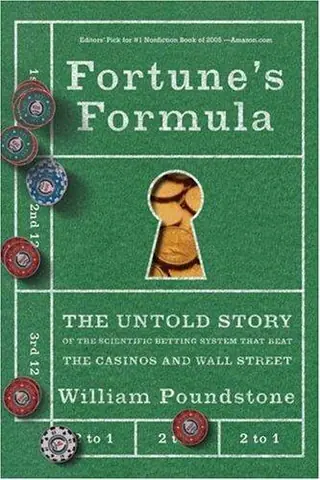
Fortune's Formula
The Untold Story of the Scientific Betting System That Beat the Casinos and Wall Street
by William Poundstone · first published 2005
86% recommend14% neutral
Why HN recommends it
Readable, entertaining account of the Kelly criterion through the lives of Claude Shannon and Ed Thorp, from blackjack and casinos to Wall Street. Suits readers wanting biography and math without textbook density.
Summarised by Claude from recommending comments
This book is about Kelly's criterion developed in 1956 by two scientists (John Kelly Jr. and Claude Shannon) at Bell Labs for the transmission of information over copper wires but who immediately realized its application to gaming and investing. Many more professional gamblers used the formula than investors. One investor Edward Thorpe used it both to beat the casino's and as a hedge fund manager to beat the market. THE FORMULA does not tell one how to find edge but once one does the formula indicates how much one should bet to maximize the creation of wealth. Be warned that the use of a full
Affiliate links. As an Amazon Associate I earn from qualifying purchases.
Mentions per year
What Hacker News says
Related books
 2008–2022
Beat the Dealer
Edward O. Thorp
Recommended by 5 · mentioned by 155 recommend · 15 mention5 recommend · 155 recommend
 2012–2026
The Quants
Scott Patterson
Recommended by 9 · mentioned by 129 recommend · 12 mention9 recommend · 129 recommend
 2017–2026
A Man for All Markets
Thorp O. Edward
Recommended by 20 · mentioned by 2520 recommend · 25 mention20 recommend · 2520 recommend
Kelly Capital Growth Investment Criterion
Leonard C. MacLean, Edward O. Thorp, William T. Ziemba
Recommended by 3 · mentioned by 33 recommend · 3 mention3 recommend · 33 recommend
 2017–2026
A mind at play
Jimmy Soni, Rob Goodman
Recommended by 21 · mentioned by 3021 recommend · 30 mention21 recommend · 3021 recommend
 2010–2022
Applied Economics
Thomas Sowell
Recommended by 5 · mentioned by 65 recommend · 6 mention5 recommend · 65 recommend
 2013–2024
Sam Walton
John Huey, WALTON
Recommended by 7 · mentioned by 87 recommend · 8 mention7 recommend · 87 recommend
 2014–2025
An introduction to information theory
John Robinson Pierce
Recommended by 15 · mentioned by 1715 recommend · 17 mention15 recommend · 1715 recommend
The blog post was inspired by The Recursive Universe by William Poundstone. I read this book years ago and found it amazing. I recently read another book by him, Fortune’s Formula, which features the Kelly Criterion, Claude Shannon beating roulette, card counting in blackjack, and the surprising origins of Warner Bros. Recommended for sure. Thanks to the HN poster who suggested…
on “The Recursive Universe” ↗…benefits for any fraction of the "full Kelly" bet and its implications. In addition to Poundstone's book [1] I strongly recommend Ed Thorp's highly readable paper[2]. [1] Poundstone, William (2005), Fortune's Formula: The Untold Story of the Scientific Betting System That Beat the Casinos and Wall Street, [2]https://wayback.archive-it.org/all/20090320125959/http://www...
on “Kelly Criterion” ↗…than the institution) winning stock trading strategies are non-trivial. However, Claude Shannon (famous computer science guy) was a pretty good investor: http://en.wikipedia.org/wiki/Kelly_criterion Fortune's Formula http://www.amazon.com/Fortunes-Formula-Scientific-Betting-Ca... details some of Shannon's methods and covers some other interesting stories like LTCM, Mathematician Edward O. Thorp's black jack schemes…
on “Ask HN: I sold my company last month for $5m. What do I do with the money?” ↗If you find this interesting, I highly recommend the book Fortune's Formula by William Poundstone. http://www.bookfinder.com/search/?author=&title=&lan...
on “Kelly Criterion For Sport Betting” ↗If you're interested in this, you might really enjoy the book Fortune's Formula by William Poundstone (ISBN: 0809046377): link: http://www.bookfinder.com/search/?author=&title=&lan... The book looks at, among other things, the Kelly Criterion: http://en.wikipedia.org/wiki/Kelly_criterion
on “Casino-rules blackjack sim (by MIT bio undergrad/Wharton mgmt PhD student)” ↗He's a legend. For further reading on Claude Shannon check out the following books. Fortune's Formula by William Poundstone (http://goo.gl/VrBMUW) The Information: A History, A Theory, A Flood by James Gleick (http://goo.gl/Q5tzCW)
on “Claude Shannon demonstrates Theseus, a magnetic maze-solving mouse [video]” ↗The Kelly Criterion is the subject of an absolutely incredible book by William Poundstone called "Fortune's Formula". In the course of discussing the formula, the book takes you through the birth of the MIT blackjack team, the genesis of statistical arbitrage, and mini biographies of people like Claude Shannon and…
on “Kelly Criterion (2007)” ↗Fortune's Formula by William Poundstone is a fun read on the origin of the Kelly criterion, as well as the role of gangsters and bookies in the funding of the early communications infrastructure in the US.
on “Kelly Criterion – how to calculate optimal bet sizes” ↗claude shannon = biggest stud ever. i highly recommend "Fortune's Formula". Great read. Smart dudes (Shannon, Ed Thorpe), blackjack, casinos, financial markets, and more. http://www.amazon.com/Fortunes-Formula-Scientific-Betting-Ca...
on “A juggler remembers Claude Shannon” ↗Fortune's Formula by William Poundstone. The story behind Claude Shannon and Ed Thorpe gambling (and then using those techniques on Wall Street).
on “Ask HN: Favorite true story tech book?” ↗I'd advise you to read Fortune's Formula, by William Poundstone first. It's entertaining, an easy read, and you'll pick up loads of information that will be useful going forward. After that: If you want to invest on fundamentals go for both…
on “Ask HN: Good resources for learning+getting into Finance / Trading?” ↗…FINANCE --- When Genius Failed Liar's Poker Buffett (Lowenstein) Bull! Black-Scholes and Beyond (textbook) Fixed Income Securities (textbook) The Road to Serfdom The Smartest Guys in the Room Fortune's Formula The Fourth Turning Inside the House of Money --- ENTREPRENEURSHIP / COMPUTERS (non-textbook) --- Masters of Doom It's Not About the Bike Dot. Bomb Founders at Work The PayPal Wars Coders at Work…
on “Ask HN: Good books?” ↗I'm guessing you mean excluding textbooks The Extended Phenotype Your Inner Fish Thinking Fast and Slow The Information Chaos Statistics in Plain English Fortune's Formula Fooled by Randomness A Random Walk Down Wall St. How to Win Friends and Influence People
on “Ask HN: Books with a high signal to noise ratio?” ↗A great book on Shannon's work and other things is "Fortune's Formula: The Untold Story of the Scientific Betting System That Beat the Casinos and Wall Street". Easy and entertaining to read, as are all William Poundstone books. http://www.amazon.com/Fortunes-Formula-Scientific-Betting-Ca...
on “Claude Shannon: Tinkerer, Prankster, and Father of Information Theory” ↗It's been forever since I read it, but Fortune's Formula [1] is an entertaining read that goes into Shannon's investment methodology, alongside Edward Thorp [2]. [1]: https://www.amazon.com/Fortunes-Formula-Scientific-Betting-C... [2]: https://en.wikipedia.org/wiki/Edward_O._Thorp
on “The Man Who Invented Information Theory (2017)” ↗