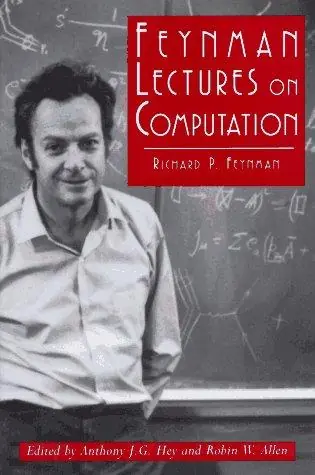
Feynman lectures on computation
by Richard Phillips Feynman · first published 1996
71% recommend25% neutral4% critical
Why HN recommends it
Builds computation up from first principles, from how a computer could be built to the theory of computation, with a physicist's view. Good on reversible and quantum computing; suits readers who want fundamentals.
Summarised by Claude from recommending comments
From 1983 to 1986, the legendary physicist and teacher Richard Feynman gave a course at Caltech called "Potentialities and Limitations of Computing Machines.". Although the lectures are over ten years old, most of the material is timeless and presents a "Feynmanesque" overview of many standard and some not-so-standard topics in computer science. These include compatibility, Turing machines (or as Feynman said, "Mr. Turing's machines"), information theory, Shannon's Theorem, reversible computation, the thermodynamics of computation, the quantum limits to computation, and the physics of VLSI de
Affiliate links. As an Amazon Associate I earn from qualifying purchases.
Mentions per year
What Hacker News says
Related books
 2010–2026
Programming on Purpose
P. J. Plauger
Recommended by 7 · mentioned by 77 recommend · 7 mention7 recommend · 77 recommend
 2008–2025
Discrete Mathematics and Its Applications
Kenneth H. Rosen
Recommended by 14 · mentioned by 1914 recommend · 19 mention14 recommend · 1914 recommend
 2008–2024
Theory of computation
Michael Sipser
Recommended by 14 · mentioned by 1914 recommend · 19 mention14 recommend · 1914 recommend
 2009–2022
C++ primer plus
Stephen Prata
Recommended by 12 · mentioned by 2312 recommend · 23 mention12 recommend · 2312 recommend
 2008–2026
Joel on Software
Joel Spolsky
Recommended by 15 · mentioned by 2315 recommend · 23 mention15 recommend · 2315 recommend
 2008–2025
More programming pearls
Jon Louis Bentley
Recommended by 12 · mentioned by 1512 recommend · 15 mention12 recommend · 1512 recommend
 2007–2026
Purely functional data structures
Chris Okasaki
Recommended by 87 · mentioned by 15587 recommend · 155 mention87 recommend · 15587 recommend
 2010–2026
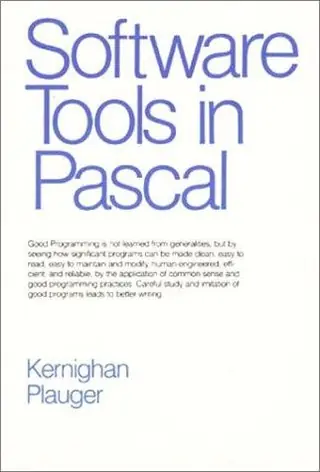
Software tools in Pascal
Brian W. Kernighan, P. J. Plauger
Recommended by 9 · mentioned by 259 recommend · 25 mention9 recommend · 259 recommend
…I still work on it from time to time and hope to come up with a solution myself one day. Facepalm. Edit: Here is a link to the book, its enjoyable for experts and laymen alike. http://www.amazon.com/Feynman-Lectures-On-Computation-Richar...
on “The Firing Squad Problem” ↗…number of particles -- 10^23 or 10^25 -- something very large. And some fraction M travel at speed A and N-M of them travel at speed B. And we count the probabilities of various mixtures occurring. Feynman Lectures on Computation is a great book https://www.amazon.com/Feynman-Lectures-Computation-Richard-...
on “Argonne researchers posit way to locally circumvent Second Law of Thermodynamics” ↗I'm going to go a bit against the grain here and suggest the Feynman Lectures on Computation: https://www.amazon.com/Feynman-Lectures-Computation-Frontier... In pure Feynman style he builds up a the theory of computation from first principles. YMMV but it really helped me put many of the ideas…
on “Ask HN: What are the most fundamental books on computer science?” ↗Feynman Lectures on Computation by Richard Feynman. Interesting perspective from a Nobel Prize winning Physicist. Chapters: Introduction to Computers, Computer Organization, The Theory of Computation, Coding and Information Theory,…
on “Ask HN: What are the most fundamental books on computer science?” ↗I learned programming and math mostly by self-driven exploration. But for computer science there was a book that hit at the right place and time: Feynman Lectures on Computation. It's bounced around between publishers over the years and is generally a pain to get. I have the 1996 edition[1] which is out of print. Then there's a 2002 edition[2] and a 2000 edition[3]. [1] https://www.amazon.com/Feynman-Lectures-Computation-Richard-...…
on “Ask HN: The book that did it for you in math and/or CS?” ↗An enjoyable and approachable text with more detail on reversible computing and energy expenditure from the perspective of physics is the Feynman Lectures on Computation[1]. [1] https://www.goodreads.com/book/show/17274.Feynman_Lectures_O...
on “Communication costs are 35-fold computational costs in the human brain (2021)” ↗…Recursive Programming Techniques Carriero and Gelernter, How to Write Parallel Programs A. K. Dewdney, The New Turing Omnibus Edsger Dijkstra, A Discipline of Programming Richard Feynman, The Feynman Lectures on Computation Friedman and Felleisen, The Little Schemer Friedman and Wand and Haynes, Essentials of Programming Languages [1st edition] James F. Gimpel, Algorithms in Snobol4 Paul Graham, On Lisp…
on “Which programming book you just couldn’t stop reading from start to end?” ↗Yeah, check out "Feynman Lectures on Computation": https://rapidshare.com/files/2100994846/Feynman_Lectures_on_... It's fantastic. Feynman dives all the way down to the very fundamentals of how a computer could be built. Much of the information…
on “Visual simulation of the 6502 CPU” ↗For the hardcore Feynman fans, there's the Feynman Lectures on Computation: http://books.theinfo.org/go/0738202967
on “Ask HN: What's a good book to learn electronics?” ↗Textbooks are indispensable for really getting the material down, but I've found it much easier to read lectures. Feynman has great examples of this type of work: "The Character of Physical Law" or "The Feynman Lectures on Computation" are both excellent. I've found that these books walk somewhere between textbook and popular science book. Easy to read but all the while teaching you the material. I've found this type of work to be…
on “Ask HN: Do you read math & hard science books? How?” ↗…lectures is also available, but can be difficult to find. Afair, some of its a little scrappy at the start (poor recording setup?) but his delivery is great. I wish there was video available. See also the Feynman Lectures on Computation.
on “MIT Level Introductory Physics - Free Online Course Starts March 1st” ↗You can also read the Feynman lectures on computation, has some notes on quantum computing.
on “Quantum Mechanics for Programmers” ↗…very slowly. There might be some applications where that would still be relevant, but it's pretty clear this trend don't last even until the 2048 mark, let alone for another 125 years and beyond. The Feynman lectures on computation have some good sections on reversible computation that I would recommend.
on “Koomey's law” ↗The Feynman lectures on Computation provide good background on reversible computation from the perspective of a brilliant physicist. https://www.scribd.com/doc/52657907/Feynman-Lectures-on-Comp...
on “Embracing the Laws of Physics: Three Reversible Models of Computation” ↗Interesting selection. I'm surprised to find some of my more eclectic favorites included: - Naked Ape, Desmond Morris - Feynman Lectures on Computation - Feynman - Guide to Feynman Diagrams - Mattuck - Visual Complexity - Lima - Data Analysis - Sivia - Emergence - Jonhson
on “Bret Victor's Bookshelf (2015)” ↗