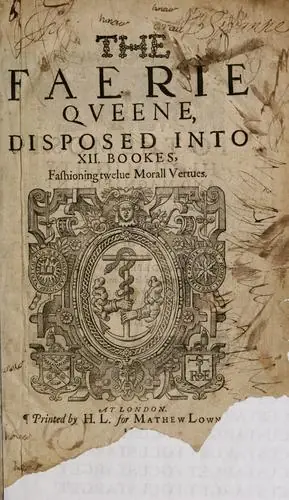
Faerie queene
by Edmund Spenser · first published 1590
6mentions
1recommended by
6HN commenters
2019–2026first – last mentioned
17% recommend83% neutral
The Faerie Queene was one of the most influential poems in the English language. Dedicating his work to Elizabeth I, Spenser brilliantly united Arthurian romance and Italian renaissance epic to celebrate the glory of the Virgin Queen. Each book of the poem recounts the quest of a knight to achieve a virtue: the Red Crosse Knight of Holinesse, who must slay a dragon and free himself from the witch Duessa; Sir Guyon, Knight of Temperance, who escapes the Cave of Mammon and destroys Acrasia’s Bowre of Bliss; and the lady-knight Britomart’s search for her Sir Artegall, revealed to her in an enchan
Affiliate links. As an Amazon Associate I earn from qualifying purchases.
Read freeStandard Ebooks

…paragraph was easier), then quite little after that - though I understood enough to glean that there was some woman who had showed up that caused the Master to flee. I really got into reading Spenser's "The Faerie Queene" (about 1497) about a year ago, and I suspect that really helped me with this exercise, since he uses some language that was archaic even back then. I really wish there was an audio recording of this…
on “How far back in time can you understand English?” ↗I have a stupid fascination with historical finance in literature myself. I focused on Early Modern Elizabethan literature. Wrote a thesis arguing that Spenser's Mammon in Book II of the Faerie Queene was not so much about the familiar allegory of illicit wealth but rather a vitriolic topical attack on the emerging proto-capitalist financial industry in Elizabethan England and the challenge it presented…
on “Mr. Darcy’s Ten Thousand a Year” ↗…wordes, elles had i deide for duel. 1570 T. Tusser Hundreth Good Pointes Husbandry (new ed.) f. 19 Where Iuie embraceth the tree very sore, kill Iuie, or tree else will adle no more. 1590 E. Spenser Faerie Queene i. i. sig. A5v Strangle her, els she sure will strangle thee. 1837 J. H. Newman Parochial Serm. (ed. 3) I. v. 115 Else how should any one be saved? 1873 R. Browning Red Cotton Night-cap Country ii.…
on “If-then-else had to be invented” ↗I’ve been reading “Deschooling Society” by Ivan Illich while slowly working my way through Spenser’s “The Faerie Queene”.
on “Ask HN: What are you reading these days?” ↗…supernatural effects. So I'm not sure what we can draw from this. > What is the first noteworthy piece of fiction set in a fictional land? "Alice in Wonderland", perhaps? Maybe Edmund Spenser's The Faerie Queene? Its connection to our real world is tenuous at best, I'd say.
on “'Fandom has toxified the world': Watchmen author Alan Moore” ↗…as the world becomes less mysterious and religion becomes increasingly seen as allegorical, the craving for fictional worlds where not all is known becomes more appealing. > Maybe Edmund Spenser's The Faerie Queene? Its connection to our real world is tenuous at best, I'd say. Maybe the oldes I can think of is the land of Avalon in Athurian legend? Still would have a tenuous connection to the real world.
on “'Fandom has toxified the world': Watchmen author Alan Moore” ↗