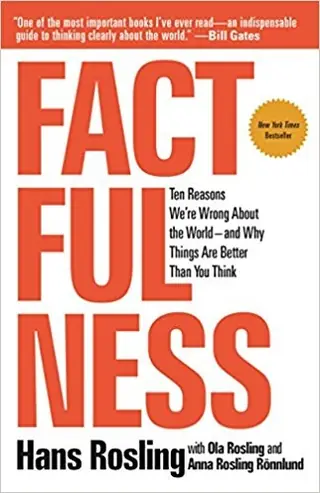
Factfulness
by Hans Rosling, Ola Rosling, Anna Rosling Rönnlund · first published 2018
77% recommend19% neutral4% critical
Why HN recommends it
Data-driven case that the world is improving faster than most people assume, with ten habits of thinking that distort our view. Suited to readers with a bleak outlook or outdated ideas about poor countries.
Summarised by Claude from recommending comments
Factfulness: The stress-reducing habit of only carrying opinions for which you have strong supporting facts. When asked simple questions about global trends―what percentage of the world’s population live in poverty; why the world’s population is increasing; how many girls finish school―we systematically get the answers wrong. So wrong that a chimpanzee choosing answers at random will consistently outguess teachers, journalists, Nobel laureates, and investment bankers. In Factfulness, Professor of International Health and global TED phenomenon Hans Rosling, together with his two long-time
Affiliate links. As an Amazon Associate I earn from qualifying purchases.
Mentions per year
What Hacker News says
Related books
 2018–2026
Enlightenment now
Steven Pinker, Pablo Hermida Lazcano
Recommended by 51 · mentioned by 9751 recommend · 97 mention51 recommend · 9751 recommend
 2021–2024
Opening the heart of compassion
Martin Lowenthal
Recommended by 2 · mentioned by 22 recommend · 2 mention2 recommend · 22 recommend
 2017–2022
The Crisis of the Modern World
René Guénon
Recommended by 3 · mentioned by 33 recommend · 3 mention3 recommend · 33 recommend
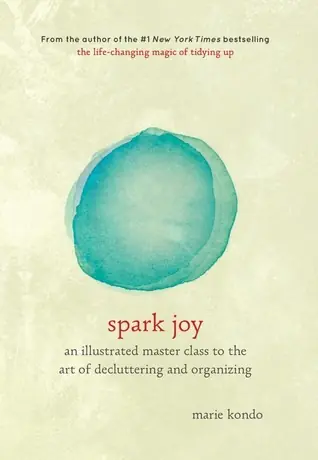 2016–2023
Spark Joy
Marie Kondo
Recommended by 3 · mentioned by 43 recommend · 4 mention3 recommend · 43 recommend
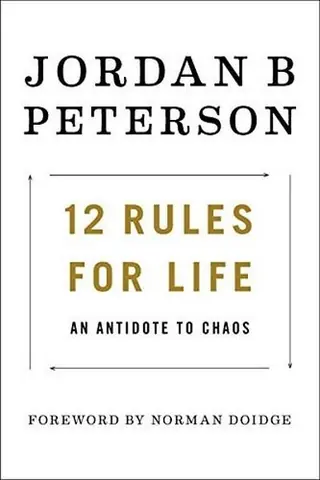 2018–2026
12 Rules for Life
Jordan B. Peterson
Recommended by 61 · mentioned by 10961 recommend · 109 mention61 recommend · 10961 recommend
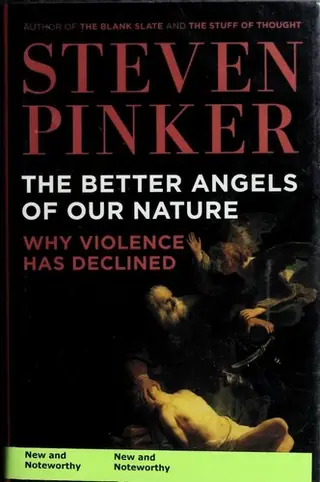 2011–2026
The better angels of our nature
Steven Pinker
Recommended by 72 · mentioned by 15272 recommend · 152 mention72 recommend · 15272 recommend
 2013–2022
Report from Engine Co. 82
Dennis Smith
Recommended by 1 · mentioned by 21 recommend · 2 mention1 recommend · 21 recommend
…We Sleep: Unlocking the Power of Sleep by Matthew Walker - The Magicians by Lev Grossman - Shoe Dog: A Memoir by the Creator of NIKE by Phil Knight - How to Change Your Mind by Michael Pollan - Factfulness: Ten Reasons We’re Wrong About the World by Hans Rosling - Man’s Search for Meaning by Viktor E. Frankl - Deep Work by Cal Newport - Homo Deus: A Brief History of Tomorrow by Yuval Noah Harari…
on “Analyzing Hacker News book suggestions in Python” ↗…data, such as infant mortality rates correlated with infrastructure development. Short version: life _is_ improving for the majority of people on the planet. Recommended reading on the subject: - _Factfulness_ by Hans Rosling, et al. - The WHO's health trend data: http://www.searo.who.int/entity/health_situation_trends/en/
on “Bill Gates says poverty is decreasing. He couldn’t be more wrong” ↗…further progress is possible. This is not optimistic. It is having a clear and reasonable idea about how things are. It is having a worldview that is constructive and useful. • • • In his book 'Factfulness' (definitely read it), he talks about "bad and better": Think of the world as a premature baby in an incubator. The baby’s health status is extremely bad and her breathing, heart rate, and other important…
on “Opt Out of Cynicism” ↗I recently read Factfulness, by Hans Rosling, and it really changed how I read articles like this. Here's where this article goes totally off the rails... It's only showing American startup activity as a proportion of global startup…
on “Venture capital investment is growing faster outside the US” ↗…tempted to victimize themselves and assume that everyone has it better than them. Which is an incredibly slippery and dangerous slope(looking at the news over the last few years). And with that in mind, "Factfulness" by Hans Rosling is a __MUST__ imo. Once you wrap your head around the facts, a next good choice is "The Black Swan" and "Antifragile" by Nassim Nicholas Taleb, despite some (to a certain extent justified)…
on “Ask HN: What, in your opinion, are the greatest and most useful textbooks?” ↗I'm in the middle of reading "Factfulness" by Hans Rosling, which does an excellent job of clearly demonstrating that not only are billions of people living better lives than they did 20 years ago, but that also we're conditioned not to believe…
on “Facts and charts that show the world is getting better” ↗Most recent: Factfulness, by Hans Rosling. For the past year or so, I've been trying hard to understand why people act the way they do, when those actions and beliefs are often irrational. This book brought so much of that together.…
on “Ask HN: What books changed the way you think about almost everything?” ↗…news and instead try to read books. The quality of the news is decreasing to Facebook/reddit levels and designed to increase engagement by preying on your emotions. It’s much like marketing. The book Factfulness by Hans Rosling has some good thoughts on this - mostly the world is getting better, but the news has to sell ads, which means telling dramatic stories. If something is truly important, I’ll find out…
on “Ask HN: How do you read the news without getting depressed?” ↗If you enjoyed this post, I highly recommend reading Factfulness by Hans Rosling. He spent his later years trying to educate the public on the realities of the world. This book contains a series of tips on how to understand facts. His TED talks are masterpieces as…
on “The world is awful, the world is much better, the world can be much better” ↗Recommended reading list thread! What have you read this year that you think others should read as well? Here's a few of mine that really stand out. Factfulness, by Hans Rosling The Ethics of Ambiguity, by Simone de Beauvoir Designing Delivery, by Jeff Sussna (re-read) The Cooking Gene, by Michael Twitty Binti, by Nnedi Okorafor The Philosophy of Spinoza…
on “Why We Should Watch Less News” ↗…right, and you're (hopefully) not the smartest person in the room. (Another rule of thumb - if you're the smartest person in the room, you need to find a better room!) This also makes me think of the book Factfulness, by Hans Rosling. Best book I've read in years. In it, he details thought patterns common to all of us that mislead us and cause us to misunderstand or ignore even basic facts. He's not talking about…
on “People are “consistently inconsistent” in reasoning about controversial topics” ↗You should read Factfulness, by Hans Rosling. In the late 1990s, 29% of the world lived in extreme poverty, defined by the World Bank as less than $1.80/day in today's dollars. Today, that number is less than 9%. We've slashed…
on “Winning the War on Poverty: The Canadians are doing it; we’re not” ↗What makes you think the gap is compounding? Is that fact-based, or feelings-based? I'd recommend reading Factfulness, by Hans Rosling. It'll cause you to rethink some things. edit: Here's an interesting fact for you. In the late 1990s, the global extreme poverty rate (around $1.80/day in today's dollars) was 29%. Today,…
on “GM fungus can rapidly kill mosquitoes that spread malaria, study suggests” ↗I agree, we need to slowly study other groups of cows to see if this is a viable solution. I'm reading Factfulness by Hans Rosling at the moment. He had a great point about "single numbers" - the jist was to always be skeptical of just a single number or metric. Here's an example [1]. During WWII, soliders were…
on “Tasty Seaweed Reduces Cows’ Methane Emissions by 99%” ↗…Steppenwolf: Hermann Hese * Library of babel: Borges * The Brain: David Eagleman * The Magical Mountain: Thomas Mann * The Dark Tower: Stephen King(actually tons of King books - I am a bit of a fanboy) * Factfulness: Hans Rosling * William Blake: selected poetry * Dostoevsky: The idiot * Captain Nemo: Jules Verne * The Hitchhiker's Guide to the Galaxy: Adams
on “Ask HN: What are some must read books?” ↗