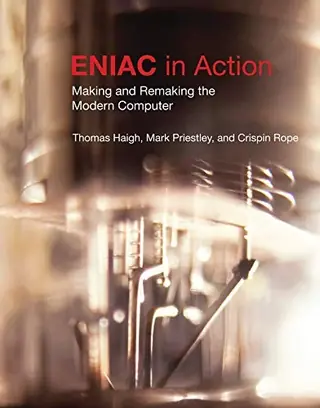
ENIAC in action
by Thomas Haigh, Mark Priestley, Crispin Rope, William Aspray · first published 2016
50% recommend50% neutral
Why HN recommends it
A technically thorough account of how the ENIAC was designed, used, and reworked, drawing on period material. It is considered the most complete book on the machine for readers interested in early computing.
Summarised by Claude from recommending comments
Conceived in 1943, completed in 1945, and decommissioned in 1955, ENIAC (Electronic Numerical Integrator and Computer) was the first general-purpose programmable electronic computer. But ENIAC was more than just a milestone on the road to the modern computer. During its decade of operational life, ENIAC calculated sines and cosines and tested for statistical outliers, plotted the trajectories of bombs and shells, and ran the first numerical weather simulations. ENIAC in Action tells the whole story for the first time, from ENIAC's design, construction, testing, and use to its afterlife as part
Affiliate links. As an Amazon Associate I earn from qualifying purchases.
I would strongly suggest to read "ENIAC in Action" from Thomas Haigh. It's by far the most technically complete book about the ENIAC. You'll even find some code samples from 1948 on the website. https://eniacinaction.com
on “ENIAC Simulator” ↗…patchcords so it's visually more interesting than all the gray boxes that came after. It looks more like a giant Moog synthesizer. Try an image search on: Eniac monte carlo patch cords Or look in the book Eniac in Action by Thomas Haigh et al. Lots of ENIAC-related diagrams linked to this page: https://eniacinaction.com/the-book/supporting-technical-mate... for example this flowchart: https://eniacinaction.com/docs/MonteCarloSecondRunFlowDiagra...
on “Ask HN: Where to learn about computer science and software engineering history?” ↗A newer book, from 2016, ENIAC in Action: Making and Remaking the Modern Computer by Thomas Haigh, Mark Priestly, and Crispin Rope https://mitpress.mit.edu/9780262334433/eniac-in-action/ An interesting revelation here is that, although ENIAC…
on “Eniac, the First General-Purpose Digital Computer, Turns 80” ↗