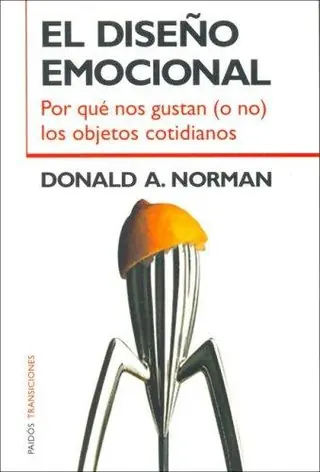
Emotional Design
Why we Love (or Hate) Everyday Things
by Donald A. Norman · first published 2003
67% recommend33% neutral
Why HN recommends it
Follow-up to The Design of Everyday Things arguing usability is only half the job. It uses studies and a visceral, behavioral, reflective framework to show why beauty and emotion matter. For UX designers and developers.
Summarised by Claude from recommending comments
"Did you ever wonder why cheap wine tastes better in fancy glasses? Or why washing and polishing your car seems to make it drive better? New research has shown that attractive things really do work better." "In the last decade, the design community has made products easier to use, largely due to Donald Norman's The Design of Everyday Things. But as he demonstrates in this book, we don't just use a product, we become emotionally involved with it. Emotional Design demonstrates for the first time the profound influence of this deceptively simple idea." "Don Norman draws on a wealth of examples an
Affiliate links. As an Amazon Associate I earn from qualifying purchases.
Mentions per year
What Hacker News says
Related books
 2012–2018
Designing for the digital age
Kim Goodwin
Recommended by 3 · mentioned by 43 recommend · 4 mention3 recommend · 43 recommend
 2011–2019
Making and breaking the grid
Timothy Samara
Recommended by 3 · mentioned by 43 recommend · 4 mention3 recommend · 43 recommend
 2011–2019
Thoughtful Interaction Design
Jonas Löwgren, Erik Stolterman
Recommended by 2 · mentioned by 32 recommend · 3 mention2 recommend · 32 recommend
 2012–2023
100 things every designer needs to know about people
Susan Weinschenk
Recommended by 4 · mentioned by 54 recommend · 5 mention4 recommend · 54 recommend
 2009–2024
About face 2.0
Cooper, Alan
Recommended by 5 · mentioned by 85 recommend · 8 mention5 recommend · 85 recommend
Designing with the Mind in Mind
Johnson, Jeff
Recommended by 10 · mentioned by 1010 recommend · 10 mention10 recommend · 1010 recommend
 2008–2014
Designing the obvious
Robert Hoekman
Recommended by 9 · mentioned by 129 recommend · 12 mention9 recommend · 129 recommend
 2008–2026
Sketching User Experiences
Bill Buxton
Recommended by 8 · mentioned by 138 recommend · 13 mention8 recommend · 138 recommend
…those intimate details go a long way. And in commoditized situations people are willing to spend more time/money or go out of their way to use your product. Dan Norman talks a lot about this in his "Emotional Design" book. It's the design stuff that goes beyond merely functionality and most efficient problem solving (ie, obsessing about fewest clicks to do x, instead of the wider experience where adding a communication…
on “A former Egyptian engineer found the secret to building a big gas-station chain” ↗…first-and-foremost as much or more as the way it looks. This is the first step in being a good and useful designer. But people don't realize that same author Don Norman released an equally important book called "Emotional Design" [2] which digs deeper into why something like an Apple product is not only easy-to-use but is designed in such that it melds into our life cleanly, it goes beyond just being a useful tool to where it…
on “Creativity is bad for UI design (2018)” ↗…not the same thing, but that doesn't mean they aren't related. If you have a very negative aesthetic reaction to a web site, it will affect your use of the site. Don Norman talks about this in his book Emotional Design. Everything we use elicits some kind of emotional response in us, and that affects our experience with the thing. Something is not "usable" if it's so repulsive that no one will use it. In this case,…
on “UI Guru Jakob Nielson's Site Is Unreadable” ↗Emotional Design http://www.amazon.com/Emotional-Design-Love-Everyday-Things/... Designing Interactions http://www.amazon.com/Designing-Interactions-Bill-Moggridge/...
on “Ask HC: Which books on user interface design do you wish your CEO/Cofounders would read?” ↗…Of course, most cognitive psychology/sociology books will only be slightly relevant to UX design. Here's a short selection to get you started: — Don Norman, Design of Everyday Objects — Don Norman, Emotional Design — Brenda Laurel, Computers as Theater — Kim Goodwin, Designing for the Digital Age: How to Create Human-Centered Products and Servicesa — Bill Moggridge, Designing Interactions Bonus: — Raph Koster,…
on “Ask HN: Recommendations for learning and improving UX/UI skills?” ↗Right, many software devs have read The Design of Everyday Things [0] and understand the value of usability. But they didn't read Don Norman's follow up book Emotional Design [1] which explains that usability is only 50% of the answer - emotion is the other 50%. And emotion often means pretty, or at the minimum a positive UX. [0] http://www.amazon.com/Design-Everyday-Things-Revised-Expande...…
on “Book design inspired by Edward Tufte” ↗…background colours. And actually when done right emotional impact is rewarding for UX. A good design must have dimensions (visceral, behavioural and reflective level). You can check Donald Norman book: Emotional design. Highly recommend.
on “Apple's Shifting Differentiation” ↗Take a look at "Emotional Design" by Don Norman (http://www.amazon.com/o/asin/0465051359/pchristensen-20 ) The thesis is that if you present people with two [websites, machines, etc] that function identically but one is beautiful, people…
on “Ask YC: Do young people care about a nice visual designed websites?” ↗How special you feel using a product is part of what makes it good. Where "special" can mean a lot of things. Don Norman covers this very well in Emotional Design.
on “Signs That Apple Customers Are No Longer Special” ↗The book "Emotional Design" (http://www.amazon.com/o/asin/0465051367 ) has lots of studies about how people complete tasks better and have better experiences with functionally equivalent products that are well designed. The beginning…
on “Ask HN: Is it worthwhile for a startup to use a professional designer?” ↗And there's also Emotional Design: http://www.amazon.com/Emotional-Design-Love-Everyday-Things/...
on “Even a URL tells a story” ↗Useful related reading: http://www.alistapart.com/articles/indefenseofeyecandy Emotional Design by Don Norman - http://www.amazon.com/Emotional-Design-Everyday-Things-ebook... (summary of above - http://www.curledup.com/emotionl.htm )
on “Skeuomorphism: The Opiate of the People” ↗1. [Visual Grammar](http://books.google.com/books/about/VISUAL_GRAMMAR.html?id=w...) by Christian Leborg 2. [Emotional Design: Why We Love (or Hate) Everyday Things](http://www.amazon.com/exec/obidos/tg/detail/-/0465051359/) by Don Norman 3. [The Elements of Typographic Style](http://www.amazon.com/Elements-Typographic-Style-Robert-Brin...)…
on “It Is Not Flat Design. It's Just Proper Design” ↗Reminds me of 'Emotional Design' book by Don Norman http://www.amazon.com/Emotional-Design-Love-Everyday-Things/... A typical designer will view functionality/usability as the ultimate goal, which often fails in practice because they…
on “Redesigning the traditional Chinese shoulder pole” ↗> Listen man the best UI and UX comes from not having the stuff get in your way. You should spend some time reading Emotional Design [1]. Only amateurs to design think it is all about usability and minimizing complexity. The real ROI from a talented designer is a product that creates an emotional connection with the user. Just look…
on “UX Is a Canary in a Coal Mine” ↗