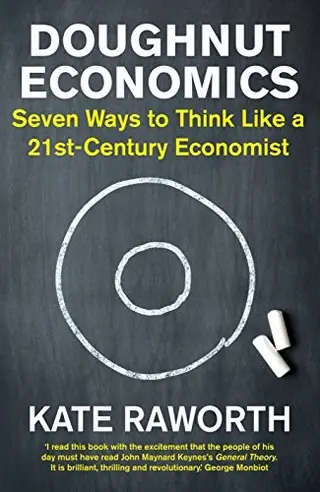
Doughnut Economics
Seven Ways to Think Like a 21st-Century Economist [Jul 25, 2017] Raworth, Kate
by Kate Raworth · first published 2017
12mentions
8recommended by
12HN commenters
2018–2026first – last mentioned
67% recommend25% neutral8% critical
Why HN recommends it
Accessible economics framed around planetary limits and social needs, with a clear doughnut model; readers cite it for critiquing GDP as a welfare measure and for ideas that reached policymakers, such as Amsterdam.
Summarised by Claude from recommending comments
Affiliate links. As an Amazon Associate I earn from qualifying purchases.
…people abuse their bodies with lack of sleep. agreeing that externalities like house work, parenting, commuting exist, have cost, and need to be considered in a viable economy could be a great step. Doughnut economics is one such approach. https://www.ted.com/talks/kate_raworth_a_healthy_economy_sho...
Yes! I like Doughnut Economics by Kate Raworth. She is also doing real well inspiring government officials with her ideas and visions.
on “We’re Measuring the Economy All Wrong” ↗You mind find Kate Raworth's proposal interesting - 'doughnut economics': https://www.kateraworth.com/doughnut/ Amsterdam's cityhall (NL) is piloting an implementation, so perhaps there is hope that it can go beyond a theoretical framework proposal.
on “Ask HN: What kind of ideas are not VC-backable but should exist in the future?” ↗Forward looking: Disunited Nations: The Scramble for Power in an Ungoverned World Doughnut Economics: Seven Ways to Think Like a 21st-Century Economist AI Superpowers: China, Silicon Valley, and the New World Order Historical: The Birth of Plenty: How the Prosperity of the Modern World was Created…
on “Ask HN: Which book helped you understand the world?” ↗Kate Raworth's book Doughnut Economics: Seven Ways to Think Like a 21st-Century Economist[0] addresses this area well and contains a lot of similar stories. [0] https://www.kateraworth.com/
on “Are there limits to economic growth?” ↗…(2017). Energy Transitions (2016) tackles the specific question of converting to a sustainable-energy path: <Energy Transitions>. And there's a long list of other Smil publications. Kate Rayworth's Doughnut Economics is another prescriptive work looking at ways forward. <https://www.kateraworth.com/> The original Limits to Growth (Meadows, Meadows, Randers, & Behrens) remains relevant, and is freely available online:…
on “Tidal Energy Is Not Renewable” ↗…descriptions of economic processes, reductionist and absurd ideas about ‘human nature’, and extracting Universal laws from historical and accidental correlations. I do recommend reading the first half of her Doughnut Economics where she makes this case at length, from someone inside the discipline.
on “Humanities aren't a science and shouldn't be treated like one (2012)” ↗The GDP should be banned as a metric for being a life quality proxy, it's insane how so many people still refer to it although proven to neglect so many parts of what counts into LQ. To OP: Go check out Doughnut Economics - the book does a good job clearing up economical fallacies & mismodelling of such things.
on “Iran Goes Into IPv6 Blackout” ↗…just in terms of climate and not also recognize biodiversity collapse, biogeochemical flows, etc. There may be opportunities in thinking about regions more from this standpoint too, a la Kate Raworth's Doughnut Economics. 2. Realize there are social practices to help deal with some of these problems, not necessarily just technological fixes. Things like possibly working at a neighborhood scale to have more local circular…
on “What can a technologist do about climate change? (2015)” ↗Would you happen to have some suggestions on where to start further reading of radical economics? I'm halfway through "Doughnut Economics" right now, but it's a bit simple -- I was looking for something more challenging.
on “Economists Are Rethinking the Numbers on Inequality” ↗Right. I think this is mentioned in the book, Doughnut Economics, in reference to monetizing interpersonal social interactions (tho I may have that reference slightly off. Sorry, in bed and book is sooo far away).
on “New York Public Library ends all late fees” ↗…values and institutions of society towards a more long-term sustainable civilization. For instance, we jump off the Breakdown curve onto a new pathway dominated by post-growth economic models such as Doughnut Economics or a Green New Deal. He makes these statements in these two sections, preceded by a first section in which he criticizes the 20th century business as usual "greed of avaricious capitalism and resource…
on “Ways to think long-term: a cognitive toolkit for good ancestors” ↗