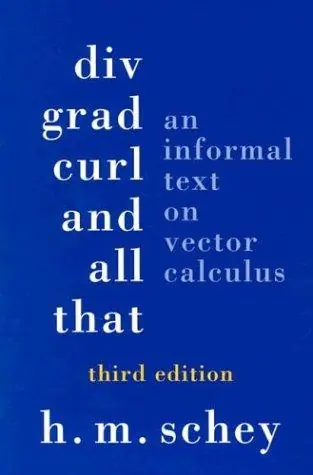
Div, grad, curl, and all that
by H. M. Schey · first published 1973
94% recommend6% critical
Why HN recommends it
Informal, intuitive and visual introduction to vector calculus, written in a conversational style. Suits physics and EE students who need the math behind electromagnetism and Maxwell's equations, not rigorous proofs.
Summarised by Claude from recommending comments
Introduction, vector functions, and electrostatics -- Surface integrals and the divergence -- Line integrals and the curl -- The gradient.
Affiliate links. As an Amazon Associate I earn from qualifying purchases.
Mentions per year
What Hacker News says
Related books
Comprehensive Introduction to Differential Geometry
Michael Spivak
Recommended by 3 · mentioned by 33 recommend · 3 mention3 recommend · 33 recommend
 2008–2026
Calculus, An Intuitive and Physical Approach
Morris Kline
Recommended by 5 · mentioned by 55 recommend · 5 mention5 recommend · 55 recommend
 2009–2023
Basic Training in Mathematics
Ramamurti Shankar
Recommended by 2 · mentioned by 42 recommend · 4 mention2 recommend · 42 recommend
 2010–2023
The elements of integration and Lebesgue measure
Robert Gardner Bartle
Recommended by 1 · mentioned by 31 recommend · 3 mention1 recommend · 31 recommend
 2016–2024
A Student's Guide to Maxwell's Equations
Daniel Fleisch
Recommended by 2 · mentioned by 42 recommend · 4 mention2 recommend · 42 recommend
 2007–2024
All the Math You Missed
Thomas A. Garrity
Recommended by 9 · mentioned by 109 recommend · 10 mention9 recommend · 109 recommend
 2018–2023
Arithmetic
Paul Lockhart
Recommended by 4 · mentioned by 54 recommend · 5 mention4 recommend · 54 recommend
 2008–2022
The foundations of mathematics
Ian Stewart, David Orme Tall
Recommended by 6 · mentioned by 66 recommend · 6 mention6 recommend · 66 recommend
"Div, Grad, Curl, And All That: An Informal Text On Vector Calculus" This was "optional" reading in my Undergrad Calculus class at Brown, I probably was the only student who bothered to read it, and it made most of engineering a breeze…
on “Ask HN: Do you recall any book or course that made a topic finally click?” ↗…book recommendations, the ones that come to the top of my mind are: - Griffiths' Quantum Mechanics [0]. It's become a pretty standard undergrad QM text, and in my experience was very approachable. - Div, Grad, Curl, and all that by Schehey [1]. I don't remember how much into vector calculus the QFT book got, but this one turned the tide of my undergrad personally. For ~120 pages it gave me a better intuition with 3D calculus…
on “What is quantum field theory and why is it incomplete?” ↗…Shakarchi, Complex Analysis , Princeton University Press, 2003. * Also useful: Bott and Tu, Differential Forms in Algebraic Topology , Springer, 1982. See especially 1.1-1.3. * Also useful: H. M. Schey, Div, Grad Curl and All That , Norton, 2005. * Also useful: Hubbard and Hubbard, Vector Calculus, Linear Algebra and Differential Forms, Prentice Hall 1999. * Also useful: T. Needham, Visual Complex Analysis , Oxford University…
on “What do Bill Gates and Richard Stallman have in common ?” ↗When I was an undergrad and graduate EE student, the "go to" book to help with electromagnetics was Div, Grad, Curl, and all that (http://www.amazon.com/Div-Grad-Curl-All-That/dp/0393925161). Back in my era it was the 1st edition of the book, not the 4th. I see another book with good recommendations, A Student's Guide to Maxwell's…
on “Feynman’s proof of the Maxwell equations” ↗…Apostol if you want to "learn calculus the hard way" -- e.g. if you want to learn calculus in a rigorous manner that prepares you well to keep going. An informal, brief book on vector calculus is Schey's Div, Grad, Curl and all That. I have not read it personally, but I have heard good things about it. It is probably the quickest way of achieving your immediate goal of understanding Maxwell's equations. Free online copy: ftp://collectivecomputers.org:21212/books/morebooks/Mathematics/Div,%20Grad,%20Curl%20and%20All%20That%20-%20Shey.pdf…
on “Ask HN: What's the best way of learning calculus, if you already know pure math” ↗There's also a book on the subject called "Div, Grad, Curl and all that" https://www.amazon.com/Div-Grad-Curl-All-That/dp/0393925161 which I would highly recommend to physics-minded folks, but would not recommend at all to maths-minded folks.
on “Divergence and curl: The language of Maxwell's equations and more [video]” ↗…everything I've read by Brian Kernighan. K&R is my favorite programming book bar none. Data Reduction and Error Analysis for the Physical Sciences by Bevington and Robinson. Very approachable introduction. div grad curl and all that by Schey. Read it before taking Fields, instead of after like I did.
on “Recommended Reading List for Developers [pdf]” ↗…engineering classes for modeling interesting "real-world" systems. Later, when I realized what I was missing out on, I tried to teach myself the missing concepts. I failed, until I found H.M. Schey's "Div, Grad, Curl, and All That: An Informal Text on Vector Calculus." It's a pragmatic, friendly, slim little math book that reads more like lecture notes than a classic textbook, and I can fairly say it's taught me everything I know…
on “So You Want to Learn Physics” ↗Before any of that, read the book "Div, Grad, Curl, and All That: An Informal Text on Vector Calculus" by H. M. Schey. It will make math of EE, particularly the interaction between electricity and magnetism (Maxwell's equations) a lot easier to understand.
on “My self-study plan for electrical engineering” ↗…the Fourth Dimension (Rudolf Rucker) - 3Blue1Brown Essence of Calculus: https://www.youtube.com/playlist?list=PLZHQObOWTQDMsr9K-rj53DwVRMYO3t5Yr - Calculus for the Practical Man (J.E. Thompson) - Div, Grad, Curl, and All That: An Informal Text on Vector Calculus (Harry M. Schey) - Who Is Fourier? a Mathematical Adventure - Physics, Topology, Logic and Computation: A Rosetta Stone (John C. Baez, Mike Stay) - An Illustrated…
on “Ask HN: Serious mathematics books that can replace a good teacher?” ↗Div, grad, curl and all that - H.M. Schey Excellent intuitive and visual introduction to vector calculus.
on “Ask HN: Math books you recommend just for the way they are written?” ↗Div Grad Curl and All That https://www.amazon.com/Div-Grad-Curl-All-That/dp/0393925161
on “Ask HN: Math books that made you significantly better at math?” ↗…easy to pick up enough basic computational ability to do applications. (The phrase "programmed learning" is so old that maybe I should clarify that it has nothing to do with computers.) H. M. Schey, "Div, Grad, Curl, and All That" - This might be helpful for people taking vector calculus, or using it in an electromagnetism course in physics. In fact, a lot of his examples are from E-M. Very good at providing intuition without…
on “Calculus Made Easy” ↗…to generalize your understanding to multiple variables (e.g., z = x^2 + y^2). This will introduce different flavors of derivatives, as well as some different flavors of integrals. Just go get the book "Div, Grad, Curl and All That". You'll need to read a different book to read and understand the theory, but reading Div, Grad, Curl will give you an intuitive feel, which can be a big hurdle to getting multivariable calculus. Before,…
on “Learning Math” ↗…Schaum's outlines, which are cheap and usually OK for self-study. There are also explanatory books that you might find helpful, that might not form a whole substitute for a textbook - an example would be Div, Grad, Curl, and All That for vector calculus. It's a bit of a trick to find them on Amazon and through other searches, but you can get practiced at it.
on “Why won’t anyone teach me math?” ↗