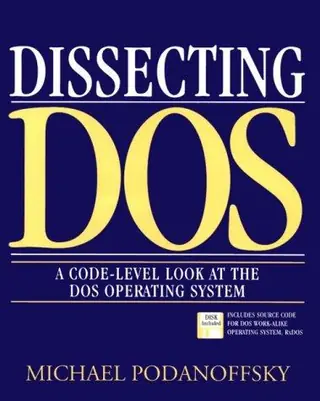
Dissecting DOS
by Michael Podanoffsky · first published 1994
6mentions
3recommended by
3HN commenters
2014–2025first – last mentioned
100% recommend
Affiliate links. As an Amazon Associate I earn from qualifying purchases.
…there is quite a bit already for a single person to digest, if you want to understand the real details of how everything works. I learned about the DOS family by reading this book: http://www.amazon.com/Dissecting-DOS-Code-Level-Operating-Sy... UnixV6 and the Lions' book come close, but Unix is still far more complex than DOS because of its multitasking, multiuser heritage. Early Unices may be within the realm of…
on “Microsoft makes source code for MS-DOS and Word for Windows available to public” ↗…http://www.ipdatacorp.com/mmurtl/mmurtlv1.pdf http://www.ipdatacorp.com/mmurtl/ I liked it and found it quite useful but I remember the folks at alt.os.development being quite negative about it because of the design. Also, Podanoffsky's 'Dissecting DOS' is a good book though obviously focused on, eh DOS.
on “Ask HN: What are some good resources to learn Operating Systems?” ↗For Dissecting DOS, I recommend eBay, but it is available on Amazon: https://www.amazon.com/Dissecting-DOS-Code-Level-Operating-S... The original companion floppy for that is available on archive.org: https://archive.org/details/dissecting-dos-companion-floppy-...…
on “Ask HN: Learn C in 2023?” ↗See: Dissecting DOS https://www.amazon.com/Dissecting-DOS-Code-Level-Operating-S...
on “Writing a DOS Clone in 2019” ↗…recommend starting small. First, Code by Petzold to make sure you understand how a computer truly works. Then I recommend: Understanding Microprocessors (Motorola) 8086/8088 Assembly Language Programming Dissecting DOS Practical Filesystem Design FreeBSD Internals The reason there are so many books is because it’s a big topic. The reason most are old is that things were once much simpler. Modern stuff builds on old,…
on “Ask HN: Learn C in 2023?” ↗…OS/2, then Windows, and then NT it would be vital to know that it only came about as a result of IBM wanting a 16bit source-compatible CP/M which didn’t yet exist. Then, you would likely want to read Dissecting DOS to see what limits were imposed by DOS. For other stuff, you would start backwards. Take the finished product and ask what the requirements were, then ask what the pain points are, then start digging…
on “Trillions spent and big software projects are still failing” ↗