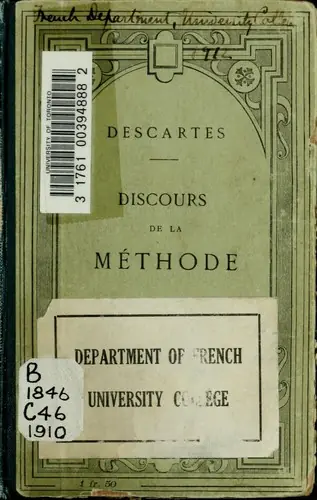
Discours de la méthode
by René Descartes · first published 1644
4mentions
2recommended by
3HN commenters
2012–2022first – last mentioned
67% recommend33% neutral
By an almost universal agreement among philosophers and historians, Rene' Descartes is considered the originator of modern philosophy, or at least the first important philosopher of our times. If we add to this the common belief that philosophy points the way for developments in all other fields, it will be evident that to Descartes is ascribed an importance comparable to that of the beginnings of intellectual culture in Greece or of the origin and spread of Christianity in the Mediterranean regions, and surpassing all other events in history. The study of Descartes can start in no more approp
Affiliate links. As an Amazon Associate I earn from qualifying purchases.
Ones I read as a teenager that have a lasting, if not nostalgic, effect: - Blaise Pascal's "Pensées" (Thoughts) - René Descartes' "Discours de la méthode" (Discourse on the method) - Henri Poincaré's "L'avenir des mathématiques" (The future of mathematics) The way they wielded words pleased me. Their hopes and doubts moved me. Their intellect shattered my brain.
on “Ask HN: What are your favorite essays?” ↗The Startup Owner's Manual - Steve Blank Discours de la Methode - Descartes
on “Ask HN: Great book that you read recently?” ↗Hmmm, Let's see... Because French is a mother tongue for me. I was raised with de Balzac, Hugo, Dumas, Molière, Verne, Voltaire, etc. (My Petit Larousse 89 saved me). I read Pascal's "Pensées" and Descartes "Discours de la Méthode" as a teenager. (blows the mind) Reading in high-school ranged from Freud and Adler, to Nietzsche, Hume, Socrates and Marcus Aurelius. To Dostoïevsky and Ostrovski. To
"Common sense is the best distributed thing in the world, for we all think we possess a good share of it." — René Descartes, Discours de la Méthode (1637) (Or in French: "Le bon sens est la chose du monde la mieux partagée, car chacun pense en être bien pourvu.") In some philosophies, what stands opposite of wisdom is not folly, but common sense. However, it might be possible that neither common s
on “Why aren't smart people happier?” ↗