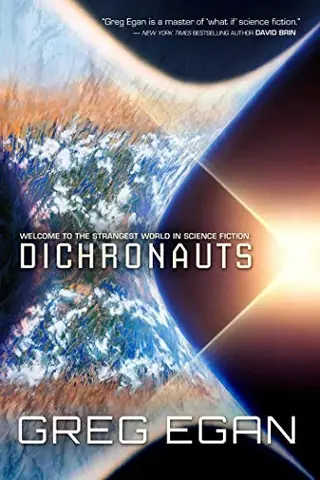
Dichronauts
by Greg Egan · first published 2017
63% recommend29% neutral8% critical
Why HN recommends it
Rigorous hard science fiction set in a universe with two space and two time dimensions, exploring its geometry and physics in depth; suits readers who enjoy math-driven, far-out speculative worldbuilding.
Common criticism: Some find the story weak, the ending poor, and the pacing tedious
Summarised by Claude from recommending comments
Hardcover
Affiliate links. As an Amazon Associate I earn from qualifying purchases.
Mentions per year
What Hacker News says
Related books
 2019–2025
The Ophiuchi Hotline
John Varley
Recommended by 3 · mentioned by 43 recommend · 4 mention3 recommend · 43 recommend
 2011–2026
The Clockwork Rocket
Greg Egan
Recommended by 17 · mentioned by 2217 recommend · 22 mention17 recommend · 2217 recommend
 2014–2026
Incandescence
Greg Egan
Recommended by 12 · mentioned by 2212 recommend · 22 mention12 recommend · 2212 recommend
 2015–2026
The inverted world
Christopher Priest
Recommended by 8 · mentioned by 128 recommend · 12 mention8 recommend · 128 recommend
 2008–2026
Axiomatic
Greg Egan
Recommended by 34 · mentioned by 4034 recommend · 40 mention34 recommend · 4034 recommend
 2010–2026
Schild's ladder
Greg Egan
Recommended by 38 · mentioned by 5738 recommend · 57 mention38 recommend · 5738 recommend
 2012–2023
An imaginary tale
Paul J. Nahin
Recommended by 10 · mentioned by 1110 recommend · 11 mention10 recommend · 1110 recommend
 2009–2026
Mission of gravity
Hal Clement
Recommended by 9 · mentioned by 109 recommend · 10 mention9 recommend · 109 recommend
…distance is larger than the actual distance, which is usually true anyway. Well, I suspect I just spent a lot of words telling you something you already knew, so I’ll leave off with a book recommendation. Dichronauts, by Greg Egan. Between that and the Clockwork Rocket trilogy, I don’t know a better way to inculcate an intuition for special relativity. One is set in a 2+2 spacetime; the other in 4+0. The differences…
on “Fundamental physics sees worlds in grains of sand and infinities in hours” ↗-- all fiction except Tense Bees -- Born - jeff vandermeer Dichronauts — Greg Egan That's Why I'm a Journalist - Mark Bulgutch interviews Mooncop - Tom Gauld Tense Bees and Shell-Shocked Crabs - Michael Tye Alif the Unseen - G. Willow Wilson Junction True - Ray Fawkes,…
on “What are the best books you read in 2017?” ↗…reality" (though some of those are also really good, "The Infinite Assassin" is a great read and it's only like 15 pages), but his later full books are basically all hard (if speculative) physics stuff. Dichronauts is difficult to get your head around, but very rewarding. It's about cartographers who work in a universe with essentially 2.5 dimensions of space and 1.5 dimensions of time. The Orthogonal trilogy is…
on “Science Fiction Stories with Good Astronomy and Physics: A Topical Index” ↗Dichronauts by Greg Egan (adventures in non-Euclidean space) Provenance by Ann Leckie (space opera) The Rise and Fall of D.O.D.O. by Neal Stephenson and Nicole Galland (similar themes to Anathem)
on “Ask HN: Best scifi of 2017? (Vernor Vinge/Larry Niven style)” ↗If you like hard sci-fi, Greg Egan has a written a few books that cover what life would be like if there were 2 dimensions of time (http://www.gregegan.net/DICHRONAUTS/DICHRONAUTS.html) or if the dimension of time was sumed instead of subtracted when measuring distance (http://www.gregegan.net/ORTHOGONAL/ORTHOGONAL.html) It's amazing to think how the universe is ruled by such minute details.
on “Do we really travel through time with the speed of light?” ↗I loved Dichronauts. It was a tough read but like you say, very rewarding. But I'm really struggling with Diaspora. I think I just find the concept of life living within computers.... kind of dull? It just doesn't seem that…
on “Science Fiction Stories with Good Astronomy and Physics: A Topical Index” ↗…in love with this mans writing, but MAN was that a tough read. With clockwork rocket (and the 5D sequences in Diaspora) I had to take some time with pen and paper to understand what he was saying, but Dichronauts takes this to another level entirely. I'm not sure I'll ever fully grok this one... His more far-out books are fully recommended though if you want your mind blown with some exotics physics..!
on “Worldbuilding” ↗If this concept is interesting to you, Greg Egan has written an entire scifi novel (Dichronauts) set in a 2+2 universe. Weirdness abounds, but quite rigorous.
on “Scientists are searching for a mirror universe” ↗I'm not cstross, but you could check out Greg Egan. He's got a number of stories set in universes that don't even have the same number of dimensions as ours (4 spatial dimensions, zero time dimensions, or 2 spatial dimensions, 2 time dimensions), where this deeply matters and directly impacts the plots, and all the mathematics is deeply worked out for these sorts of universes and also impacts the
on “Science Fiction’s Wonderful Mistakes” ↗…the time dimension is just acceleration. The math is simpler if you’re in a ++++ metric - rotations are a bit weird in +++- because rotations into the time dimension are hyperbolic. I suggest reading Dichronauts, a book covering a ++-- tensor.
on “How imaginary numbers were invented [video]” ↗…speak in diagrams, with which they explain the science to each other and to the reader.) It builds up to include some plot twists that are only made possible by the strange nature of time and space. Dichronauts seems to be an iteration on this formula (now there are two time-like dimensions), which sounds more bewildering and constraining to the plot, but I trust Egan to do it well.
on “Dichronauts” ↗Dichronauts, biggest mindfuck of 2017 for sure! (it's highly recommended, just keep pen and paper ready to grok all the non-euclidian shenanigans)
on “Ask HN: Best scifi of 2017? (Vernor Vinge/Larry Niven style)” ↗If you want universes that run on alternate topologies taken seriously, I mean, like, the maximum level of serious possible, you want Greg Egan. For instance, Greg Egan seriously considering the nature of 2+2 universe, that is, two space, two time dimensions: https://www.gregegan.net/DICHRONAUTS/DICHRONAUTS.html (Don't miss the interactive simulation: https://www.gregegan.net/DICHRONAUTS/02/Inter
on “Can Life Exist in 2 and 1 Dimensions?” ↗…hyperbolic structure of +-. Once you're going FTL, changing your direction to point backwards in time is trivial; you just turn your engines on and accelerate. Read Greg Egan's "Clockwork Rocket" and "Dichronauts" books and support material on his website to develop an intuitive understanding of spacetimes with ++++ and ++-- signatures and (by contrast) our own spacetime with a +--- signature.
on “Sabine Hossenfelder: I think faster than light travel is possible. Here's why” ↗I love sc-fi. It's by far my favourite type of novel to read. In fact I usually read either non fiction (popular science, reportage) or sci-fi. I have read probably a couple hundred sci-fi books, including many on that list. I have read a lot in order to find the really good stuff which is quite rare imo. My favorite sci-fi authors are Arthur C. Clarke and Greg Egan. But I also like Kim Stanley Ro
on “New Wave Sci-Fi: 75 Best Novels of 1964–1983” ↗