Design by ContractBertrand Meyer
Design by Contract
by Bertrand Meyer · first published 2020
20mentions
4recommended by
9HN commenters
2015–2026first – last mentioned
44% recommend56% neutral
Affiliate links. As an Amazon Associate I earn from qualifying purchases.
Mentions per year
What Hacker News says
Related books
 2010–2026
Program development in Java
B. Liskov
Recommended by 3 · mentioned by 43 recommend · 4 mention3 recommend · 43 recommend
 2010–2026
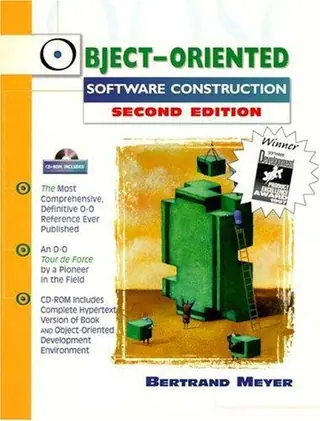
Object-oriented software construction
Bertrand Meyer
Recommended by 22 · mentioned by 3722 recommend · 37 mention22 recommend · 3722 recommend
 2014–2025
From Mathematics to Generic Programming
Alexander A. Stepanov, Daniel E. Rose
Recommended by 12 · mentioned by 2212 recommend · 22 mention12 recommend · 2212 recommend
Software FoundationsBenjamin C. Pierce2011–2026
Software Foundations
Benjamin C. Pierce
Recommended by 58 · mentioned by 6058 recommend · 60 mention58 recommend · 6058 recommend
Eiffel has loop invariants, for example see: http://se.ethz.ch/~meyer/publications/methodology/invariants... Also see Meyer's Design By Contract book, which you should read even if you will never use Eiffel - it's a gem.
on “Loop invariants can give you coding superpowers” ↗Also read Robert Floyd's paper Assigning Meanings to Programs. After getting the gist of the above, reading Bertrand Meyer's Design by Contract and Applying Design by Contract will clarify on how to apply the ideas to "real" systems.
on “An Axiomatic Basis for Computer Programming (1969) [pdf]” ↗…can do all that if you build thetoing for given language and platform. Static typing is a subset of formal specifications. I suggest using the other phrase so they find more interesting stuff. Meyer's Design-by-Contract is an easy one you can do in basically any language.
on “The memory safety problem isn't bad coders” ↗The paper "Applying Design by Contract" by Bertrand Meyer shows how DbC is to be used. It is sufficient to have only preconditions turned on by default in "release" mode, others are optional. My thumb rule is to have all preconditions/postconditions/invariants…
on “Ada for the C++ and Java Developer [pdf]” ↗…program correctness design constructs. Thus it is a systematic (i.e. not ad-hoc) way of using asserts correctly to guarantee program state. I highly recommend reading Bertrand Meyer's papers "Applying Design By Contract" and "Design by Contract". They are well worth every programmer's time.
on “Ada for the C++ and Java Developer [pdf]” ↗PSA: The above DbC wikipedia page contains a link to the paper Applying Design by Contract by Bertrand Meyer which is THE paper to read to learn usage.
on “Ask HN: What helped you get good at programming?” ↗…contracts is that they can be enabled at runtime, so very different from UT. Also different from assertions in that 'class' invariants applies to every public method of the class. : All I know about 'Design by Contract' I learned it in the (very good IMHO) book Object Oriented Software Construction by Bertrand Meyer (he made the Eiffel language).
…rather than the details of the Eiffel language (not necessary during the first pass). It is a huge book so skip topics as needed to focus on the essential concepts. You should also look into Meyer's "Design By Contract" technique for writing "correct" OO and other-paradigm programs. This is of great value in real-world programming. PS: You might also find another Meyer's book Agile! The Good, the Hype and the Ugly…
on “Object-oriented Programming with ANSI-C (1993) [pdf]” ↗Interesting. I am a fan of DbC (following Meyer's Applying "Design by Contract" - pdf at https://se.inf.ethz.ch/~meyer/publications/computer/contract...) though due to runtime costs (as you point out) i limit it to pre-conditions only everywhere (almost all "policy" part of the…
on “Contracts for C++ (DbC) [pdf]” ↗…concepts here, you can apply them explicitly even if your language does not support the needed syntax (eg. Contracts). See Bertrand Meyer's OOSC2 for details - https://bertrandmeyer.com/oosc2/ Specifically "Design-by-Contract (DbC)" and "Inheritance Techniques" and "Using Inheritance well". Also relevant is my other comment here - https://news.ycombinator.com/item?id=42788947
on “Liskov Substitution: The real meaning of inheritance” ↗You need to study Bertrand Meyer's "Design by Contract" and "Applying Design by Contract" papers - https://news.ycombinator.com/item?id=48358691 There are also ways to turn runtime contract checks into static verification checks. See my other comment for…
on “C++26 Contracts: Introduction to Preconditions and Postconditions” ↗Asserts in any language must not be added willy-nilly but following a specific methodology viz. Design By Contract (DbC) - https://en.wikipedia.org/wiki/Design_by_contract DbC was first introduced in Eiffel but the ideas can be used in any language. See the following; 1) Design by Contract and Assertions - https://www.eiffel.org/doc/solutions/Design_by_Contract_and_...…
on “You Must Fix Your Asserts (Zig)” ↗The best description of exceptions that I've seen is Bertrand Meyer's exposition of them in _Object Oriented Software Construction_. His definition depends on the notion of Design by Contract. An exception is an event that causes a function/method to fail because it is unable to satisfy its contract. The caller is then responsible for cleaning things up (so it can satisfy its contract) or…
on “Programming Paradigms for Dummies: What Every Programmer Should Know (2009) [pdf]” ↗Your background immediately reminded me of Betrand Meyer and Design by Contract[1]. I wonder how much of Hoare's work influenced Meyer. Do you care to opine? :-) 1 - http://www.artima.com/intv/contracts.html
on “Floyd–Hoare logic” ↗I don't know much about Meyer's history and the history of Design by Contract, but I'm going to go out on a limb and say, "quite a bit." The major difference that I can see, with my limited experience, is that DbC seems to be focused on the boundaries between functions and is more…
on “Floyd–Hoare logic” ↗