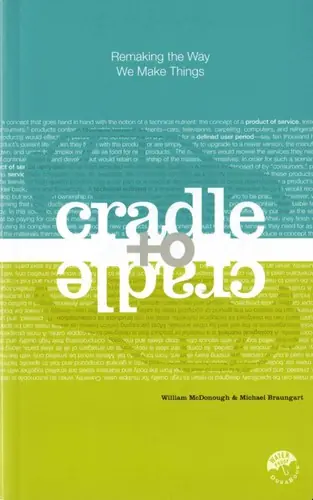
Cradle to Cradle
Remaking the Way We Make Things
by William McDonough, Michael Braungart · first published 2002
73% recommend27% neutral
Why HN recommends it
Explains a design philosophy that treats waste as nutrients, arguing products should be made for reuse or safe return to nature
Summarised by Claude from recommending comments
"Reduce, reuse, recycle," urge environmentalists; in other words, do more with less in order to minimize damage. But as architect William McDonough and chemist Michael Braungart point out in this provocative, visionary book, such an approach only perpetuates the one-way, "cradle to grave" manufacturing model, dating to the Industrial Revolution, that creates such fantastic amounts of waste and pollution in the first place. Why not challenge the belief that human industry must damage the natural world? In fact, why not take nature itself as our model for making things? A tree produces thousands
Affiliate links. As an Amazon Associate I earn from qualifying purchases.
Mentions per year
What Hacker News says
Related books
 2007–2026
Patterns of software
Richard P. Gabriel
Recommended by 31 · mentioned by 4031 recommend · 40 mention31 recommend · 4031 recommend
 2007–2026
Book of the New Sun
Gene Wolfe
Recommended by 64 · mentioned by 9364 recommend · 93 mention64 recommend · 9364 recommend
 2007–2026
House of Leaves
Mark Z. Danielewski
Recommended by 59 · mentioned by 13959 recommend · 139 mention59 recommend · 13959 recommend
…sustainability is, in fact, economically sustainable and even beneficial is a pretty amazing thing. It's a way to be more successful; it is not a cost. For more, check out Bill McDonough's excellent book "Cradle to Cradle: Remaking the Way we Make Things" -- http://www.mcdonough.com/speaking-writing/cradle-to-cradle/ Side note, I grew up extremely close to Patagonia for about 25 years (literally—went to kindergarten there),…
on “The Patagonia Clothing Company’s Anti-Growth Strategy” ↗…ends up in the landfill. The only true solution would be to manufacture consumables as if they're in a closed ecosystem - either able to easily be reused, or easily put into the natural ecosystem. Read "Cradle to Cradle" by William McDonough for more information (the book itself is printed on special infinitely recyclable plastic paper; the ink can be removed by boiling the book).
on “Teen Decomposes Plastic Bag In 3 Months” ↗I highly suggest reading the book "Cradle to Cradle: Remaking the Way We Make Things" by Michael Braungart & William McDonough. Essentially the book explains how things currently are made in a "Cradle to Grave" style, meaning products are sourced from…
on “GoPro Developing Line of Consumer Drones” ↗…form of leaves but these are almost immediately recycled. Given that the natural world has been doing this for literally billions of years, there is much to be learned. A great book on this subject is Cradle to Cradle (http://www.mcdonough.com/cradle_to_cradle.htm) which proposes radically re-thinking our industrial cycle.
on “Stop shipping hardware products that are only “beautifully designed”” ↗Cradle to cradle, by William McDonough & Michael Braungart http://www.mcdonough.com/cradle_to_cradle.htm About environmental design of, well, everything. Might fall into the "technical" category, though.
on “Ask YC: favorite books” ↗Not a buzzword. Has nothing to do with "aggressive recycling". It's a true paradigm shift. Much better explanation comes from Michael Braungart and William McDonough's Cradle to Cradle book explaining what the difference is. https://www.amazon.com/Cradle-Remaking-Way-Make-Things/dp/14...
on “Educating towards a circular economy” ↗Cradle to Cradle: Remaking the Way We Make Things Very thought provoking look at recycling and design for eventual recycling.
on “Ask HN: What are the best books you've read that few others have?” ↗There is no single silver bullet. One mechanism which can have lasting impact is applying William McDonough's "Cradle-to-Cradle" philosophy to large sectors. Apple seems to be trying to do that. It needs better support and awareness from consumers, to reward the corporations who deliver on these parameters.
on “Ask HN: What can be done to prevent a climate catastrophe?” ↗I recommend 2 older books on the topic: Cradle to Cradle Natural Capitalism Appreciate other recommendations.
on “Why Recycling Doesn't Work” ↗Cradle to Cradle (2010) is a great read on this subject, https://www.amazon.com/dp/B0012KS568 . It's written by a couple industrial designers and I suspect it would be widely interesting to the HN audience.
on “They Used To Last 50 Years” ↗For more on this topic, I can't recommend this book more highly: https://en.m.wikipedia.org/wiki/Cradle_to_Cradle:_Remaking_t...
on “Japanese architects who treated buildings like living organisms” ↗This message feed reminds me of the (excellent) book "Cradle to Cradle". It's about sustainable design/manufacturing and one of the lines that has stuck with me since I read it years ago was (summarizing here), "In the US we regulate how much poison is acceptable per person…
on “Lead exposure in last century shrunk IQ scores of half of Americans: study” ↗Even metal is very difficult to recycle, especially cars - it's often very difficult to separate the non-recyclable materials from the recyclable materials. Cradle to Cradle (McDonough) addresses these concerns. The book is printed with a hot-water soluble ink on infinitely recyclable plastic. Most recycled plastic bottles end up in carpet, which cannot be recycled again…
on “Recycling is Bullshit; Make Nov. 15 Zero Waste Day, not America Recycles Day” ↗Don't be evil? "Being less bad is not being good." - William McDonough in Cradle to Cradle.
on “My biggest frustration with Google AdWords” ↗Cradle to Cradle? http://www.amazon.com/gp/product/0865475873/ref=as_li_tl?ie=...
on “Is it time to rethink recycling?” ↗