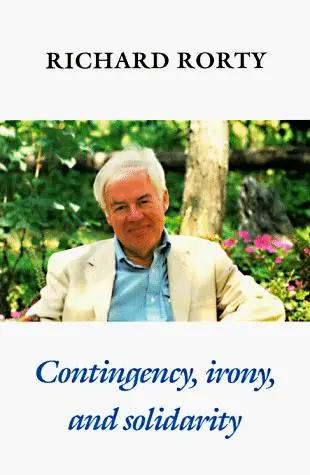
Contingency, irony, and solidarity
by Richard Rorty · first published 1989
12mentions
4recommended by
7HN commenters
2010–2024first – last mentioned
57% recommend43% neutral
In this book Rorty argues that thinkers such as Nietzsche, Freud, and Wittgenstein have enabled societies to see themselves as historical contingencies, rather than as expressions of underlying, ahistorical human nature or as realizations of suprahistorical goals. This ironic perspective on the human condition is valuable on a private level, although it cannot advance the social or political goals of liberalism. In fact Rorty believes that it is literature not philosophy that can do this, by promoting a genuine sense of human solidarity. A truly liberal culture, acutely aware of its own histor
Affiliate links. As an Amazon Associate I earn from qualifying purchases.

…without them." http://www.furious.com/perfect/pulnoc.html Um, I'm heading for work and don't have time to think up a coherent way to end this. But a lot of my thinking is influenced by Richard Rorty's Contingency, Irony, and Solidarity. Just one more random speculation: the focus on "habits" subtly inforces a morality of stability. People who emphasize habits probably aren't going to say that the primary ethical injunction is to dismantle…
on “The lost hope of self-help” ↗…attitude shows someone who could have been a good poet of individualism — like a more austere and condemning Whitman — if she hadn't gotten tangled up in the business of philosophy. (Richard Rorty's "Contingency, Irony, and Solidarity" to me shines brightly with a kind of humble yet very discerning rationality, almost saintly honesty — yet he and Rand are completely, utterly at odds philosophically.)
on “The Mystical Ethics of the New Atheists (Sam Harris, Richard Dawkins, etc)” ↗…the philosophers who got lumped into this category. Of these, Rorty was the one I found myself most sympathetic to. His writing is quite accessible and understandable to an intelligent reader. His book, Contingency, Irony, and Solidarity is probably the best one to start with. Achieving Our Country is also interesting, but more political.
on “Richard Rorty in Tehran” ↗…reading the new stuff all the time so my thoughts are grounded in the older tradition, but contemporary philosophy touches on a lot of interesting things. Richard Rorty is a recent favorite of mine – his Contingency, Irony, and Solidarity is twenty years old, but still offers some fascinating insights into a subject that is very much dominating a part of our popular culture.
on “How To Do Philosophy (2007)” ↗…from another perspective be considered false idols. Still, ideals are great for rallying around. Some of what I'm trying to say here is articulated by Richard Rorty, through his concept of "ironism" in Contingency, Irony, and Solidarity, which I recommend!
on “What “Worse is Better vs. The Right Thing” is really about (2012)” ↗I'd actually never heard of Margaret MacDonald before, but this approach sounds similar to the more contemporary Richard Rorty, for example in "Contingency, Irony, and Solidarity" (which is more artistic and less academic than Rorty's earlier book "Philosophy and the Mirror of Nature").
on “Philosophy is an art” ↗…volition, so I have to credit it as a major influence. Structure and Interpretation of Computer Programs for showing that you can think rigorously and compose beautiful programs out of simple pieces. Contingency, Irony, and Solidarity by Richard Rorty for showing that it's possible to think and feel about politics while maintaining a profoundly ironic and groundless mind. The Body in Pain by Elaine Scarry for its beautiful view of…
on “Ask HN: What are your favorite books of all time, and why?” ↗…independent? Spring by Knausgaard. I don't think I can do justice to this by summarizing it. It's a beautiful, sad, and short book. Definitely worth reading. Against Bosses, Against Oligarchies and Contingency, Irony, and Solidarity by Richard Rorty. I'd been hearing a lot about postmodernism, mostly in a derogatory way, over the past year, but I had a hard time believing many of the criticisms of it were true. These two books do…
on “Ask HN: Books you read in 2018?” ↗…Language Theory [3]. At the risk of being a little too radical (with some intent of shock value) my view is that Truth is constructed not discovered [4]. This is also an argument Richard Rorty makes in "Contingency, Irony and Solidarity" [5]. Ultimately, language is a tool [6]. The responsible use of any tool (be it language or a gun) is a moral concern and an individual responsibility. For unpacking the question "What is communication?"…
on “The Logic of Information: A Theory of Philosophy as Conceptual Design” ↗…they do -- but also that they apparently can find no terminus. There seems to be no rational way of securing moral agreement in our culture." Another source informing my approach is Richard Rorty's "Contingency, Irony, and Solidarity". I see free software as way to actualize solidarity, and yet I'm skeptical about the possibility of convincing people that proprietary software is "wrong" or "evil".
on “Why are developers switching from Mac OS X to Linux?” ↗…summed up in his catchphrase the ‘weakening of Being,’ which he sees as a happy unburdening of the West, for weakening promotes tolerance, peace, and freedom. [...]" That sort of reminds me of Rorty's Contingency, Irony, and Solidarity (although I read it when I was much younger and felt that I didn't full understand it, so maybe the connection isn't as strong as I imagine), or Singer's Unsanctifying Human Life (though maybe I'm reminded…
on “On Being Blacklisted” ↗…a number of Rorty's books, and he is strangely contradictory. On the one hand, he strongly supports democracy and the whole modern project. On the other hand, his essay The Contingency of the Self in Contingency, Irony and Solidarity presents a very Nietzschean view of the self as a nothing that can be made into something only by creating by telling myths that fool others into thinking you know something important. As for the claim…
on “Richard Rorty: Life, Pragmatism, and Conversational Philosophy” ↗